
New York Tech Media
  • News
  • FinTech
  • AI & Robotics
  • Cybersecurity
  • Startups & Leaders
  • Venture Capital
No Result
View All Result
  • News
  • FinTech
  • AI & Robotics
  • Cybersecurity
  • Startups & Leaders
  • Venture Capital
No Result
View All Result
New York Tech Media
No Result
View All Result
Home Cybersecurity

Trojan Source attack lets hackers exploit source code

New York Tech Editorial Team by New York Tech Editorial Team
November 1, 2021
in Cybersecurity
0
Trojan Source attack lets hackers exploit source code
Share on FacebookShare on Twitter

Trojan Source attack impacts all popular programming language compilers, such as C, C++, C#, Java, JavaScript, Python, Rust, and Go.

A research paper published by Cambridge University researchers Ross Anderson and Nicholas Boucher, titled “Trojan Source: Invisible Vulnerabilities,” reveals details of a unique class of vulnerabilities that can be exploited to inject malware in the source code without getting detected.

According to the research, the malware can alter the source code’s defined logic, allowing a range of first-party and supply-chain risks. The issue lies in Unicode, a digital text encoding standard that enables computers to exchange information no matter which language is used.

Currently, Unicode defines over 143,000 characters in 154 different languages scripts and many non-script character sets like emojis.


About Trojan Source Attacks

This technique exploits the text-encoding standards’ subtleties, including Unicode, so as to produce a different source code, the tokens of which are logically encoded in a completely different order from the original one. This can create vulnerabilities that human code reviewers cannot perceive directly.

These vulnerabilities are classified as — CVE-2021-42574 and CVE-2021-42694 impact all popular programming language compilers, such as:

  • Go
  • C#
  • C, C++
  • Rust
  • Java
  • Python
  • JavaScript

“The fact that the Trojan Source vulnerability affects almost all computer languages makes it a rare opportunity for a system-wide and ecologically valid cross-platform and cross-vendor comparison of responses,” the paper [PDF] read.

For your information, compiler programs are responsible for interpreting high-level human-readable source code into their lower-level representations that the OS can execute. These include object code, assembly language, and machine code.

How is Unicode Algorithm Exploited?

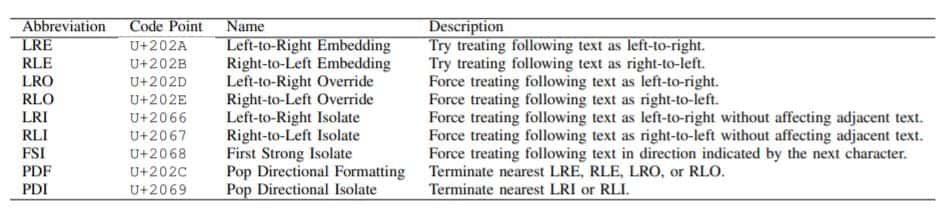
The core issue lies in the Bidi (bidirectional) algorithm of Unicode. This algorithm encourages support for left-to-right and right-to-left languages, such as English and Arabic, respectively. Moreover, it also features Bidi overrides to enable writing of left-to-right words within a right-to-left sentence or vice versa. Hence, it forces the left-to-right text to be used as right-to-left.
'Trojan Source' Bug Lets Hackers Exploit Source Code

Unicode directionality formatting characters relevant to reordering attacks.

But while the compiler’s output is required to implement the source code correctly, any alterations generated by injecting Unicode Bidi override characters into strings and comments can yield a syntactically valid source code where the characters’ display order present a different logic from the actual one.

The Attack details

The source code files’ encoding is exploited to create targeted vulnerabilities instead of introducing logical bugs independently. This allows visual reordering of tokens in the source code. When rendered acceptably, the compiler is tricked into processing the code in a novel way, thus modifying the program flow. For instance, it can make a comment appear as a code.

Therefore, if Program A is anagrammed into Program B, the change in code logic would be subtle enough to remain undetected in further testing as an adversary can introduce targeted vulnerabilities, and these would remain hidden.

“You can use them in source code that appears innocuous to a human reviewer [that] can actually do something nasty. That’s bad news for projects like Linux and Webkit that accept contributions from random people, subject them to manual review, then incorporate them into critical code. This vulnerability is, as far as I know, the first one to affect almost everything,” wrote Ross Anderson.

Impact on The Supply Chain

These encodings can impact the supply chain because when invisible software vulnerabilities are injected into open-source software, it will eventually affect all users. Furthermore, researchers warned that Trojan Source attacks’ impact could be severer if an attacker uses homoglyphs to redefine pre-existing functions within an upstream package, thus, invoking them from a victim program.

“As powerful supply-chain attacks can be launched easily using these techniques, it is essential for organizations that participate in a software supply chain to implement defenses,” researchers warned.

Did you enjoy reading this article? Like our page on Facebook and follow us on Twitter.


Credit: Source link

Previous Post

Banc of California Considers Backing Finexio

Next Post

Paving Way for FinTech Growth in Brazil, Colombia

New York Tech Editorial Team

New York Tech Editorial Team

New York Tech Media is a leading news publication that aims to provide the latest tech news, fintech, AI & robotics, cybersecurity, startups & leaders, venture capital, and much more!

Next Post
Paving Way for FinTech Growth in Brazil, Colombia

Paving Way for FinTech Growth in Brazil, Colombia

  • Trending
  • Comments
  • Latest
Meet the Top 10 K-Pop Artists Taking Over 2024

Meet the Top 10 K-Pop Artists Taking Over 2024

March 17, 2024
Panther for AWS allows security teams to monitor their AWS infrastructure in real-time

Many businesses lack a formal ransomware plan

March 29, 2022
Zach Mulcahey, 25 | Cover Story | Style Weekly

Zach Mulcahey, 25 | Cover Story | Style Weekly

March 29, 2022
How To Pitch The Investor: Ronen Menipaz, Founder of M51

How To Pitch The Investor: Ronen Menipaz, Founder of M51

March 29, 2022
10 Raunchy Movies on Netflix You Won’t Regret Watching

10 Raunchy Movies on Netflix You Won’t Regret Watching

May 20, 2024
Japanese Space Industry Startup “Synspective” Raises US $100 Million in Funding

Japanese Space Industry Startup “Synspective” Raises US $100 Million in Funding

March 29, 2022
Startups On Demand: renovai is the Netflix of Online Shopping

Startups On Demand: renovai is the Netflix of Online Shopping

2
Robot Company Offers $200K for Right to Use One Applicant’s Face and Voice ‘Forever’

Robot Company Offers $200K for Right to Use One Applicant’s Face and Voice ‘Forever’

1
Menashe Shani Accessibility High Tech on the low

Revolutionizing Accessibility: The Story of Purple Lens

1

Netgear announces a $1,500 Wi-Fi 6E mesh router

0
These apps let you customize Windows 11 to bring the taskbar back to life

These apps let you customize Windows 11 to bring the taskbar back to life

0
This bipedal robot uses propeller arms to slackline and skateboard

This bipedal robot uses propeller arms to slackline and skateboard

0
laptop on glass table

Automat-it Cuts Deployment Friction as Monce Scales AI Order Processing on AWS

April 13, 2026
Lee's Famous Recipe Chicken

Why Lee’s Famous Recipe Chicken Is Betting on Hi Auto to Quietly Rewire the Drive-Thru

April 9, 2026
computer generated image of letters

San Francisco Tribune Lists 11 HumanX Startups Moving AI Closer to the Operating Core

April 8, 2026
Impala CEO and Highrise AI CEO

The Industrialization of AI Infrastructure: What Impala and Highrise AI Reveal About the Next Scaling Frontier

April 7, 2026
Employee Time Tracking

What is an Employee Time Tracking Solution? A Definite Guide for 2026

March 31, 2026
Voltify founders

Voltify Raises $30 Million Seed Round as It Challenges $1 Trillion Rail Electrification Model

March 31, 2026

Recommended

laptop on glass table

Automat-it Cuts Deployment Friction as Monce Scales AI Order Processing on AWS

April 13, 2026
Lee's Famous Recipe Chicken

Why Lee’s Famous Recipe Chicken Is Betting on Hi Auto to Quietly Rewire the Drive-Thru

April 9, 2026
computer generated image of letters

San Francisco Tribune Lists 11 HumanX Startups Moving AI Closer to the Operating Core

April 8, 2026
Impala CEO and Highrise AI CEO

The Industrialization of AI Infrastructure: What Impala and Highrise AI Reveal About the Next Scaling Frontier

April 7, 2026

Categories

  • AI & Robotics
  • Benzinga
  • Cybersecurity
  • FinTech
  • New York Tech
  • News
  • Startups & Leaders
  • Venture Capital

Tags

AI AI QSRs Allseated Automat-it AWS B2B marketing Business CISO CISO Whisperer Collaborations Companies To Watch cryptocurrency Cybersecurity Entrepreneur Fetcherr Finance FINQ Fintech Funding Announcement hi-tech Hi Auto Impala Investing Investors investorsummit Israel israelitech Leaders LinkedIn Leaders Metaverse Mindset Minnesota omri hurwitz PointFive PR QSR Real Estate start- up startupnation Startups Startups On Demand Tech Tech leaders Unlimited Robotics VC
  • Contact Us
  • Privacy Policy
  • Terms and conditions

© 2024 All Rights Reserved - New York Tech Media

No Result
View All Result
  • News
  • FinTech
  • AI & Robotics
  • Cybersecurity
  • Startups & Leaders
  • Venture Capital

© 2024 All Rights Reserved - New York Tech Media