

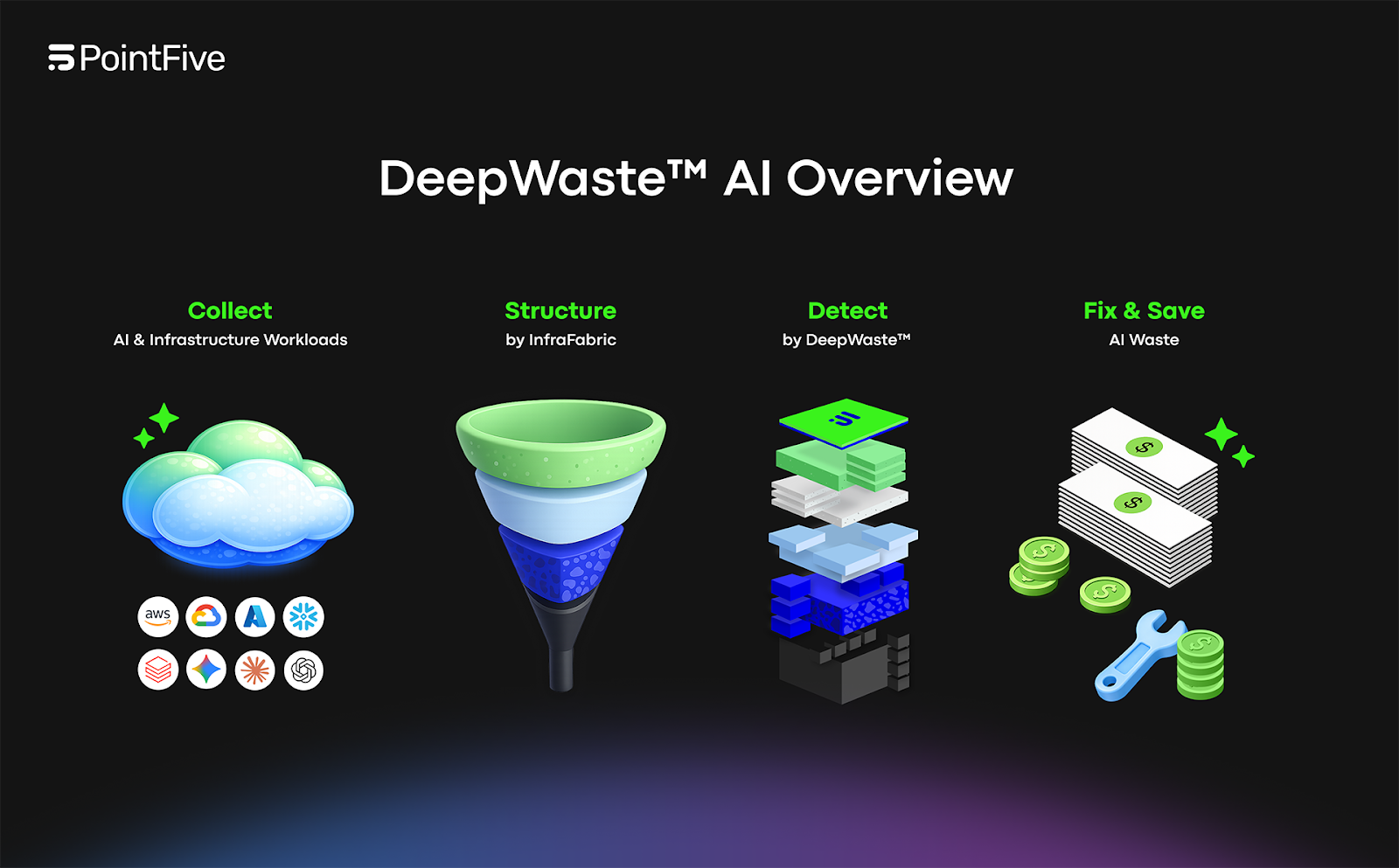
On February 27, 2026, PointFive announced DeepWaste™ AI, a full-stack module designed to continuously optimize production AI, including GPU utilization, configuration efficiency, and infrastructure alignment. While LLM usage is often the headline, PointFive’s launch puts GPU efficiency at the center of production economics, where infrastructure choices can make or break AI cost at scale.
Why GPU Efficiency Becomes a Production Bottleneck
In production AI, GPU resources are rarely a simple “add more, go faster” equation. Utilization fluctuates with workload patterns, orchestration decisions, and latency requirements. It’s possible for overall AI spend to rise while GPU fleets remain partially idle, or for performance to degrade even when capacity is plentiful due to misalignment between hardware and workload characteristics. Add in drivers, operating systems, and instance selection, and the GPU layer becomes a source of operational leakage that isn’t captured by generic cloud optimization tools.
PointFive’s broader framing is that inefficiency spreads across the stack: model selection, token consumption, routing logic, caching behavior, GPU utilization, retry patterns, and data platform orchestration all shape cost and performance. DeepWaste AI is positioned to read those signals together, not separately.
What DeepWaste AI Looks for on GPUs
PointFive says DeepWaste AI continuously optimizes GPU infrastructure by identifying:
- underutilized or idle GPUs
- instance-type mismatches
- OS and driver misconfigurations
- hardware-to-workload misalignment
These categories capture both waste and performance loss. Underutilized GPUs can indicate overprovisioning or scheduling imbalance. Instance-type mismatches can mean paying for the wrong shape for the workload. OS and driver misconfigurations can limit throughput. Hardware-to-workload misalignment can show up when the chosen GPU and configuration are not suited to the actual inference or processing profile.
Coverage Across Clouds and AI Services
DeepWaste AI provides native, agentless connectivity across:
- AWS (Bedrock, SageMaker, and AI managed services)
- Azure (Azure OpenAI, Azure ML, Cognitive Services)
- GCP (Vertex AI and AI services)
- OpenAI and Anthropic direct APIs
This matters for GPU operations because production environments often run mixed strategies: managed LLM services combined with custom GPU infrastructure, plus direct API usage in parallel. PointFive’s goal is to optimize GPU decisions with awareness of how models are routed, how often they are invoked, and how workloads behave end to end.
Agentless Telemetry and Operational Practicality
PointFive emphasizes that DeepWaste AI connects directly to cloud APIs, LLM service metrics, GPU telemetry, and billing systems without agents, instrumentation, or code changes. From an infrastructure standpoint, agentless deployment reduces rollout friction, especially across large fleets. PointFive also notes that optimization runs by default using metadata, billing signals, performance metrics, and configuration data, without requiring raw inference logs, aiming to minimize data access requirements.
For organizations that want deeper insight into prompt architecture and orchestration logic, optional inference-level analysis can be enabled, with customers controlling the depth of analysis.
How GPU Waste Connects to the Rest of the Stack
PointFive’s product framing is that GPU inefficiency is rarely isolated. Routing choices determine which workloads hit GPUs and at what frequency. Token economics influence how long inference runs take and how resources are consumed. Caching impacts repeated work. Retry patterns can multiply GPU cycles while creating latency outliers. DeepWaste AI is built to interpret these relationships through unified workload signals rather than treating GPU usage as a standalone utilization chart.
Findings That Lead to Action
DeepWaste AI detects inefficiency across four layers, one of which is Infrastructure & Operational Leakage, including idle GPUs, instance-type mismatch, driver-level throughput limitations, retry-driven cost inflation, latency outliers, and provisioning misalignment. PointFive states that each finding comes with a quantified savings estimate and implementation guidance, prioritized by financial impact and mapped directly to engineering and FinOps workflows.
The goal is to help teams evaluate projected savings before committing to changes, then track realized improvements over time, moving from reactive monitoring to a continuous optimization discipline.
The New Operational Complexity of AI Workloads
“AI workloads introduce a new category of operational complexity,” said Alon Arvatz, CEO of PointFive. “DeepWaste AI gives organizations the intelligence required to scale AI efficiently, across models, infrastructure, and data platforms, without sacrificing control.”
DeepWaste AI is now available to PointFive customers.