Honeybees dance to direct hive mates to new food sources. Guppies negotiate leadership with their schoolmates. Flocks of homing pigeons take evasive action when a falcon attacks. Since the dawn of animal behavior research, scientists have studied social interactions like these.
But now there’s a new twist to their research: Here, one of the actors is not a real animal, but a robot. Under the control of researchers, these bots socialize with flesh and blood creatures in experiments that scientists hope will yield fresh insights into what it means to be a socially competent guppy, how bees educate their hive mates, and other features of animal social life.
The notion isn’t as peculiar as it sounds. Advances in robotics technology and computing power mean that engineers can build robots realistic enough that animals respond to them as if they were real. (How realistic is “realistic enough” varies with the animals being studied. Sometimes the robot has to look right, sometimes it has to smell right, and sometimes all it has to do is move.)
And robots offer one big advantage over live animals: They do what researchers tell them to do, in exactly the same way, time after time. That gives scientists a degree of control over their experiments that can be difficult or impossible to achieve in any other way.
“If you can build a robot that you can embed in a group of animals as a stooge, and they accept that robot as one of them, then you can make the robot do things and see how real animals respond,” says Dora Biro, an animal cognition researcher at the University of Rochester, New York.
With robots, researchers can tease apart factors, such as a fish’s size and its experience, that are inextricably linked in real animals. They can expose animals to exactly the same stimulus over and over, speeding up the experimental process. And sometimes, they can do all this without exposing animals to risk from real predators or potentially invasive species.
Here are five animal-like, or biomimetic, robots that researchers are already using to study — and, in one case, to control — the social life of real-life animals.
5. Robobee is in the hive
The famous “waggle dance” of honeybees — in which a worker returning to the hive signals the location of a food source by running in specific patterns near the entrance to the hive while vibrating its wings and body — has been known for more than 60 years. But researchers still don’t know exactly how the bee’s hive mates decode its message.
“What are the signals here? What are the components of the dance that actually carry information, and which are just a by-product?” says Tim Landgraf, a roboticist at the Free University of Berlin. This, he thought, was a job for Robobee.
Landgraf built a life-size bee replica — just a vaguely bee-shaped plastic blob with a single wing — and attached it to a mechanical drive system that allowed him to vary where and how the replica moved and vibrated. After inserting the bee into the hive, Landgraf found he could indeed direct real bees to a food source, even once they’d never used before — solid proof of principle.
But Robobee’s successes didn’t happen reliably. “Sometimes the bees would follow within seconds,” Landgraf says. “But sometimes it would take days, and we couldn’t say why.”
That made him realize there was another facet to the dance communication that he had never considered: how bees decide which dancer to follow, and when. Are potential follower bees actively searching for information about food sources, he wondered, or does the dancer somehow have to persuade them to listen? Are only certain individual workers receptive to any particular signal, as a result of their prior experience?
To answer these questions, Landgraf and his team are developing an upgraded Robobee with a more realistic odor and a more reliable wing-vibration mechanism to go in a hive full of individually marked bees whose experience they can track. After the inevitable Covid-related delays, they’ve finally begun testing the system, but he’s not ready to talk about results yet. However, he says, “I think there’s a good chance of finding something.”
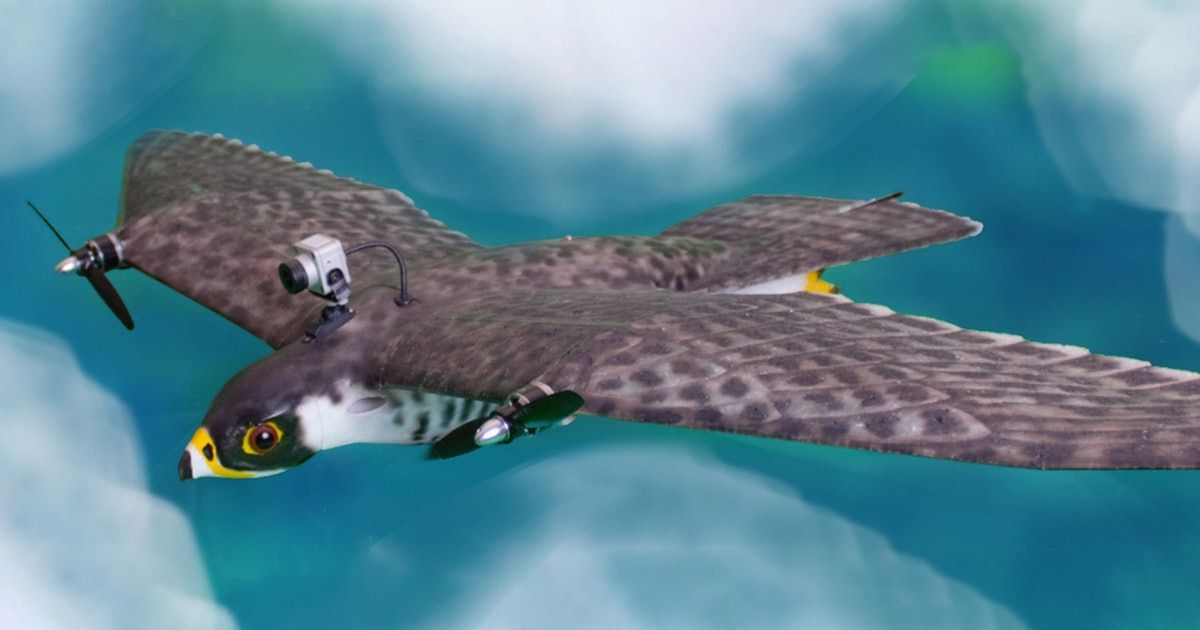
4. Robotic falcon on the hunt
When a falcon strikes, how does a flock of pigeons respond? The classic theory — often called the “selfish herd” hypothesis — assumes that every pigeon merely tries to get into the middle of the flock, so that the predator takes some other unfortunate bird. But that idea isn’t easy to test.
Every falcon strike is different: Some start a little higher than others, or from a different angle, and all this variability can affect how the pigeons respond. So Daniel Sankey, a behavioral ecologist now at the University of Exeter in the UK, turned to a robot.
“We thought of it as a very controlled way to conduct this study,” says Sankey. “You could make sure the falcon was always exactly 20 meters behind when the pigeons were released, which made it repeatable.” Plus, he notes, the robot was safer for the pigeons. “I know a trained falcon in the past has absolutely obliterated a flock of pigeons.”
With the help of a falcon enthusiast’s robotic falcon — lifelike in appearance, except for the propellers that drive it — Sankey repeatedly attacked a flock of homing pigeons, while tracking each bird’s position by GPS. Contrary to the selfish flock hypothesis, the pigeons were no more likely to move to the middle of the flock when under attack than when unmolested, he found.
Instead, Sankey’s analysis showed that the pigeons mostly tried to fly in the same direction as their flock mates, so that the flock dodged in unison, leaving no stragglers for the predator to pick off.
“This suggests that by aligning with each other, you can escape the predator as a group, so no one gets eaten,” he says. While not conclusive proof, this suggests that the pigeon flock may be cooperative, not selfish.
3. Robofish in school
Which fish in a school is most likely to lead the group? Most studies have suggested that the larger fish tend to have the most influence over where the school swims — but there’s a problem: Big fish are also older and more experienced, and they can act differently than their smaller schoolmates. Which of these differences has the strongest effect on who becomes the leader? That’s hard to test with real fish.
“How could you make a big fish behave like a small one? These are the kinds of things you could only test with robots,” says Jens Krause, an animal behaviorist at Humboldt University of Berlin who coauthored an overview of robots in behavioral research in the 2021 Annual Review of Control, Robotics, and Autonomous Systems.
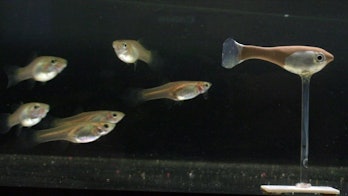
So Krause and his colleagues developed Robofish, a 3D-printed replica of a guppy mounted on a magnetic pedestal and driven by a motorized unit underneath the tank. Two video cameras coupled to computers let Robofish respond to its schoolmates’ movements in real-time.
As long as the model had eyes and a vaguely realistic color pattern, they found, the guppies behaved toward the model much as they did toward any other fish. This allowed the researchers to swap in larger or smaller versions of Robofish while keeping every other aspect of its behavior identical, to study the effect of size alone.
Sure enough, real guppies were more likely to follow larger Robofish leaders, they found. The team has also used Robofish to study how individuals’ swimming speeds affect the behavior of the school.
And Krause’s team learned another surprising thing about fishy leadership: Politeness helps. Early versions of their Robofish control program caused the robot to approach schoolmates too closely, causing the real fish to back off.
“We had some robots that ended up chasing the fish,” Krause recalls. After the team tweaked the robot so it respected its schoolmates’ space, the new “socially competent” Robofish proved to be much better at attracting followers.
2. Termite robots in a swarm
The previous studies used robots to infiltrate real groups of animals and provoke a response. But there’s another way to use robots to understand animal behavior: Program a swarm of robots to act according to the rules you think real animals are following, and see if the result mimics how the animals act.
That’s the approach followed by Justin Werfel, a collective behavior researcher at Harvard. Werfel wanted to understand how termites build such intricate mounds, notable for the arrays of fluted chimneys at their entrances. He focused on a single step in the process: how termites carrying excavated soil from the mound choose where to dump it. This simple decision determines the complex shape of the mound entrance.
Werfel and his colleagues had some evidence to suggest that termites might drop their dirt at the point where the mound’s high internal humidity gives way to the drier air on the surface, a good marker for the boundary of their home. But they didn’t know if the termites’ dirt-dropping behavior depended on other factors, too.
So they built a swarm of robotic termites. Since the robots didn’t have to interact with real insects, they didn’t have to appear lifelike. Instead, the robots were brick-sized carts that could carry and drop colored blocks on a flat surface. Each “termite” carried a humidity sensor and was programmed to carry the blocks when humidity was high and drop them when humidity fell. Meanwhile, a hamster tube dribbled water as each “termite” moved, ensuring that the humidity was higher in occupied areas.
“We know the robot is only paying attention to humidity because that’s what we told it to do,” says Werfel. And that proved to be enough: The robot swarm ended up dropping its blocks in a two-dimensional version of a real termite mound entrance. The robots even sealed off the opening on breezy days, just like real termites do. The experiment doesn’t prove, of course, that termites actually use a humidity rule to build their mounds, Werfel notes — but such a rule is sufficient to accomplish the task.
1. The terror-fish is lurking
Biomimetic robots don’t just reveal animal behavior. They may soon be used to manipulate it in useful ways.
Mosquitofish, native to the southern US, has become one of the top 100 invasive species worldwide. Giovanni Polverino, a behavioral ecologist at the University of Western Australia, decided to try an unusual form of bio-robotic control.
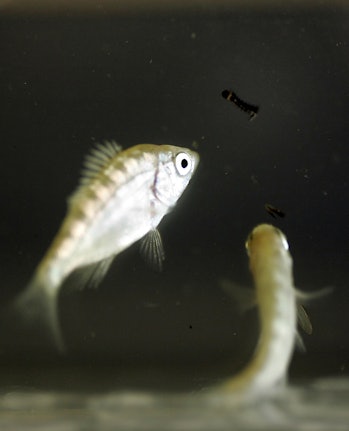
Polverino and his colleagues built a robotic fish designed to look like a largemouth bass, a key predator of mosquitofish in their native waterways. By programming the robot to swim aggressively toward mosquitofish, they hoped to terrorize the invasive species while leaving native Australian species unaffected. (Many wild animals show lasting effects of fear.)
And that’s exactly what they saw: As little as 15 minutes per week with the robotic predator caused the mosquitofish to lose body fat and allocate more energy to escape and less to reproduction. “The effect on the mosquitofish is huge, and the other species is not scared at all, because we copied a predator that in Australia does not exist,” says Polverino.
Polverino has a lot more work to do before he can deploy his artificial predator in the real world. “Our robot works well in the lab,” he says. “But it has a computer nearby, a webcam over the tank, and a battery with a short lifetime.”
Even so, he’s in discussion now with a national park in Queensland where two endangered fish species live in small, clear pools that have recently been colonized by mosquitofish. Because the pools are so small, they might provide a good first test in the wild. “It’s not ready now,” says Polverino, “but it’s a clear possibility.”
Much can go wrong, of course, when researchers try to insinuate robots into animal social groups — and sometimes, the failures are for prosaic reasons. When Biro tried to build a robotic pigeon to study collective decision-making by groups of homing pigeons, for example, the robot proved unable to fly fast enough to keep up with the real flock.
Still, the opportunity to test animal behavior in new ways has enough promise that she hopes to try again someday. “If we had got all of this to work, there would have been all sorts of interesting things to do,” she says. “It is on my list of things that I hope to do.”
This article originally appeared in Knowable Magazine, an independent journalistic endeavor from Annual Reviews. Sign up for the newsletter.
Credit: Source link