New York Tech Media
  • News
  • FinTech
  • AI & Robotics
  • Cybersecurity
  • Startups & Leaders
  • Venture Capital
No Result
View All Result
  • News
  • FinTech
  • AI & Robotics
  • Cybersecurity
  • Startups & Leaders
  • Venture Capital
No Result
View All Result
New York Tech Media
No Result
View All Result
Home Startups & Leaders

Biosensor startup Monod lands $6M and spins out of Univ. of Washington’s Institute for Protein Design

New York Tech Editorial Team by New York Tech Editorial Team
December 23, 2021
in Startups & Leaders
0
Biosensor startup Monod lands $6M and spins out of Univ. of Washington’s Institute for Protein Design
Share on FacebookShare on Twitter
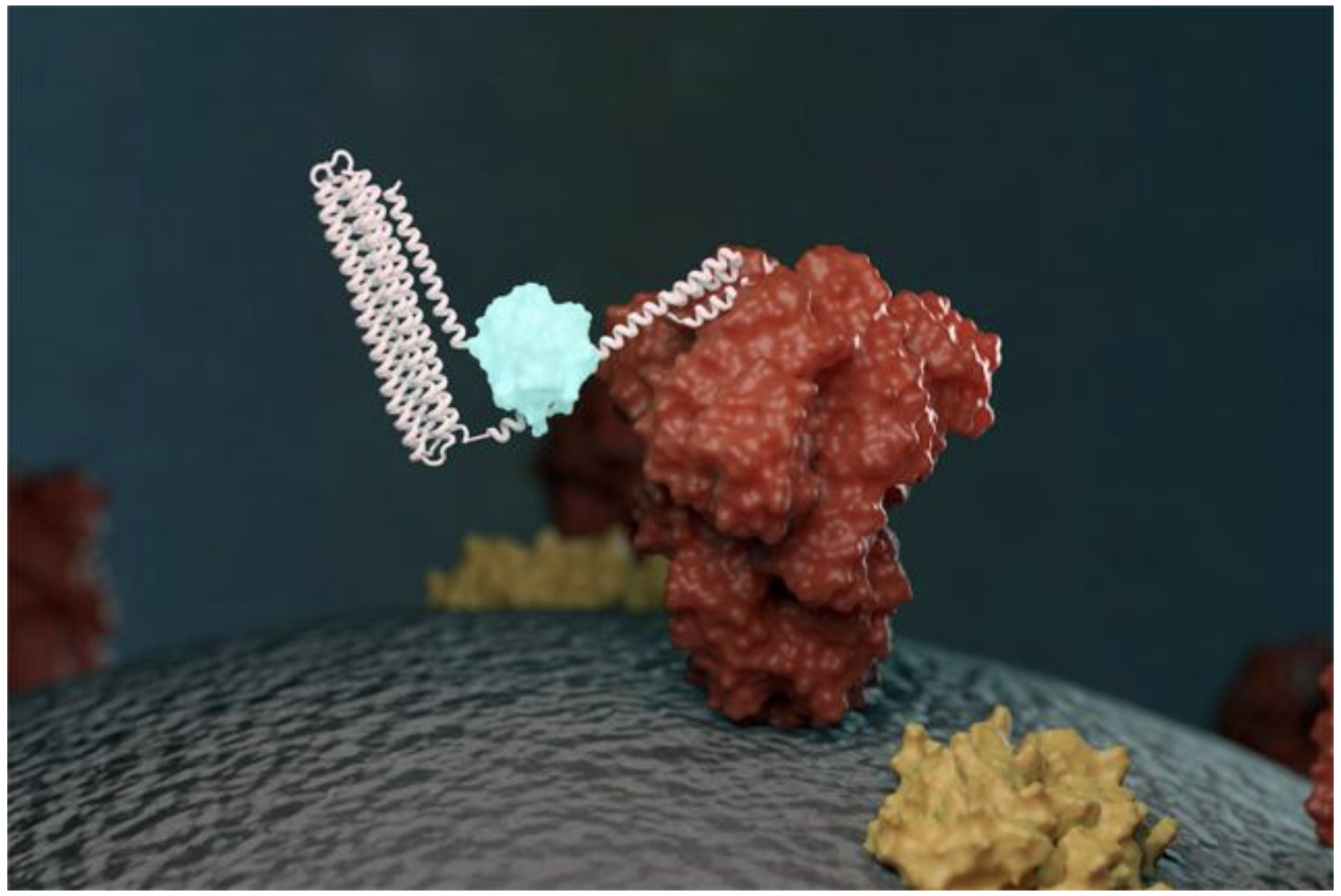
Illustration of a biosensor glowing (light blue) after detecting its target (a coronavirus protein, red). (UW IPD | Ian Haydon)

A new biotech startup has hatched from the University of Washington’s Institute for Protein Design with $6 million in funding and a leadership team fresh from Neoleukin Therapeutics, another IPD spinout.

Monod Bio is developing biosensors that can quickly detect viral proteins, toxins, antibodies, or other molecules. The sensors are built from engineered proteins developed at the IPD. When the sensor recognizes its target, it emits light.

The sensors are engineered using IPD software that can design proteins from scratch, “de novo”, instead of from the more limited number of designs found in nature.

“We are the first company, as far as we know, using de novo computational protein design for biosensors and diagnostics,” said chief scientific officer Alfredo Quijano Rubio in an interview with GeekWire. The sensors work in test tubes, and one of the company’s next steps is to make them easier to use, similar to at-home pregnancy tests.

Quijano Rubio designed sensors to recognize a variety of targets while working in the lab of IPD head David Baker, where he was a graduate student until this spring.

In a study in Nature this January, Quijano Rubio, Baker and their colleagues showcased sensors that recognize the “spike” protein of the COVID-19 virus as well as antibodies to it. Other sensors recognized botulism toxin, the cancer-related HER2 receptor, and cardiac troponin, which is released by the body after a heart attack.

“The consequence of this is that you can now bring biosensors to places where you usually don’t have them, like wearables or point of care,” said Monod CEO Daniel-Adriano Silva.

Troponin, for instance, is usually measured in the hospital to help assess if someone has had a heart attack. Instead, Silva envisions testing someone in the ambulance on the way to the hospital.

From left: Monod CEO Daniel-Adriano Silva, CSO Alfredo Quijano Rubio, and COO David Shoultz. (Monod Photos)

Silva left his job this spring as head of research at Neoleukin, which is developing treatments for cancer and COVID-19, to explore starting a new company. “I started going back to talk to David, to see what was the next technology,” he said.

He didn’t have to look far. Quijano Rubio is also a co-founder at Neoleukin. David Shoultz, formerly head of Neoleukin’s COVID-19 program, was tapped as COO and co-founder.

Other Monod co-founders include IPD head Baker, IPD scientist Andy (Hsien Wei) Yeh and Dave Johnson, former CEO of VelosBio, which was acquired by Merck for $2.75 billion last year.

The team has been operating since November from CoMotion Labs on the University of Washington campus. In December, the startup completed its $6 million seed round from friends and family.  

Seattle is peppered with IPD startups. Cyrus Biotechnology, for instance, recently raised $18 million and has more than 90 drug company partnerships, A-Alpha Bio has raised $20 million, and Icosavax went public this year with a $180 million raise to advance its vaccines for COVID-19 and other conditions.

RELATED: Univ. of Washington AI protein folding discovery wins ‘Breakthrough of the Year’ award from Science


IPD researchers also won Science magazine’s “Breakthrough of the Year” award this December for their AI-powered software to predict how proteins fold. Monod’s sensors are designed with protein engineering software developed earlier at IPD, called Rosetta.

The Monod team will use the funds to mature and expand its platform, generate new biosensors for additional targets in biotechnology and health, and build prototypes to detect targets in real-world applications.

IPD researchers have also built sensors to detect a suite of COVID-19 antibodies, with the aim of determining a person’s level of antibody immune protection. They showcased these sensors in a recent preprint.
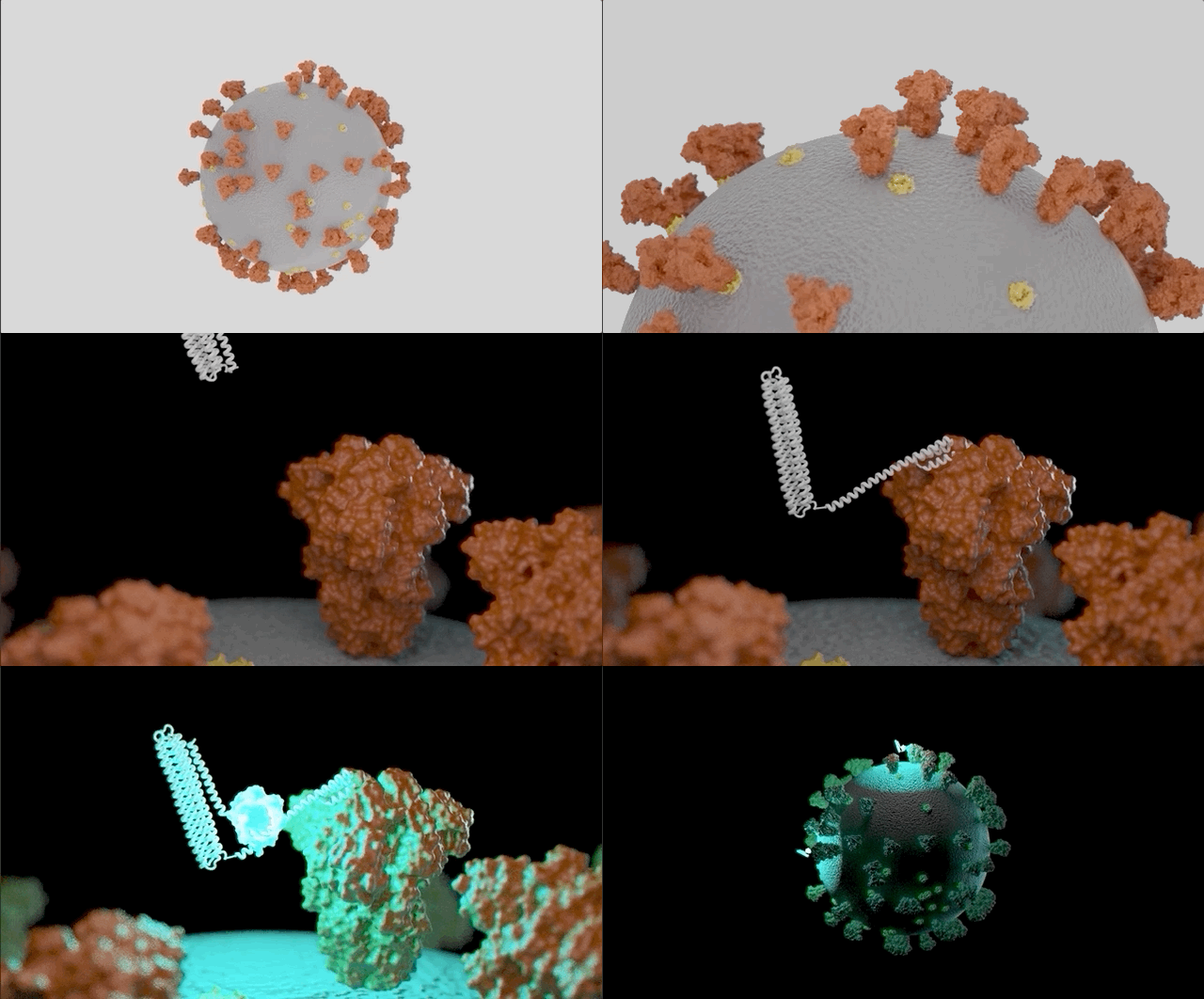
Video of a biosensor binding its target (a coronavirus protein, red) and then glowing. (UW IPD Video)

Monod’s sensors rely on two components. One component is a protein that recognizes a target. Upon target recognition the protein shifts from a closed to an open state. In its open state, the protein is able to bind the second component of the sensor. When the two bind, the sensor lights up. The light is emitted from luciferase, a light-emitting enzyme.

The region that recognizes the target can be swapped out for another. “Alfredo figured out a way to make this in a modular way,” said Silva.

Upon target binding, the sensor shifts in a way that propagates through the protein to open up its shape. Such an effect, where an action at one part of a protein is transmitted to another, is called allostery, and it’s used to regulate the activity of many of the body’s proteins. Allostery was discovered in the 1960’s by Nobel-prize winning biochemist Jacques Monod and his colleagues.

Monod is now hiring protein biochemists and engineers. The team is looking for its own space in Seattle’s tight lab market and aims to grow to around 15 or 20 employees by the end of 2022.


Credit: Source link

Previous Post

Robots and conveyor belts: Jacky Li talks kitchen tech at Roger Bar and Restaurant | News

Next Post

Digital surgery startup Apella scoops up $21M

New York Tech Editorial Team

New York Tech Editorial Team

New York Tech Media is a leading news publication that aims to provide the latest tech news, fintech, AI & robotics, cybersecurity, startups & leaders, venture capital, and much more!

Next Post
Digital surgery startup Apella scoops up $21M

Digital surgery startup Apella scoops up $21M

  • Trending
  • Comments
  • Latest
Meet the Top 10 K-Pop Artists Taking Over 2024

Meet the Top 10 K-Pop Artists Taking Over 2024

March 17, 2024
Panther for AWS allows security teams to monitor their AWS infrastructure in real-time

Many businesses lack a formal ransomware plan

March 29, 2022
Zach Mulcahey, 25 | Cover Story | Style Weekly

Zach Mulcahey, 25 | Cover Story | Style Weekly

March 29, 2022
How To Pitch The Investor: Ronen Menipaz, Founder of M51

How To Pitch The Investor: Ronen Menipaz, Founder of M51

March 29, 2022
10 Raunchy Movies on Netflix You Won’t Regret Watching

10 Raunchy Movies on Netflix You Won’t Regret Watching

May 20, 2024
Japanese Space Industry Startup “Synspective” Raises US $100 Million in Funding

Japanese Space Industry Startup “Synspective” Raises US $100 Million in Funding

March 29, 2022
Startups On Demand: renovai is the Netflix of Online Shopping

Startups On Demand: renovai is the Netflix of Online Shopping

2
Robot Company Offers $200K for Right to Use One Applicant’s Face and Voice ‘Forever’

Robot Company Offers $200K for Right to Use One Applicant’s Face and Voice ‘Forever’

1
Menashe Shani Accessibility High Tech on the low

Revolutionizing Accessibility: The Story of Purple Lens

1

Netgear announces a $1,500 Wi-Fi 6E mesh router

0
These apps let you customize Windows 11 to bring the taskbar back to life

These apps let you customize Windows 11 to bring the taskbar back to life

0
This bipedal robot uses propeller arms to slackline and skateboard

This bipedal robot uses propeller arms to slackline and skateboard

0
laptop on glass table

Automat-it Cuts Deployment Friction as Monce Scales AI Order Processing on AWS

April 13, 2026
Lee's Famous Recipe Chicken

Why Lee’s Famous Recipe Chicken Is Betting on Hi Auto to Quietly Rewire the Drive-Thru

April 9, 2026
computer generated image of letters

San Francisco Tribune Lists 11 HumanX Startups Moving AI Closer to the Operating Core

April 8, 2026
Impala CEO and Highrise AI CEO

The Industrialization of AI Infrastructure: What Impala and Highrise AI Reveal About the Next Scaling Frontier

April 7, 2026
Employee Time Tracking

What is an Employee Time Tracking Solution? A Definite Guide for 2026

March 31, 2026
Voltify founders

Voltify Raises $30 Million Seed Round as It Challenges $1 Trillion Rail Electrification Model

March 31, 2026

Recommended

laptop on glass table

Automat-it Cuts Deployment Friction as Monce Scales AI Order Processing on AWS

April 13, 2026
Lee's Famous Recipe Chicken

Why Lee’s Famous Recipe Chicken Is Betting on Hi Auto to Quietly Rewire the Drive-Thru

April 9, 2026
computer generated image of letters

San Francisco Tribune Lists 11 HumanX Startups Moving AI Closer to the Operating Core

April 8, 2026
Impala CEO and Highrise AI CEO

The Industrialization of AI Infrastructure: What Impala and Highrise AI Reveal About the Next Scaling Frontier

April 7, 2026

Categories

  • AI & Robotics
  • Benzinga
  • Cybersecurity
  • FinTech
  • New York Tech
  • News
  • Startups & Leaders
  • Venture Capital

Tags

AI AI QSRs Allseated Automat-it AWS B2B marketing Business CISO CISO Whisperer Collaborations Companies To Watch cryptocurrency Cybersecurity Entrepreneur Fetcherr Finance FINQ Fintech Funding Announcement hi-tech Hi Auto Impala Investing Investors investorsummit Israel israelitech Leaders LinkedIn Leaders Metaverse Mindset Minnesota omri hurwitz PointFive PR QSR Real Estate start- up startupnation Startups Startups On Demand Tech Tech leaders Unlimited Robotics VC
  • Contact Us
  • Privacy Policy
  • Terms and conditions

© 2024 All Rights Reserved - New York Tech Media

No Result
View All Result
  • News
  • FinTech
  • AI & Robotics
  • Cybersecurity
  • Startups & Leaders
  • Venture Capital

© 2024 All Rights Reserved - New York Tech Media