

New York Tech Media
  • News
  • FinTech
  • AI & Robotics
  • Cybersecurity
  • Startups & Leaders
  • Venture Capital
No Result
View All Result
  • News
  • FinTech
  • AI & Robotics
  • Cybersecurity
  • Startups & Leaders
  • Venture Capital
No Result
View All Result
New York Tech Media
No Result
View All Result
Home AI & Robotics

What we know about a forthcoming robotic Navy ship

New York Tech Editorial Team by New York Tech Editorial Team
January 28, 2022
in AI & Robotics
0
What we know about a forthcoming robotic Navy ship
Share on FacebookShare on Twitter

The utility ship of tomorrow is a robot that will follow the laws of the sea, autonomously plot its own path, and take on a range of payloads to serve the Navy over the course of its life.

As reported by Inside Defense last week, the US Navy’s new Medium Unmanned Surface Vessel (MUSV) will “feature a broad payload area where the Navy can ‘pick and choose’ the platform’s capabilities.”

Another way to look at this tidbit is that the Navy wants a new kind of robotic boat, knows the rough size of the vessel it wants, and does not yet know exactly how that robot will be used for war. Designing a boat that can take on a range of payloads, and as such perform a wide range of missions, lets the Navy figure out how to best incorporate robotic boats into normal operations first, and then fine-tune how it wants to use those machines in the future.

The MUSV is part of an ongoing program to deliver a range of robotic vehicles for the Navy. It is being built by defense giant L3Harris, and what is most immediately notable about the ship are all the features it will not have. 

“One of the most common requests we used to see was for a bridge—I need a bridge on my ship,” Regan Campbell, the General Manager of Autonomous and Advanced Naval Platforms at L3 Harris, told the Tech Unmanned podcast in December 2021. 

It’s not hard to understand how human captains started imagining robotic ships as merely automated versions of existing vessels. The bridge is a central node for face-to-face communication between the people managing important ship functions, like steering, mission, and smooth operations. But that is wholly unnecessary on a robotic boat, where those tasks are handled algorithmically or, if the boat needs human involvement, people on land or another vessel can handle it.

[Related: The US Navy is testing autonomous seafaring robots that patrol the ocean]

Designing a ship without a bridge is only the first part of making a vessel autonomous from the start. Human crews require spaces to eat, sleep, and take care of other biological functions. A robotic vessel has no need for any of that, and can instead devote its space to fuel, sensors, redundant safety systems, and whatever else its operation may require.
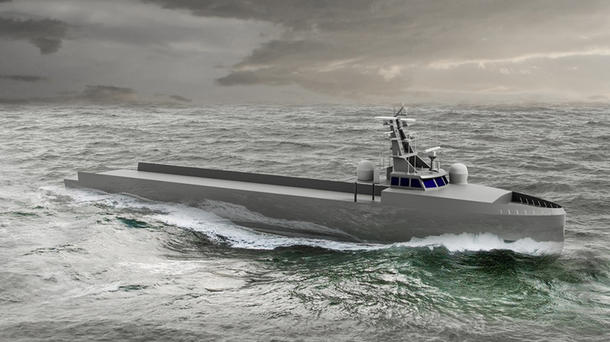
The Navy’s next robotic ship could be customizable
A concept rendering of the MUSV. L3Harris

Without a human crew on board, the MUSV will instead need automated systems to sustain it for missions lasting between 30 and 45 days, or possibly longer. Redundant safety systems, as well as sensors to detect damage and initiate repair, will be essential in ensuring the long-term viability of a robot without human tenders on board doing routine maintenance.

[Related: The US Navy launched a missile from a ghost ship. Wait, what?]

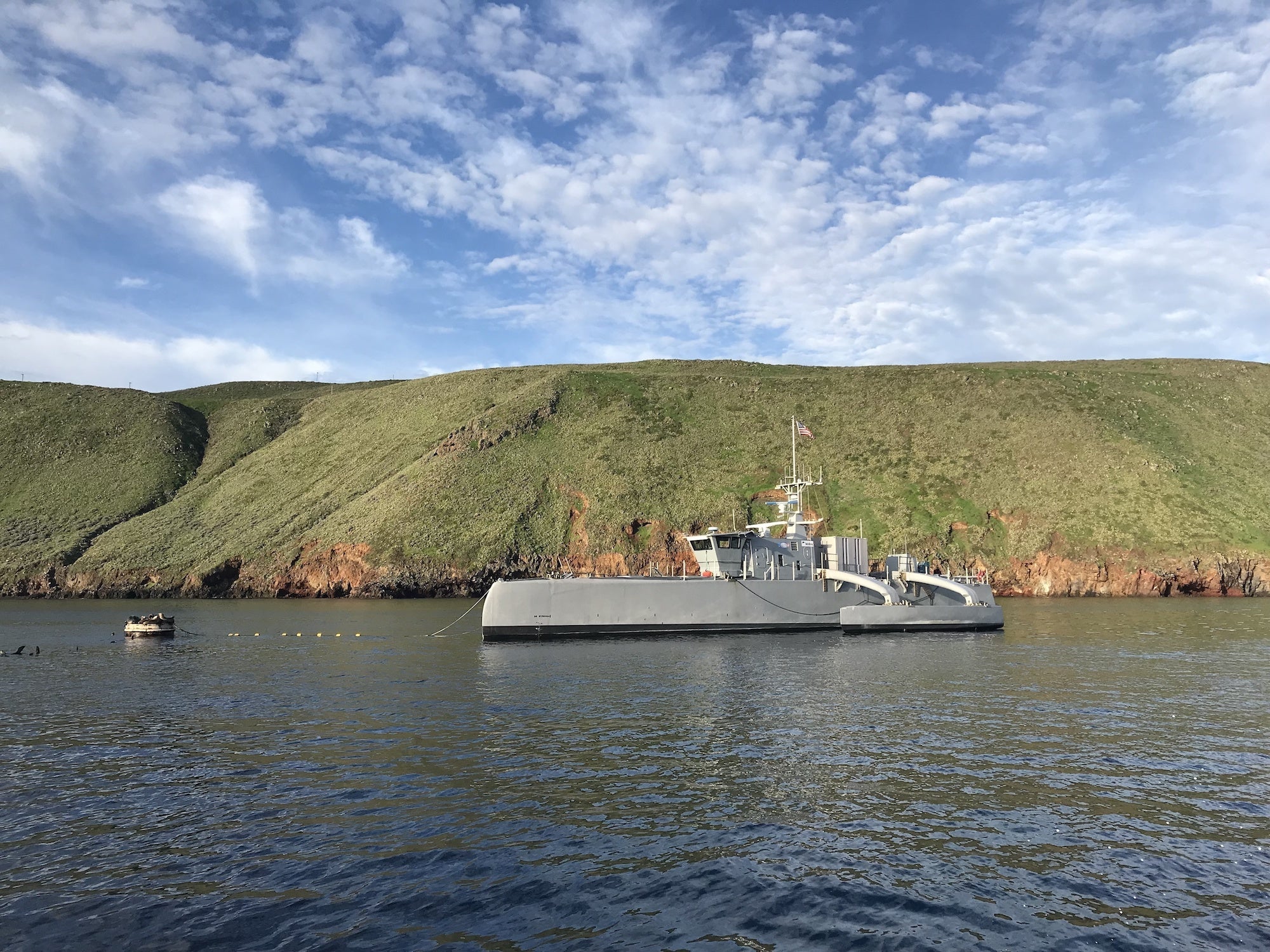
“Medium” is a relative term, and the Navy’s definition for the vehicle is between 45 to 190 feet long. That size range encompasses the size of existing patrol boats, or smaller vessels used by navies and coast guards to operate in rivers, harbors, and along coasts. Sea Hunter, the autonomous boat originally developed for a DARPA project, is 132 feet long.

The Sea Hunter had a displacement of 140 tons, which is on the lower end of what can be expected for the MUSV. The Navy requirements could see vessels as massive as 500 tons in displacement. That mass of ship will be taken up by a variable range of tools for missions, from scouting to jamming enemy signals to transportation, at least at the start. The ability to select configurations of sensors and other tools could let the MUSV be a flexible part of Navy operations.

L3Harris started building the prototype in 2021. Once it is completed and in the water, it will have a mundane hurdle to overcome: understanding and operating within the laws of the sea. The goal for maritime autonomy, said Campbell, is for the robotic vessels to “understand the environment around them and function effectively and predictably in that environment.”

[Related: The Navy’s next-gen destroyer concept involves powerful lasers]

That means following the collision regulations, or the international rules that sailors all follow to prevent crashes at sea. 

This work will build to a future where robot vessels “behave more predictably to a human and other maritime traffic that’s out there,” said Campbell. If the MUSV can navigate like a human, and follow the same rules, it can fit into existing sea traffic, ideally without behaving erratically or endangering other vessels.

With luck, that means a useful robotic ship that can be on patrol for weeks at a time, without an onboard human crew or remote control. If it behaves normally, it can blend in with other traffic, right until sailors on another ship realize the robot is navigating without a bridge.


Credit: Source link

Previous Post

Power tool companies have discovered USB-C — and DeWalt’s two-way charger sounds awesome

Next Post

WhiteSource for Azure Repos scans open source code for security vulnerabilities

New York Tech Editorial Team

New York Tech Editorial Team

New York Tech Media is a leading news publication that aims to provide the latest tech news, fintech, AI & robotics, cybersecurity, startups & leaders, venture capital, and much more!

Next Post
SentinelOne Remote Script Orchestration enables security teams to remotely automate custom responses

WhiteSource for Azure Repos scans open source code for security vulnerabilities

  • Trending
  • Comments
  • Latest
Meet the Top 10 K-Pop Artists Taking Over 2024

Meet the Top 10 K-Pop Artists Taking Over 2024

March 17, 2024
Panther for AWS allows security teams to monitor their AWS infrastructure in real-time

Many businesses lack a formal ransomware plan

March 29, 2022
Zach Mulcahey, 25 | Cover Story | Style Weekly

Zach Mulcahey, 25 | Cover Story | Style Weekly

March 29, 2022
10 Raunchy Movies on Netflix You Won’t Regret Watching

10 Raunchy Movies on Netflix You Won’t Regret Watching

May 20, 2024
How To Pitch The Investor: Ronen Menipaz, Founder of M51

How To Pitch The Investor: Ronen Menipaz, Founder of M51

March 29, 2022
Japanese Space Industry Startup “Synspective” Raises US $100 Million in Funding

Japanese Space Industry Startup “Synspective” Raises US $100 Million in Funding

March 29, 2022
Startups On Demand: renovai is the Netflix of Online Shopping

Startups On Demand: renovai is the Netflix of Online Shopping

2
Robot Company Offers $200K for Right to Use One Applicant’s Face and Voice ‘Forever’

Robot Company Offers $200K for Right to Use One Applicant’s Face and Voice ‘Forever’

1
Menashe Shani Accessibility High Tech on the low

Revolutionizing Accessibility: The Story of Purple Lens

1

Netgear announces a $1,500 Wi-Fi 6E mesh router

0
These apps let you customize Windows 11 to bring the taskbar back to life

These apps let you customize Windows 11 to bring the taskbar back to life

0
This bipedal robot uses propeller arms to slackline and skateboard

This bipedal robot uses propeller arms to slackline and skateboard

0
laptop on glass table

Automat-it Cuts Deployment Friction as Monce Scales AI Order Processing on AWS

April 13, 2026
Lee's Famous Recipe Chicken

Why Lee’s Famous Recipe Chicken Is Betting on Hi Auto to Quietly Rewire the Drive-Thru

April 9, 2026
computer generated image of letters

San Francisco Tribune Lists 11 HumanX Startups Moving AI Closer to the Operating Core

April 8, 2026
Impala CEO and Highrise AI CEO

The Industrialization of AI Infrastructure: What Impala and Highrise AI Reveal About the Next Scaling Frontier

April 7, 2026
Employee Time Tracking

What is an Employee Time Tracking Solution? A Definite Guide for 2026

March 31, 2026
Voltify founders

Voltify Raises $30 Million Seed Round as It Challenges $1 Trillion Rail Electrification Model

March 31, 2026

Recommended

laptop on glass table

Automat-it Cuts Deployment Friction as Monce Scales AI Order Processing on AWS

April 13, 2026
Lee's Famous Recipe Chicken

Why Lee’s Famous Recipe Chicken Is Betting on Hi Auto to Quietly Rewire the Drive-Thru

April 9, 2026
computer generated image of letters

San Francisco Tribune Lists 11 HumanX Startups Moving AI Closer to the Operating Core

April 8, 2026
Impala CEO and Highrise AI CEO

The Industrialization of AI Infrastructure: What Impala and Highrise AI Reveal About the Next Scaling Frontier

April 7, 2026

Categories

  • AI & Robotics
  • Benzinga
  • Cybersecurity
  • FinTech
  • New York Tech
  • News
  • Startups & Leaders
  • Venture Capital

Tags

AI AI QSRs Allseated Automat-it AWS B2B marketing Business CISO CISO Whisperer Collaborations Companies To Watch cryptocurrency Cybersecurity Entrepreneur Fetcherr Finance FINQ Fintech Funding Announcement hi-tech Hi Auto Impala Investing Investors investorsummit Israel israelitech Leaders LinkedIn Leaders Metaverse Mindset Minnesota omri hurwitz PointFive PR QSR Real Estate start- up startupnation Startups Startups On Demand Tech Tech leaders Unlimited Robotics VC
  • Contact Us
  • Privacy Policy
  • Terms and conditions

© 2024 All Rights Reserved - New York Tech Media

No Result
View All Result
  • News
  • FinTech
  • AI & Robotics
  • Cybersecurity
  • Startups & Leaders
  • Venture Capital

© 2024 All Rights Reserved - New York Tech Media