Follow our latest coverage of the 2022 Winter Olympics.
BEIJING — The strategy is audacious and stifling, and that is very much the point.
To Chinese officials, the creation of a vast bubble was their best (and maybe only) hope to stage the Olympic Games safely and preserve the kind of “zero Covid” policy that has been a priority for the government and a point of national pride.
Games organizers said they had conducted more than 500,000 tests since Jan. 23 and uncovered at least 232 virus cases, most of them as people arrived at Beijing Capital International Airport. Eleven people have been hospitalized, the authorities said.
Here is a journey through 48 hours in the Olympic bubble, starting when Air France Flight 128 from Paris arrived on Monday.
Monday, 7:06 a.m.
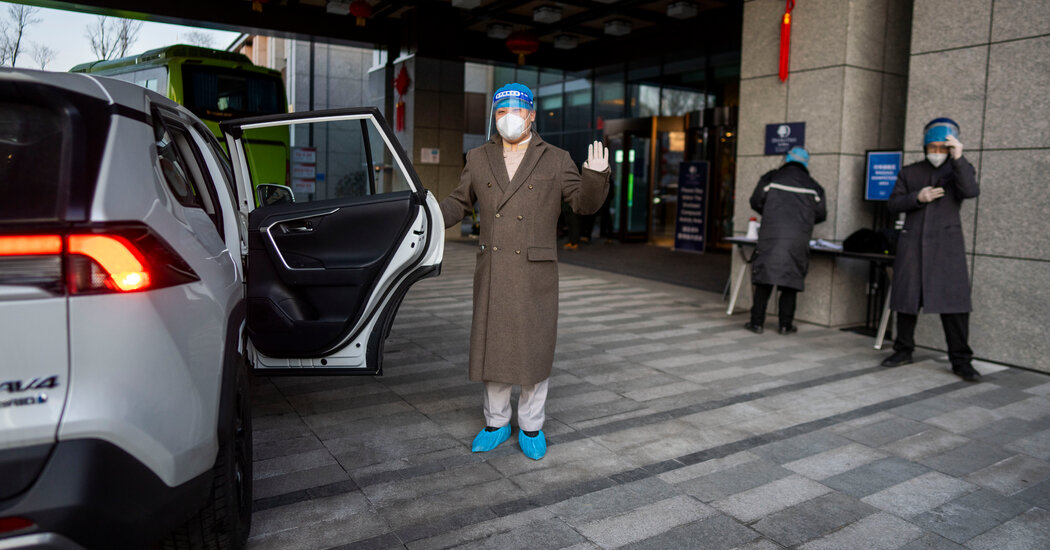
Even before sunlight drenches the airport, all it takes to spot the “closed loop” is a glance out the Boeing 777’s window: The tarmac workers marshaling Games flights as they arrive in Beijing are dressed in protective gear, the crisp white more startling than their illuminated orange batons.
More gowned-and-gloved people stand in the jetway. Then more in the cavernous, empty concourse, sealed off to all but those connected to the Games. Still more await in small bays, armed with nasal and throat swabs to check thousands who tested negative just before their flights and are, for the most part, fully vaccinated.
After some twists in a nostril and some swirls in the throat, eliciting a bounty of gags, the attendant has specimens that are one of China’s last and best chances to contain the virus.
10:34 a.m.
The bus driver sits behind a plastic barrier, leaving him and his passengers to communicate by gestures and shrugs.
A worker sprays the bus, presumably with disinfectant, as it leaves the airport for a hotel with guards who control a gate that opens only to allow bubble-approved vehicles through.
An assistant manager hands over a key to my room, where I will stay until my airport test result is ready. I can, however, order room service during the wait.
The doorbell rings. By the time I reach the door, the delivery person is barely in sight down the hall, the neatly packaged food abandoned on a table marked “Contact-free Handover Desk.”
At 1:14 p.m., a woman calls with the test result: negative. I can leave my room. Beijing is open, or as open as it will be this trip.
2:19 p.m.
The repurposed city bus is racing through Beijing. Every block showcases how the serendipity that so often comes during traveling and reporting will be stunted.
Outside venues, “Closed Loop Area” signs remind a Chinese public that their views of the Olympics on the ground will be through glimpses past fences and guards. “Please Don’t Cross the Line.”
Restaurants beyond the bubble are, of course, forbidden for Games participants. But the machinery of the state and the Olympics have conjured a city unto itself. The “Main Media Center,” more than 400,000 square feet, can feel like a cross between Epcot and Willy Wonka’s factory, where robots and computers orchestrate cleaning floors, taking temperatures and scanning credentials at checkpoints.
I have heard about a robot that will nag anyone not properly masked, and I see machines prepare dumplings, fried rice and broccoli. Saucers sometimes descend from the ceiling with glimmering bowls of hot food. (The dumplings and broccoli were excellent; the rice, though, was a bit dry.)
Outside after dusk, the 846-foot Olympic Tower glimmers with red and blue lights as music pulses just ahead of the Lunar New Year. The plazas closest to it, though, are largely empty.
Tuesday, 2:49 p.m.
I apparently passed the Covid test I took on Monday evening at the hotel, part of the daily ritual of covering these Games. I figure I will breathe easier later, once the threat of infection from the travel to Asia has ebbed.
I watch American hockey players and coaches cruise the ice at practice. Kendall Coyne Schofield, appearing in her third Games, beams as she poses for a snapshot in the face-off circle. There is, even in this cloistered world, still joy in sports, still pride that these are the Olympic Games.
4:23 p.m.
My phone buzzes just before Hilary Knight, a star American forward, plans to chat with reporters.
“A person is confirmed positive on Flight AF128 seated in SEAT 53A,” the formulaic email announces.
I flew in seat 54A and am now classified as a close contact.
I leave the interview room hurriedly, a touch rattled but mostly uncertain of every nuance of the protocols and fearful of inadvertently tripping more trouble. Between emails and calls with Terri Ann Glynn, the Olympics logistics mastermind for The New York Times and our designated Covid liaison officer, I debate whether to text my wife back home, 13 hours behind Beijing. I decide to let her sleep.
I take a private car to the media center; the Olympic bus system is not an option for close contacts.
The Coronavirus Pandemic: Key Things to Know
I remember enough of the rules to know that the days ahead hinge on whether I am “critical” to the Games. I am surprised to learn that I am, and so the rules are essentially these: For seven days, medical personnel will visit my hotel room twice a day for testing. I must eat alone, and I must stay off the buses.
But I can still cover the Games — if I remain negative.
8:57 p.m.
When the doorbell rings this time, the visitor does not flee. Instead, two attendants in blue protective gear are waiting to start the enhanced testing. I think I hear chuckles as I bend so the man can swab my throat. Maybe I am becoming accustomed to it; I barely gag.
About 10:15 p.m., a photographer sends a group text: “Ambulance outside the hotel again,” presumably for someone needing treatment for Covid-19 elsewhere. I wonder whether my result is already back.
It is not. But a testing team will visit my room again in less than 12 hours.
Wednesday, 5:53 a.m.
I have no symptoms. I am awake, though, because of jet lag, and I am paranoid about morphing into a case and being cast into an isolation facility. I eat a piece of chocolate to see if I still have a sense of taste. I do, so I again calculate potential incubation periods.
But it is an exercise of only so much value. There is nothing that can stop the infection that might be brewing in the bubble. I turn my attention to writing about sports.
After all, the Games are still on course to happen, just as China promised.
Credit: Source link