

New York Tech Media
  • News
  • FinTech
  • AI & Robotics
  • Cybersecurity
  • Startups & Leaders
  • Venture Capital
No Result
View All Result
  • News
  • FinTech
  • AI & Robotics
  • Cybersecurity
  • Startups & Leaders
  • Venture Capital
No Result
View All Result
New York Tech Media
No Result
View All Result
Home AI & Robotics

The robber fly is an aerodynamic acrobat that can catch its prey in midflight

New York Tech Editorial Team by New York Tech Editorial Team
February 15, 2022
in AI & Robotics
0
The robber fly is an aerodynamic acrobat that can catch its prey in midflight
Share on FacebookShare on Twitter
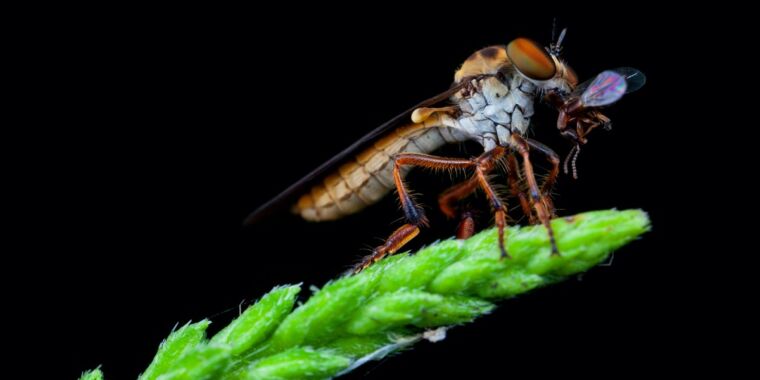
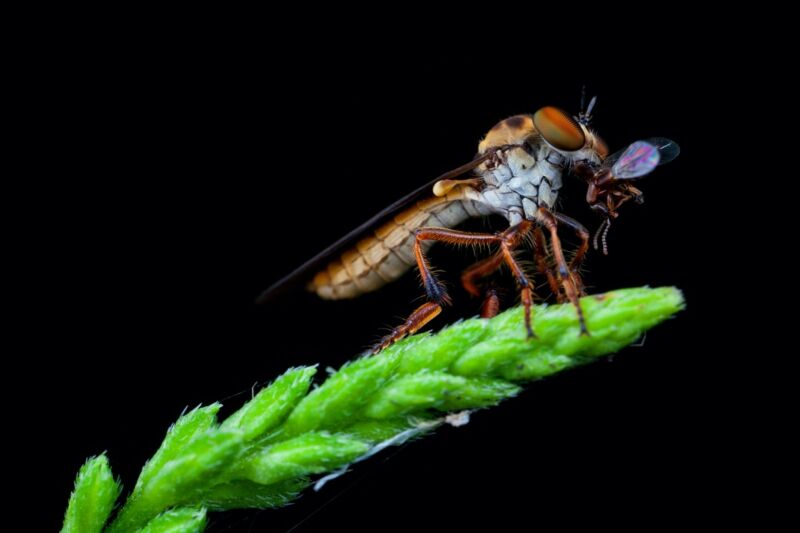
A miniature predatory robber fly (<em>Holcocephala fascia</em>) feeds on a captured rove beetle. A new study reveals that the fly approaches its prey from underneath, aiming for a future meeting point wth the target.
Enlarge / A miniature predatory robber fly (Holcocephala fascia) feeds on a captured rove beetle. A new study reveals that the fly approaches its prey from underneath, aiming for a future meeting point wth the target.

Samuel Fabian

Robber flies are aerodynamic acrobats, able to spot their prey, dodge around obstacles, and capture smaller insects at high speeds in midflights. Scientists have taken a closer look at how robber flies manage this amazing feat despite having brains on par with a single grain of sand. According to a new paper published in the Journal of Experimental Biology, the flies combine two distinct feedback-based navigation strategies: one that involves intercepting the prey when the view is clear, and another that allows the flies to swerve around any obstacles in their flight path.

One of the challenges in robotics is how to design robots that can navigate cluttered environments—something humans and other animals manage to do instinctively every day. Per the authors, many robotic systems rely upon a kind of path-planning: using sound (sonar) or lasers to send out signals and then detecting the reflections. That data can then be used to build a distance map of the surroundings.

But compared to using simple visual cues (i.e., “reactive methods”), path-planning is a costly approach in terms of energy use. Humans and other animals don’t require elaborate maps or specific knowledge about a target’s location, speed, and other details. We simply react to any relevant stimuli in our environment in real time. Devising navigational behavioral algorithms based on biological systems is thus of great interest to roboticists.

Past studies have focused on the ability of various species, including fruit flies and pigeons as well as humans, to negotiate cluttered environments. “However, in these instances, obstacle avoidance was the only goal,” the authors wrote. “Navigating around an obstacle is more challenging when a particular location acts as a target, because the aversion to obstacles must be balanced by the navigational goal.”

Advertisement

That’s why bioengineer Samuel Fabian of Imperial College, London and three collaborators from the University of Minnesota decided to conduct their own experiments using the predatory robber fly (Holocephala fusca) as a test subject. The robber fly was chosen because of its highly predictable interception path to catch prey. Also, its small size and relative fast behavior (most flights last less than a second) “require rapid reactions with minimum computational effort,” the authors wrote.

Fabian et al. liken the robber fly’s hunting behavior to that of falcons, hawks, and modern guided missiles. Robber flies typically hunt by perching somewhere that gives them a clear view of the sky. Once a robber fly spots potential prey and begins pursuit, the fly must navigate to both intercept the prey and avoid any obstacles along the way, such as errant branches.

The robber flies were presented with a moving target in the form of a small silver-colored reflective bead being pulled along a transparent fishing line with pulleys and a stepper motor. “The flies really didn’t know it’s not real prey, even when very close,” said Fabian. “If something is small enough, they generally seem to assume it’s food.”

The frame also held an obstacle: an acetate bar painted with black acrylic paint, either a thin (2.5 cm) or thick (5 cm) version, placed just below the path of the target. “The exact placement of the bar and the initial trajectory of the fly determined whether the object became an obstacle in the flight path and whether it obscured the target,” the authors wrote.

Advertisement

The researchers recorded all the flights under field conditions to get the most naturalistic behavior. Next, they digitally reconstructed 26 flights of robber flies pursuing the moving bead in the presence of an obstacle. Maneuvering the overhead equipment tended to startle the flies, so those 26 flights represent flies who remained on their perch as the apparatus was set up around them instead of flying away.

The results: when there was no obstacle, the robber flies maintained the same line of sight to the bead throughout their approach in order to intercept and capture their prey. When a thin or thick black bar partially obscured their view for brief periods (less than 0.1 second), the flies engaged in evasive maneuvers to get around the obstacle before getting back on course for an interception. Sometimes a fly would swerve in response to a black bar even when the bar didn’t obscure their line of sight. And when the researchers obscured the flies’ line of sight for longer than 0.1 second, the flies would abandon the interception entirely.

Fabian et al. concluded that the robber flies were employing a simple obstacle-avoidance strategy in combination with their standard interception strategy, which they have termed combined guidance. “The faster the obstacle is getting larger in their field of view, the more they turn away from it,” said Fabian. Flies revert to the interception trajectory once said obstacle begins to recede from view. “They are paying attention to their surroundings even when focused on the target.”

This “demonstrates that obstacle avoidance can be the product of simple feedback laws that do not require absolute knowledge of distance, size, or velocity,” the authors wrote, in keeping with prior work showing that simple feedback laws can also explain the flies’ interception strategy. Granted, this is based on a limited number of field trials, and the team hopes to conduct more trials in the future.

DOI: Journal of Experimental Biology, 2022. 10.1242/jeb.243568  (About DOIs).

Credit: Source link

Previous Post

Unknown TA2541 group attacking aviation and defense sectors since 2017

Next Post

Mercedes-Benz announces high-performance AMG version of its EQE electric sedan

New York Tech Editorial Team

New York Tech Editorial Team

New York Tech Media is a leading news publication that aims to provide the latest tech news, fintech, AI & robotics, cybersecurity, startups & leaders, venture capital, and much more!

Next Post
Mercedes-Benz announces high-performance AMG version of its EQE electric sedan

Mercedes-Benz announces high-performance AMG version of its EQE electric sedan

  • Trending
  • Comments
  • Latest
Meet the Top 10 K-Pop Artists Taking Over 2024

Meet the Top 10 K-Pop Artists Taking Over 2024

March 17, 2024
Panther for AWS allows security teams to monitor their AWS infrastructure in real-time

Many businesses lack a formal ransomware plan

March 29, 2022
Zach Mulcahey, 25 | Cover Story | Style Weekly

Zach Mulcahey, 25 | Cover Story | Style Weekly

March 29, 2022
How To Pitch The Investor: Ronen Menipaz, Founder of M51

How To Pitch The Investor: Ronen Menipaz, Founder of M51

March 29, 2022
10 Raunchy Movies on Netflix You Won’t Regret Watching

10 Raunchy Movies on Netflix You Won’t Regret Watching

May 20, 2024
Japanese Space Industry Startup “Synspective” Raises US $100 Million in Funding

Japanese Space Industry Startup “Synspective” Raises US $100 Million in Funding

March 29, 2022
Startups On Demand: renovai is the Netflix of Online Shopping

Startups On Demand: renovai is the Netflix of Online Shopping

2
Robot Company Offers $200K for Right to Use One Applicant’s Face and Voice ‘Forever’

Robot Company Offers $200K for Right to Use One Applicant’s Face and Voice ‘Forever’

1
Menashe Shani Accessibility High Tech on the low

Revolutionizing Accessibility: The Story of Purple Lens

1

Netgear announces a $1,500 Wi-Fi 6E mesh router

0
These apps let you customize Windows 11 to bring the taskbar back to life

These apps let you customize Windows 11 to bring the taskbar back to life

0
This bipedal robot uses propeller arms to slackline and skateboard

This bipedal robot uses propeller arms to slackline and skateboard

0
laptop on glass table

Automat-it Cuts Deployment Friction as Monce Scales AI Order Processing on AWS

April 13, 2026
Lee's Famous Recipe Chicken

Why Lee’s Famous Recipe Chicken Is Betting on Hi Auto to Quietly Rewire the Drive-Thru

April 9, 2026
computer generated image of letters

San Francisco Tribune Lists 11 HumanX Startups Moving AI Closer to the Operating Core

April 8, 2026
Impala CEO and Highrise AI CEO

The Industrialization of AI Infrastructure: What Impala and Highrise AI Reveal About the Next Scaling Frontier

April 7, 2026
Employee Time Tracking

What is an Employee Time Tracking Solution? A Definite Guide for 2026

March 31, 2026
Voltify founders

Voltify Raises $30 Million Seed Round as It Challenges $1 Trillion Rail Electrification Model

March 31, 2026

Recommended

laptop on glass table

Automat-it Cuts Deployment Friction as Monce Scales AI Order Processing on AWS

April 13, 2026
Lee's Famous Recipe Chicken

Why Lee’s Famous Recipe Chicken Is Betting on Hi Auto to Quietly Rewire the Drive-Thru

April 9, 2026
computer generated image of letters

San Francisco Tribune Lists 11 HumanX Startups Moving AI Closer to the Operating Core

April 8, 2026
Impala CEO and Highrise AI CEO

The Industrialization of AI Infrastructure: What Impala and Highrise AI Reveal About the Next Scaling Frontier

April 7, 2026

Categories

  • AI & Robotics
  • Benzinga
  • Cybersecurity
  • FinTech
  • New York Tech
  • News
  • Startups & Leaders
  • Venture Capital

Tags

AI AI QSRs Allseated Automat-it AWS B2B marketing Business CISO CISO Whisperer Collaborations Companies To Watch cryptocurrency Cybersecurity Entrepreneur Fetcherr Finance FINQ Fintech Funding Announcement hi-tech Hi Auto Impala Investing Investors investorsummit Israel israelitech Leaders LinkedIn Leaders Metaverse Mindset Minnesota omri hurwitz PointFive PR QSR Real Estate start- up startupnation Startups Startups On Demand Tech Tech leaders Unlimited Robotics VC
  • Contact Us
  • Privacy Policy
  • Terms and conditions

© 2024 All Rights Reserved - New York Tech Media

No Result
View All Result
  • News
  • FinTech
  • AI & Robotics
  • Cybersecurity
  • Startups & Leaders
  • Venture Capital

© 2024 All Rights Reserved - New York Tech Media