


Source: Exposing mice with the autism-associated SHANK3 genetic mutation to new environments can trigger autism-like behaviors, including repetitive movements and problems with social engagement. However, adding familiar objects to the novel environment during the first exposure can reduce the behavioral and brain signaling deficits.
Summary: Friedrich Miescher Institute for Biomedical Research
The emergence of autism traits can result from different factors, such as a person’s environment and genetic background. FMI researchers and their Novartis collaborators showed that exposing mice with an autism mutation to a new environment can trigger autism-like behaviors—through faulty signaling in the brain.
However, adding familiar objects to the environment can rescue these defects, suggesting that behavioral therapies involving familiar features may help to prevent the emergence of autism traits in predisposed people.
Every person on the autism spectrum is unique, and autistic traits may differ significantly even between siblings with similar genetic backgrounds. To investigate the factors that might contribute to the emergence of autism, researchers in the Caroni group and their colleagues at the FMI and the Novartis Institutes for BioMedical Research set out to study mice who carry a mutation in the SHANK3 gene.
SHANK3 encodes a protein that helps neurons communicate throughout the brain. Mutations in this gene have been associated with autism and intellectual disability, and deletions of the chromosomal region containing SHANK3 lead to Phelan-McDermid syndrome, a condition characterized by intellectual disability, problems with speech, and autism.
The results, published in Neuron on February 25, show that exposing mice with the SHANK3 mutation to a new environment can trigger autism-like behaviors, including problems with social engagement and repetitive movements upon subsequent exposures.
These defects are a result of faulty brain signaling that creates a long-term memory of not engaging in an unfamiliar context. However, adding familiar objects to the environment at first exposure can rescue the behavioral and brain-signaling defects.
“Nobody expected that experiencing a novel context would have such a major impact on engagement, and that this can be prevented by including familiar objects,” says study senior author Pico Caroni. The findings may have implications for autistic people. “It might be possible to expand the comfort zone of a person with autism by introducing familiar things in a new environment,” Caroni says.
Testing engagement
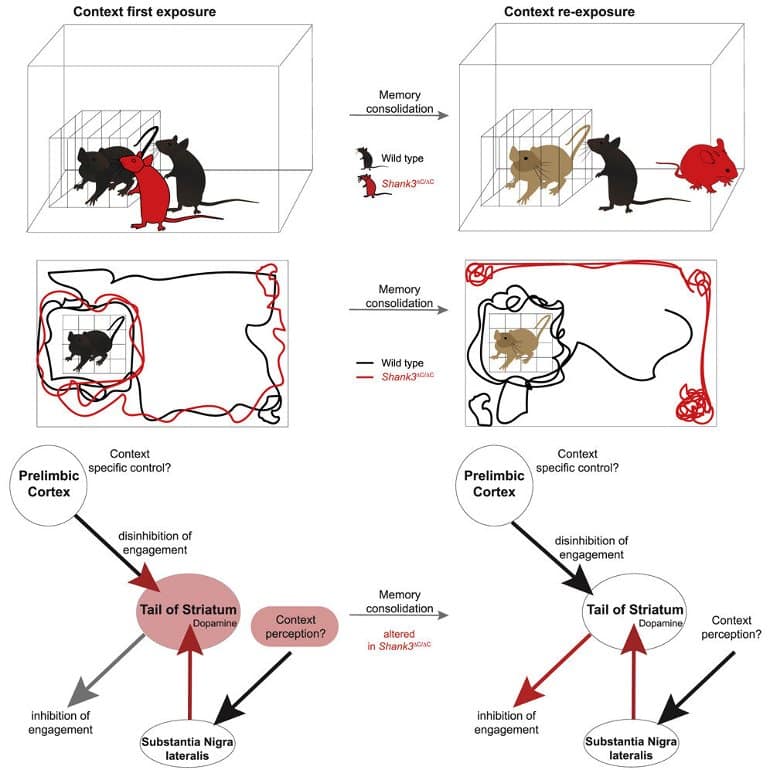
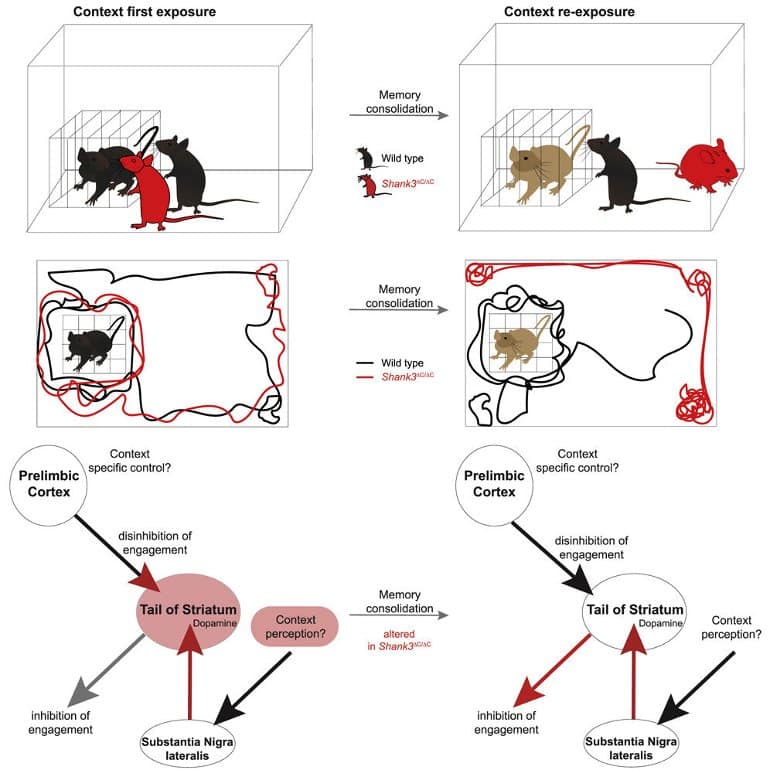
First, the researchers placed mice for 10 minutes in a new environment—a large, empty box that the animals had never seen before. Then, they returned the mice to their home cages. After 24 hours, the researchers put the mice back into the box, which this time contained an object or another mouse.
Control mice without the SHANK3 mutation explored the object and interacted with the stranger mouse, but those with the SHANK3 mutation did not. Instead, SHANK3 mice showed self-centered behaviors such as grooming and repetitive movements—a core autism trait.
However, if SHANK3 mice were asked to engage with another mouse or an object shortly after their first exposure to the new environment, they did so at levels comparable to those of control mice. So, the researchers set out to investigate what happens in the SHANK3 mice’s brain after their first exposure to a new environment.
Scientists have known that the signaling of dopamine—a chemical messenger involved in movement, reward, and emotional control—during a period of 12 to 15 hours after a particular experience is important for long-term memory consolidation in specific brain areas. Dopamine release in a brain region involved in reward and movement, called the tail of striatum, is also a teaching signal for retreat.
The researchers found that in SHANK3 mice, dopamine signals in the tail of striatum induced when mice explored objects where much larger than in control mice. Preventing dopamine signaling in this brain area rescued the engagement problems seen when the mice were re-exposed to the unfamiliar environment. These findings suggest that a memory induced in the tail of striatum by elevated dopamine levels results in reduced engagement with objects or other mice.
“Dopamine signaling at the first encounter may be part of the signaling machinery that leads to the long-term memory of not engaging in that context,” Caroni says.
Further experiments showed that in control mice, the activity of a group of neurons that project from the prelimbic cortex, a brain area involved in social engagement, to the tail of striatum mediates engagement with objects or other mice after the animals are exposed to a new environment. Activating these neurons in SHANK3 mice prevented the animals’ lack of engagement with their peers, the team found.
Familiar features
Next, the researchers repeated the engagement tests, but this time they added objects that the mice were familiar with, such as fresh bedding material, during the rodents’ first exposure to the new environment. When initial exposure to the new context included familiar objects, SHANK3 mice engaged with their peers in the same way that control mice did, and dopamine levels in their tail of striatum didn’t become too high.
“Insistence on familiar things is a hallmark of autism, and here we show that adding something familiar to a novel context is sufficient to remove the phenotype in that context,” Caroni says.
How the presence of familiar features translates into signals in the brain is still unclear. Scientists have known that autistic people tend to overreact to sensory stimuli such as light, touch or sound. Caroni speculates that these sensory issues may influence the way a new environment is perceived when there are no familiar faces or objects, leading to withdrawal upon subsequent exposures to the same environment.
See also

The researchers also found that SHANK3 mice had fewer-than-expected behavioral problems if they grew up in a stimulating enclosure, filled with toys, running wheels and other enrichments. Now, Caroni’s team is investigating whether the findings generalize to other mice with autism-linked mutations.
This research collaboration highlights the benefits of the close interaction between the Novartis Institutes for BioMedical Research and the FMI, which allowed the researchers to tap into the FMI’s research strengths in order to tackle fundamental scientific questions that may be of interest to Novartis.
About this autism research news
Author: Press Office
Source: Friedrich Miescher Institute for Biomedical Research
Contact: Press Office – Friedrich Miescher Institute for Biomedical Research
Image: The image is credited to the researchers
Original Research: Open access.
“Absence of familiarity triggers hallmarks of autism in mouse model through aberrant tail-of-striatum and prelimbic cortex signaling” by Sebastian Krüttner et al. Neuron
Abstract
Absence of familiarity triggers hallmarks of autism in mouse model through aberrant tail-of-striatum and prelimbic cortex signaling
Autism spectrum disorder (ASD) involves genetic and environmental components. The underlying circuit mechanisms are unclear, but behaviorally, aversion toward unfamiliarity, a hallmark of autism, might be involved.
Here, we show that in Shank3ΔC/ΔC ASD model mice, exposure to novel environments lacking familiar features produces long-lasting failure to engage and repetitive behaviors upon re-exposure. Inclusion of familiar features at first context exposure prevented enhanced dopamine transients in tail of striatum (TS) and restored context-specific control of engagement to wild-type levels in Shank3ΔC/ΔC mice.
Engagement upon context re-exposure depended on the activity in prelimbic cortex (PreL)-to-TS projection neurons in wild-type mice and was restored in Shank3ΔC/ΔC mice by the chemogenetic activation of PreL→TS projection neurons. Environmental enrichment prevented ASD-like phenotypes by obviating the dependence on PreL→TS activity.
Therefore, novel context experience has a key role in triggering ASD-like phenotypes in genetically predisposed mice, and behavioral therapies involving familiarity and enrichment might prevent the emergence of ASD phenotypes.
Credit: Source link