

New York Tech Media
  • News
  • FinTech
  • AI & Robotics
  • Cybersecurity
  • Startups & Leaders
  • Venture Capital
No Result
View All Result
  • News
  • FinTech
  • AI & Robotics
  • Cybersecurity
  • Startups & Leaders
  • Venture Capital
No Result
View All Result
New York Tech Media
No Result
View All Result
Home AI & Robotics

Simulated Human Eye Movement Aims to Train Metaverse Platforms

New York Tech Editorial Team by New York Tech Editorial Team
March 7, 2022
in AI & Robotics
0
Simulated Human Eye Movement Aims to Train Metaverse Platforms
Share on FacebookShare on Twitter

Summary: EyeSyn, a newly developed “virtual eye” that simulates how humans look at the world accurately enough for the development of new augmented reality programs, can help create applications for the metaverse.

Source: Duke University

Computer engineers at Duke University have developed virtual eyes that simulate how humans look at the world accurately enough for companies to train virtual reality and augmented reality programs. Called EyeSyn for short, the program will help developers create applications for the rapidly expanding metaverse while protecting user data.

The results have been accepted and will be presented at the International Conference on Information Processing in Sensor Networks (IPSN), May 4-6, 2022, a leading annual forum on research in networked sensing and control.

“If you’re interested in detecting whether a person is reading a comic book or advanced literature by looking at their eyes alone, you can do that,” said Maria Gorlatova, the Nortel Networks Assistant Professor of Electrical and Computer Engineering at Duke.

“But training that kind of algorithm requires data from hundreds of people wearing headsets for hours at a time,” Gorlatova added. “We wanted to develop software that not only reduces the privacy concerns that come with gathering this sort of data, but also allows smaller companies who don’t have those levels of resources to get into the metaverse game.”

The poetic insight describing eyes as the windows to the soul has been repeated since at least Biblical times for good reason: The tiny movements of how our eyes move and pupils dilate provide a surprising amount of information. Human eyes can reveal if we’re bored or excited, where concentration is focused, whether or not we’re expert or novice at a given task, or even if we’re fluent in a specific language.

“Where you’re prioritizing your vision says a lot about you as a person, too,” Gorlatova said. “It can inadvertently reveal sexual and racial biases, interests that we don’t want others to know about, and information that we may not even know about ourselves.”

Eye movement data is invaluable to companies building platforms and software in the metaverse. For example, reading a user’s eyes allows developers to tailor content to engagement responses or reduce resolution in their peripheral vision to save computational power.

With this wide range of complexity, creating virtual eyes that mimic how an average human responds to a wide variety of stimuli sounds like a tall task. To climb the mountain, Gorlatova and her team — including former postdoctoral associate Guohao Lan, who is now an assistant professor at the Delft University of Technology in the Netherlands, and current PhD student Tim Scargill — dove into the cognitive science literature that explores how humans see the world and process visual information.

For example, when a person is watching someone talk, their eyes alternate between the person’s eyes, nose and mouth for various amounts of time. When developing EyeSyn, the researchers created a model that extracts where those features are on a speaker and programmed their virtual eyes to statistically emulate the time spent focusing on each region.

“If you give EyeSyn a lot of different inputs and run it enough times, you’ll create a data set of synthetic eye movements that is large enough to train a (machine learning) classifier for a new program,” Gorlatova said.

See also

This shows a cartoon of children playing

To test the accuracy of their synthetic eyes, the researchers turned to publicly available data. They first had the eyes “watch” videos of Dr. Anthony Fauci addressing the media during press conferences and compared it to data from the eye movements of actual viewers. They also compared a virtual dataset of their synthetic eyes looking at art with actual datasets collected from people browsing a virtual art museum. The results showed that EyeSyn was able to closely match the distinct patterns of actual gaze signals and simulate the different ways different people’s eyes react.
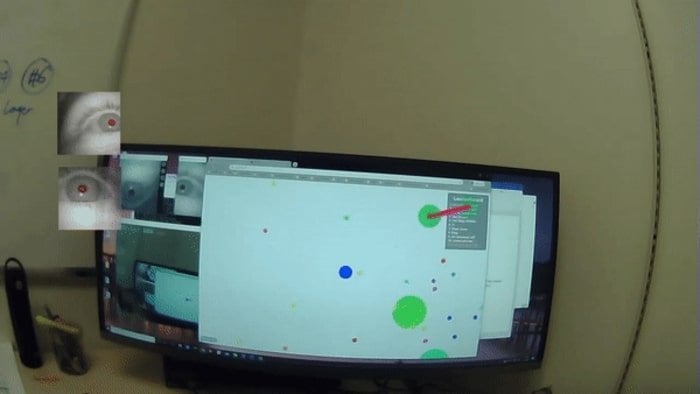
This shows dots on a computer monitor
Rather than collecting actual eye movement data, as seen here, Duke engineers have developed a set of “virtual eyes” that simulate the data well enough to train new metaverse applications. Credit: Maria Gorlatova, Duke University

According to Gorlatova, this level of performance is good enough for companies to use it as a baseline to train new metaverse platforms and software. With a basic level of competency, commercial software can then achieve even better results by personalizing its algorithms after interacting with specific users.

“The synthetic data alone isn’t perfect, but it’s a good starting point,” Gorlatova said. “Smaller companies can use it rather than spending the time and money of trying to build their own real-world datasets (with human subjects). And because the personalization of the algorithms can be done on local systems, people don’t have to worry about their private eye movement data becoming part of a large database.”

Funding: This research was funded by the National Science Foundation (CSR-1903136, CNS-1908051, IIS-2046072) and an IBM Faculty Award.

About this metaverse and virtual reality research news

Author: Ken Kingery
Source: Duke University
Contact: Ken Kingery – Duke University
Image: The image is credited to Maria Gorlatova, Duke University

Original Research: The findings will be presented at 21st ACM/IEEE Conference on Information Processing in Sensor Networks (IPSN 2022)

Credit: Source link

Previous Post

Five questions about women’s health, women with Lux Capital’s Deena Shakir

Next Post

Hank Payments Becomes a Member of the North American Financial Data and Technology Associations (FDATA)

New York Tech Editorial Team

New York Tech Editorial Team

New York Tech Media is a leading news publication that aims to provide the latest tech news, fintech, AI & robotics, cybersecurity, startups & leaders, venture capital, and much more!

Next Post
Hank Payments Becomes a Member of the North American Financial Data and Technology Associations (FDATA)

Hank Payments Becomes a Member of the North American Financial Data and Technology Associations (FDATA)

  • Trending
  • Comments
  • Latest
Meet the Top 10 K-Pop Artists Taking Over 2024

Meet the Top 10 K-Pop Artists Taking Over 2024

March 17, 2024
Panther for AWS allows security teams to monitor their AWS infrastructure in real-time

Many businesses lack a formal ransomware plan

March 29, 2022
Zach Mulcahey, 25 | Cover Story | Style Weekly

Zach Mulcahey, 25 | Cover Story | Style Weekly

March 29, 2022
10 Raunchy Movies on Netflix You Won’t Regret Watching

10 Raunchy Movies on Netflix You Won’t Regret Watching

May 20, 2024
How To Pitch The Investor: Ronen Menipaz, Founder of M51

How To Pitch The Investor: Ronen Menipaz, Founder of M51

March 29, 2022
Japanese Space Industry Startup “Synspective” Raises US $100 Million in Funding

Japanese Space Industry Startup “Synspective” Raises US $100 Million in Funding

March 29, 2022
Startups On Demand: renovai is the Netflix of Online Shopping

Startups On Demand: renovai is the Netflix of Online Shopping

2
Robot Company Offers $200K for Right to Use One Applicant’s Face and Voice ‘Forever’

Robot Company Offers $200K for Right to Use One Applicant’s Face and Voice ‘Forever’

1
Menashe Shani Accessibility High Tech on the low

Revolutionizing Accessibility: The Story of Purple Lens

1

Netgear announces a $1,500 Wi-Fi 6E mesh router

0
These apps let you customize Windows 11 to bring the taskbar back to life

These apps let you customize Windows 11 to bring the taskbar back to life

0
This bipedal robot uses propeller arms to slackline and skateboard

This bipedal robot uses propeller arms to slackline and skateboard

0
laptop on glass table

Automat-it Cuts Deployment Friction as Monce Scales AI Order Processing on AWS

April 13, 2026
Lee's Famous Recipe Chicken

Why Lee’s Famous Recipe Chicken Is Betting on Hi Auto to Quietly Rewire the Drive-Thru

April 9, 2026
computer generated image of letters

San Francisco Tribune Lists 11 HumanX Startups Moving AI Closer to the Operating Core

April 8, 2026
Impala CEO and Highrise AI CEO

The Industrialization of AI Infrastructure: What Impala and Highrise AI Reveal About the Next Scaling Frontier

April 7, 2026
Employee Time Tracking

What is an Employee Time Tracking Solution? A Definite Guide for 2026

March 31, 2026
Voltify founders

Voltify Raises $30 Million Seed Round as It Challenges $1 Trillion Rail Electrification Model

March 31, 2026

Recommended

laptop on glass table

Automat-it Cuts Deployment Friction as Monce Scales AI Order Processing on AWS

April 13, 2026
Lee's Famous Recipe Chicken

Why Lee’s Famous Recipe Chicken Is Betting on Hi Auto to Quietly Rewire the Drive-Thru

April 9, 2026
computer generated image of letters

San Francisco Tribune Lists 11 HumanX Startups Moving AI Closer to the Operating Core

April 8, 2026
Impala CEO and Highrise AI CEO

The Industrialization of AI Infrastructure: What Impala and Highrise AI Reveal About the Next Scaling Frontier

April 7, 2026

Categories

  • AI & Robotics
  • Benzinga
  • Cybersecurity
  • FinTech
  • New York Tech
  • News
  • Startups & Leaders
  • Venture Capital

Tags

AI AI QSRs Allseated Automat-it AWS B2B marketing Business CISO CISO Whisperer Collaborations Companies To Watch cryptocurrency Cybersecurity Entrepreneur Fetcherr Finance FINQ Fintech Funding Announcement hi-tech Hi Auto Impala Investing Investors investorsummit Israel israelitech Leaders LinkedIn Leaders Metaverse Mindset Minnesota omri hurwitz PointFive PR QSR Real Estate start- up startupnation Startups Startups On Demand Tech Tech leaders Unlimited Robotics VC
  • Contact Us
  • Privacy Policy
  • Terms and conditions

© 2024 All Rights Reserved - New York Tech Media

No Result
View All Result
  • News
  • FinTech
  • AI & Robotics
  • Cybersecurity
  • Startups & Leaders
  • Venture Capital

© 2024 All Rights Reserved - New York Tech Media