 When we last rapped about non-fungible tokens (NFTs), we focused on how the creators of the artworks that are sold alongside the alphanumeric codes that comprise the NFTs almost always maintain the copyrights for those artworks. And that the buyer takes ownership only of the code, which is then inscribed on the blockchain forevermore. The creator of the artwork can then exploit that artwork in any way they see fit without interference from the NFT owner.
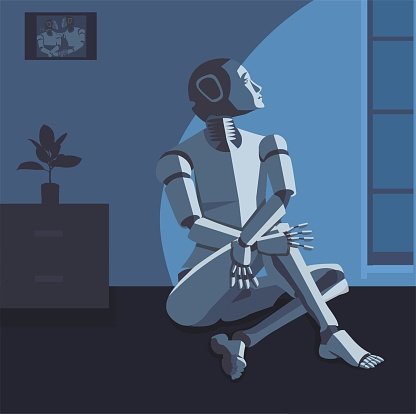
Many of the artworks, though, that are associated with NFTs are at least in part created by robots, benevolent ones, sure, but robots nonetheless. These robots rely on algorithms and at times artificial intelligence to mass-create digital artwork in various iterations, each of which is marketed as a “unique” work of art to pair with your NFT. There are 10,000 CryptoPunks, for example, each of which was generated by software code.
There is usually humanoid involvement, to be sure — in many cases a person will write the software code, upload a data set to a computer, and apply creation protocols to the data, which is then, per those protocols, synthesized and converted to create the art. But the actual execution of the art — fixing it in a digital medium so that it can be perceived by the viewer — is done by the robot.
Dr. Stephen Thaler would be a good person to explain how this all works. A very interesting fellow who has worked with diamonds, brains, and computers, though not always at the same time, he applied in 2018 to register an artwork entitled “Creativity Machine” with the U.S. Copyright Office. He ran into a roadblock in doing so, though, because, for a work to be registrable, a claimant must identify the creative content for which the presumably human claimant is responsible.
In Thaler’s application, he stated, problematically, that the “Creativity Machine” work was “autonomously created by a computer algorithm running on a machine” that he owned. The work, he advised, was made “for hire,” a designation usually applied to work created by an employee for an employer in the scope of their employment. Thaler was advising the Copyright Office that the work was created by his robot artist in the course of its robot duties.
The Copyright Office, in addressing Thaler’s appeal of the denial of his registration for “Creativity Machine,” was skeptical because “human authorship” is necessary to make a work registrable. And while the authorship threshold for registration is quite humble, with most elementary school-level work making the grade, that work must be the product of humanity.
The Copyright Office makes clear that the “crucial question” when determining whether there is sufficient human authorship is whether a computer is “merely being an assisting instrument” or “actually conceive[s] and execute[s]” the “traditional elements of authorship in the work.” Many artists use computers and other “machines” — e.g., a camera — to create their work, and so long as they “conceive” the work their authorship is sufficient for protection. As a result, a work created on a computer will not be found to be created by a computer except in rare instances.
Thaler’s work, in which he claims to have made no contribution as a human, is one of those instances. His work, like that created by Naruto in the famous Ninth Circuit case in which it was decided that monkeys cannot own copyrights, did not have the human tincture needed to be protectable.
Finding that Thaler had failed to provide evidence of “sufficient creative input or intervention” by him or any other human, the Copyright Office rejected his application. He appealed it all the way up the chain but the Copyright Office held firm, finding no reason to depart from the long-standing approach of awarding copyright registrations only to humans.
In so holding, the Copyright Office emphasized that its compendium precludes registration of a work “produced by a machine” unless there is some creative human input. Thaler, whose application was adamant about disclaiming any such input, didn’t make the grade on this count. He was so explicit on this issue that it appears he had a greater interest in arguing the point that robots should have the opportunity to hold copyright registration than he was in obtaining a copyright registration.
Most original art that is created on, and even substantially by, a computer will be protectable. Someone can imagine an application that made clear that the writing of the algorithm and selection of the various datum inputs and arrangement of the creation protocols would easily meet the threshold of human “creative input or intervention” that is required. But Thaler averred that the robot and the robot alone did the thing, and he was denied registration as a result.
The Copyright Act, which is intended to incentivize the creation of new works of art, including those that push the proverbial envelope, would seemingly embrace the use of computers to create works and seek to encourage artists in digital media to develop and create innovative works. And copyright law protects “the fruits of intellectual labor,” which would seemingly cover the intellectual labor attendant to writing a sweet algorithm and populating it with the most carefully curated and creatively arranged data. But, in a most telling bracketed interposition, the Copyright Office notes that the compendium states that such fruits must be “founded in the creative powers of the [human] mind” to be protectable, leaving out in the cold works founded in the autonomous robot mind.
This has ramifications for NFTs whose attendant artwork is algorithm- or computer-generated. Should the Copyright Office find that such works are not protectable by copyright because they are machine-created without the requisite human contribution, it will further devalue the value of the works as intellectual property assets, though it is unclear if this would affect the token value.
While Thaler’s complete disavowal of any human involvement in the computer-driven development of “Creativity Machine” made this more of a policy move and a relatively easy decision for the Copyright Office, there will surely be future instances in which artists who create on and with computers will more heavily blur the line between what is and isn’t human-generated art. And what is protected by copyright law.
 Scott Alan Burroughs, Esq. practices with Doniger / Burroughs, an art law firm based in Venice, California. He represents artists and content creators of all stripes and writes and speaks regularly on copyright issues. He can be reached at scott@copyrightLA.com, and you can follow his law firm on Instagram: @veniceartlaw.
Credit: Source link