

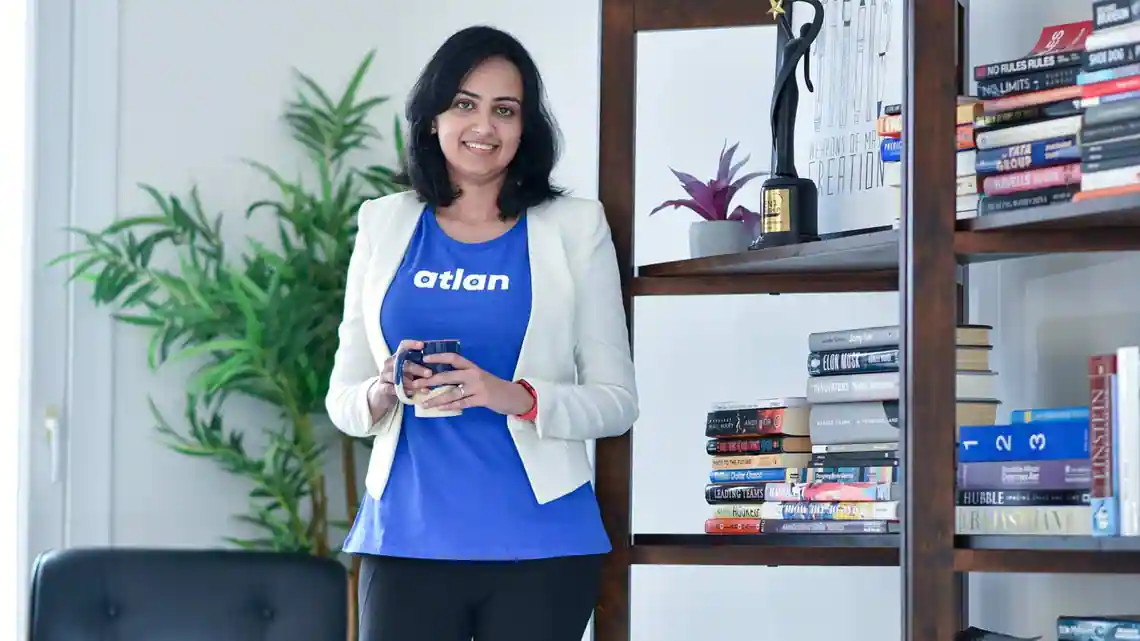
The world is going back to work. But not Prukalpa Sankar, the 30-year-old co-founder of Atlan, a technology company with a mission to democratise data. Sankar is happy in her Bengaluru home office, with a wooden desk, a large monitor, an Eames armchair, a bookcase, and a small sit-out area with plants, which she uses as a space to think.
“I still am old school when I’m figuring things out,” she says. “I still like to use a notebook and a pencil and get away from laptops.”
Also read: Punit Renjen: The purpose-led leader
Sankar is not alone in her desire to work from home. Ebuka Ezeh, 26, a senior software engineer at Atlan, works off a desk in his bedroom in Lagos. Despite his initial skepticism about working for a company based in a different time zone, he is vocal about the joys of remote working. “I’ve only had one office job. Every other has been remote,” he says. “I’m really used to working from home.”
As is Isabel Atienza, 36, a business development executive and a working mother who works for Atlan, based out of Manila. “I get to work at my own time and at my own pace; I love what I’m doing. And I can be with my children. This is the best work setting for me,” she insists. A portable table and office-chair accompany her around the house, as she moves between the master bedroom, dining room and children’s playroom.
Sankar, Ezeh and Atienza are a representative sample of a company that thinks of itself as a “remote working global startup”. With around 100 employees, three-year-old Atlan has a remarkably global footprint. It has employees in 30 cities and 12 countries, and remarkably little real estate: limited offices, with nearly all employees working from home.
Tech startups such as Atlan often serve customers around the world, but it is less common for employees themselves to be so distributed and operating from their home-offices, in a fast-changing startup environment. It is a creative attempt at subverting one of the root causes of an issue such as “the great resignation”: the reluctance to go back to a physical office.
THE success formula
Atlan’s ability to make remote working succeed lies in organisational culture. Culture is vital to any organisation’s success, but especially in one so nascent and virtual.
Sankar says distributed working was part of Atlan’s DNA early on, when it began serving customers in other parts of the world, especially the US. Covid accelerated this way of working, and facilitated global hiring. “Once we decided that we were going to go distributed, we just committed to being distributed. I think we are building that new breed of company, which is not location first, but people first. What matters is that you are the best at what you do, wherever you are around the world. We think of ourselves fundamentally as a global company, from day zero,” she says.
Global hiring has led to a concentration of employees in certain locations, such as Delhi, New York, Lagos and Manila. The company wants to experiment with a more hybrid format, such as getting teams in these hub locations to work out of a co-working space often, or when they are trying to solve specific problems, or conducting training programmes in office spaces. “We definitely want to infuse more elements of human connection, but I think it’s safe to say that we will never be a ‘fully in office company’ for the foreseeable future,” she says.
One of the biggest benefits of remote working is that people are “more thoughtful, more reflective, with more of a written work culture,” Sankar observes. This is reflected in the way meetings are run. With teams in time zones as far apart as the Bay Area and the Philippines, the number of overlapping hours for co-workers to meet is limited. “We’ve started moving away from meetings for the sake of updates, and we do meetings for solving problems. We don’t have 12 hours a day to be in a meeting, we only have three hours a day, if you want everyone in the same (virtual) room. And so, if that’s the case, then we have to use the time to maximise the potential of this meeting, by solving problems” and insisting on written pre-preparation for meetings, in advance.
THE TWO BIG Cs
Remote working culture’s biggest bedrocks are collaboration and communication. Ezeh describes how these elements manifest themselves in daily work life: “Collaboration is about always being in sync with the other person. Because if you’re working with someone and they’re having roadblocks, and they don’t communicate; there will be no progress. You have to constantly communicate with them. Every decision you want to take, you have to communicate it, it’s really important.
“If texting or Slack doesn’t work, you can set up a quick Zoom call. If you are going to be away from your keyboard for 30 minutes or an hour, you need to communicate that or if you have to visit the doctor, let them know. In some companies, you can’t access your teammates, but here we have processes and workflows to communicate.”
Not being able to see colleagues face to face has tremendous downsides, though. Sankar acknowledges the loss of serendipitous water-cooler conversations that are essential to a company’s social, intellectual and economic fabric. “There is a lot of onus on us to create serendipity. Serendipity doesn’t just happen, you have to create avenues for serendipity to happen,” she explains. For example, Atlan organises “Jeffersonian” dinners on Friday evenings, when the company conducts demos of its products. Inspired by the later former US President Thomas Jefferson, the dinners facilitate “deep” conversations among employees on curated topics, including “emotional, or funny stuff”.
Other structures to promote social exchange include setting up a remote working task force, whose goal is to build a better remote working culture. Atienza, who is on the task force, enjoys “coffee roulette”, held every Wednesday. “It’s not mandatory. People are randomly grouped and asked to take 30 minutes off to talk among themselves on topics that are not work related,” she says. For Atienza, Atlan’s work culture is “contagious”. The energy, the motivation and the working habits are a huge draw, she says.
Remote working has been a preferred way of life for some professionals, and covid has only expanded this tribe. Atlan exemplifies that remote working is increasingly part of business strategy too, and not just a lifestyle preference.
Although Sankar refrains from sharing financials, she says the customer base has grown five times since the company started and she is confident the company can continue to adopt this model, as it expands headcount.
Companies expend their energies on reaching global customers and markets. By committing to tapping global talent during a pandemic, Atlan has developed a remote work blueprint that offers lessons to other companies grappling with post-covid worklife models.
Also read: Meet Walkaroo’s design thinker
Credit: Source link