

New York Tech Media
  • News
  • FinTech
  • AI & Robotics
  • Cybersecurity
  • Startups & Leaders
  • Venture Capital
No Result
View All Result
  • News
  • FinTech
  • AI & Robotics
  • Cybersecurity
  • Startups & Leaders
  • Venture Capital
No Result
View All Result
New York Tech Media
No Result
View All Result
Home AI & Robotics

Facebook researchers build better skin and fingertips for softer, more sensitive robots – TechCrunch

New York Tech Editorial Team by New York Tech Editorial Team
November 1, 2021
in AI & Robotics
0
Facebook researchers build better skin and fingertips for softer, more sensitive robots – TechCrunch
Share on FacebookShare on Twitter

According to Facebook AI Research, the next generation of robots should be much better at feeling — not emotions, of course, but using the sense of touch. And to advance the ball in this relatively new area of AI and robotics research, the company and its partners have built a new kind of electronic skin and fingertip that are inexpensive, durable and provide a basic and reliable tactile sense to our mechanical friends.

The question of why exactly Facebook is looking into robot skin is obvious enough that AI head Yann LeCun took it on preemptively on a media call showing off the new projects.

Funnily enough, he recalled, it started with Zuckerberg noting that the company seemed to have no good reason to be looking into robotics. LeCun seems to have taken this as a challenge and started looking into it, but a clear answer emerged in time: If Facebook was to be in the business of providing intelligent agents — and what self-respecting tech corporation isn’t? — then those agents need to understand the world beyond the output of a camera or microphone.

The sense of touch isn’t much good at telling whether something is a picture of a cat or a dog, or who in a room is speaking, but if robots or AIs plan to interact with the real world, they need more than that.

“What we’ve become good at is understanding pixels and appearances,” said FAIR research scientist Roberto Calandra, “But understanding the world goes beyond that. We need to go towards a physical understanding of objects to ground this.”

While cameras and microphones are cheap and there are lots of tools for efficiently processing that data, the same can’t be said for touch. Sophisticated pressure sensors simply aren’t popular consumer products, and so any useful ones tend to stay in labs and industrial settings.

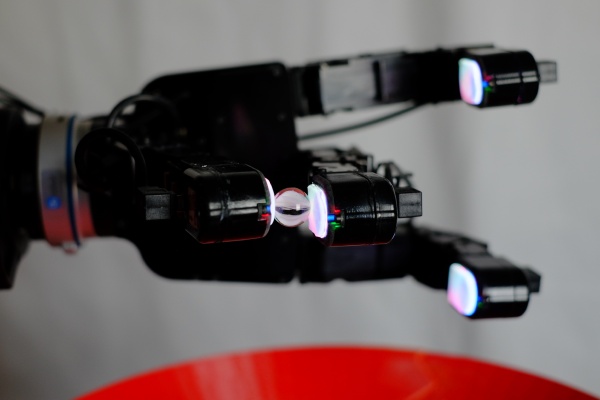
DIGIT was released in 2020 as an open source design; it uses a tiny camera pointed at the pads to produce a detailed image of the item being touched. You can see the fingertips themselves in the image at top; it’s quite sensitive, as you can see from the detailed maps it’s able to create when touching various items:
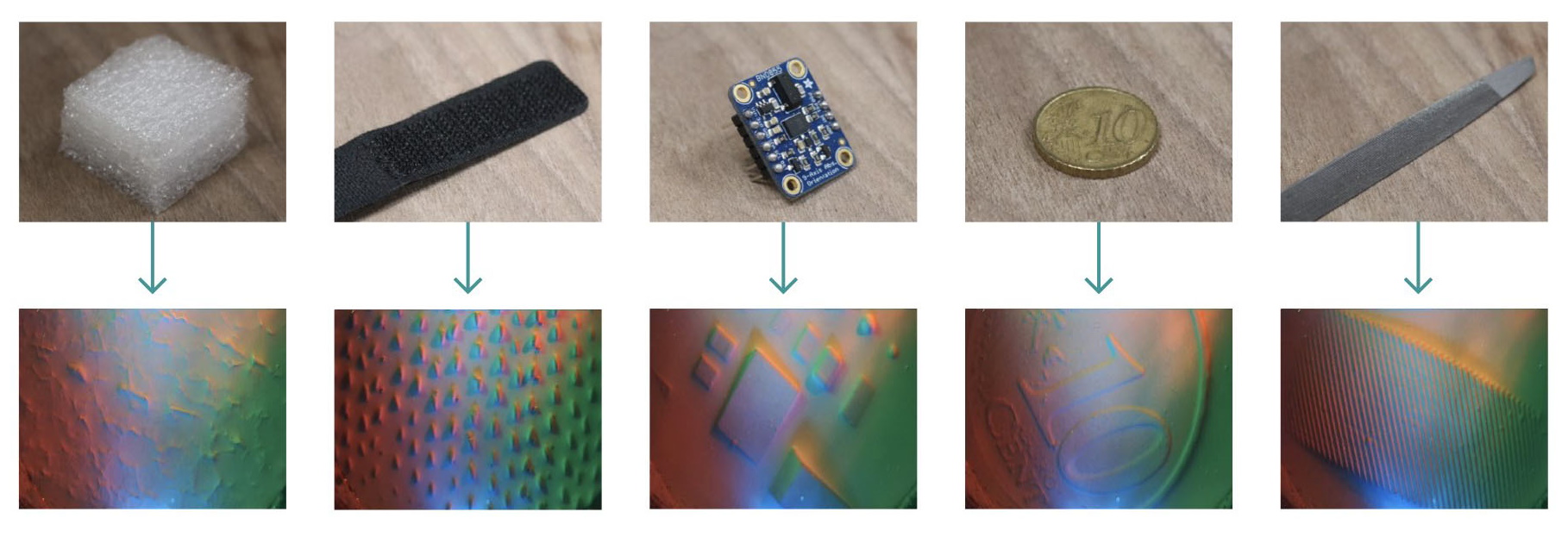
Objects shown above images of the signals produced by the robotic fingertip.

Image Credits: Facebook

The ReSkin project has roots dating back to 2009; we wrote about the MIT project called GelSight in 2014, then again in 2020 — the company has spun out and is now the manufacturing partner for this well-documented approach to touch. Basically you have magnetic particles suspended in a soft gel surface, and a magnetometer beneath it can sense the displacement of those particles, translating those movements into accurate force maps of the pressures causing the movement.

One of the advantages of the GelSight type system is that the hard component — the chip with the magnetometer and logic and so on — is totally separate from the soft component, which is just a flexible pad impregnated with magnetic dots. That means the surface can get dirty or scratched and is easily replaced, while the sensitive part can hide safely below.

In the case of ReSkin, it means you can hook up a bunch of the chips in any shape and lay a slab of magnetic elastomer on top, then integrate the signals and you’ll get touch information from the whole thing. Well… it’s not quite that simple, since you have to calibrate it and all, but it’s a lot simpler than other artificial skin systems that were possible to operate at scales beyond a couple square inches.

You can even make it into little dog shoes, because why not?
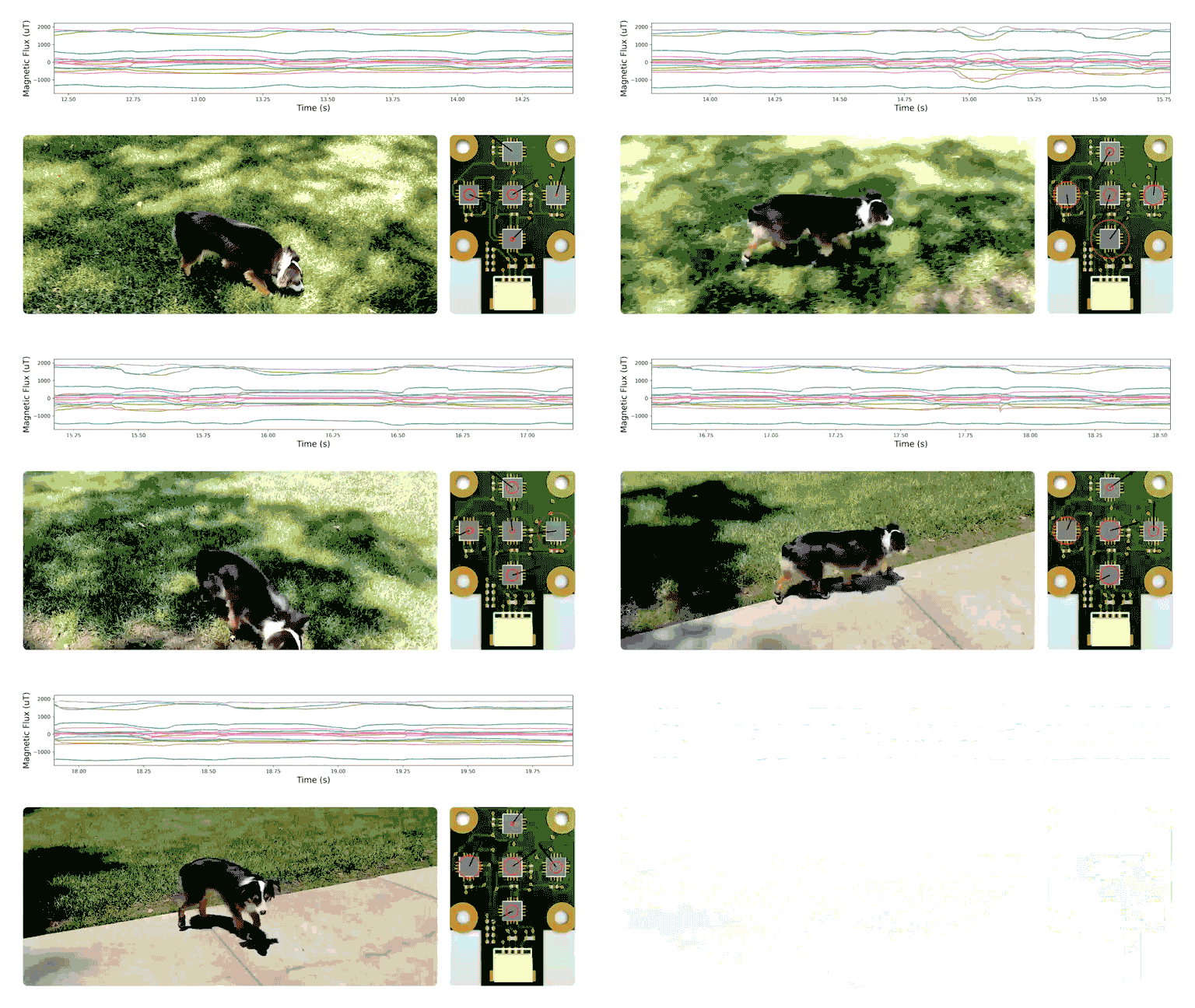
Animated image of a dog with pressure-sensing pads on its feet and the readings from them.

Animated image of a good dog with pressure-sensing pads on its feet and the readings from them. Image Credits: Facebook

With a pressure-sensitive surface like this, robots and other devices can more easily sense the presence of objects and obstacles, without relying on, say, extra friction from the joint exerting force in that direction. This could make assistive robots much more gentle and responsive to touch — not that there are many assistive robots out there to begin with. But part of the reason why is because they can’t be trusted not to crush things or people, since they don’t have a good sense of touch!

Facebook’s work here isn’t about new ideas, but about making an effective approach more accessible and affordable. The software framework will be released publicly and the devices can be bought fairly cheaply, so it will be easier for other researchers to get into the field.

Credit: Source link

Previous Post

Meta’s ultra-thin synthetic skin for robots enables them to ‘feel’ objects to build its metaverse 

Next Post

Autonomous Vehicles, Connected Vehicles, and Their Impact on Payments

New York Tech Editorial Team

New York Tech Editorial Team

New York Tech Media is a leading news publication that aims to provide the latest tech news, fintech, AI & robotics, cybersecurity, startups & leaders, venture capital, and much more!

Next Post
How FinTech Innovation and VC Warchests Fuel Markets

Autonomous Vehicles, Connected Vehicles, and Their Impact on Payments

  • Trending
  • Comments
  • Latest
Meet the Top 10 K-Pop Artists Taking Over 2024

Meet the Top 10 K-Pop Artists Taking Over 2024

March 17, 2024
Panther for AWS allows security teams to monitor their AWS infrastructure in real-time

Many businesses lack a formal ransomware plan

March 29, 2022
Zach Mulcahey, 25 | Cover Story | Style Weekly

Zach Mulcahey, 25 | Cover Story | Style Weekly

March 29, 2022
How To Pitch The Investor: Ronen Menipaz, Founder of M51

How To Pitch The Investor: Ronen Menipaz, Founder of M51

March 29, 2022
10 Raunchy Movies on Netflix You Won’t Regret Watching

10 Raunchy Movies on Netflix You Won’t Regret Watching

May 20, 2024
Japanese Space Industry Startup “Synspective” Raises US $100 Million in Funding

Japanese Space Industry Startup “Synspective” Raises US $100 Million in Funding

March 29, 2022
Startups On Demand: renovai is the Netflix of Online Shopping

Startups On Demand: renovai is the Netflix of Online Shopping

2
Robot Company Offers $200K for Right to Use One Applicant’s Face and Voice ‘Forever’

Robot Company Offers $200K for Right to Use One Applicant’s Face and Voice ‘Forever’

1
Menashe Shani Accessibility High Tech on the low

Revolutionizing Accessibility: The Story of Purple Lens

1

Netgear announces a $1,500 Wi-Fi 6E mesh router

0
These apps let you customize Windows 11 to bring the taskbar back to life

These apps let you customize Windows 11 to bring the taskbar back to life

0
This bipedal robot uses propeller arms to slackline and skateboard

This bipedal robot uses propeller arms to slackline and skateboard

0
laptop on glass table

Automat-it Cuts Deployment Friction as Monce Scales AI Order Processing on AWS

April 13, 2026
Lee's Famous Recipe Chicken

Why Lee’s Famous Recipe Chicken Is Betting on Hi Auto to Quietly Rewire the Drive-Thru

April 9, 2026
computer generated image of letters

San Francisco Tribune Lists 11 HumanX Startups Moving AI Closer to the Operating Core

April 8, 2026
Impala CEO and Highrise AI CEO

The Industrialization of AI Infrastructure: What Impala and Highrise AI Reveal About the Next Scaling Frontier

April 7, 2026
Employee Time Tracking

What is an Employee Time Tracking Solution? A Definite Guide for 2026

March 31, 2026
Voltify founders

Voltify Raises $30 Million Seed Round as It Challenges $1 Trillion Rail Electrification Model

March 31, 2026

Recommended

laptop on glass table

Automat-it Cuts Deployment Friction as Monce Scales AI Order Processing on AWS

April 13, 2026
Lee's Famous Recipe Chicken

Why Lee’s Famous Recipe Chicken Is Betting on Hi Auto to Quietly Rewire the Drive-Thru

April 9, 2026
computer generated image of letters

San Francisco Tribune Lists 11 HumanX Startups Moving AI Closer to the Operating Core

April 8, 2026
Impala CEO and Highrise AI CEO

The Industrialization of AI Infrastructure: What Impala and Highrise AI Reveal About the Next Scaling Frontier

April 7, 2026

Categories

  • AI & Robotics
  • Benzinga
  • Cybersecurity
  • FinTech
  • New York Tech
  • News
  • Startups & Leaders
  • Venture Capital

Tags

AI AI QSRs Allseated Automat-it AWS B2B marketing Business CISO CISO Whisperer Collaborations Companies To Watch cryptocurrency Cybersecurity Entrepreneur Fetcherr Finance FINQ Fintech Funding Announcement hi-tech Hi Auto Impala Investing Investors investorsummit Israel israelitech Leaders LinkedIn Leaders Metaverse Mindset Minnesota omri hurwitz PointFive PR QSR Real Estate start- up startupnation Startups Startups On Demand Tech Tech leaders Unlimited Robotics VC
  • Contact Us
  • Privacy Policy
  • Terms and conditions

© 2024 All Rights Reserved - New York Tech Media

No Result
View All Result
  • News
  • FinTech
  • AI & Robotics
  • Cybersecurity
  • Startups & Leaders
  • Venture Capital

© 2024 All Rights Reserved - New York Tech Media