

New York Tech Media
  • News
  • FinTech
  • AI & Robotics
  • Cybersecurity
  • Startups & Leaders
  • Venture Capital
No Result
View All Result
  • News
  • FinTech
  • AI & Robotics
  • Cybersecurity
  • Startups & Leaders
  • Venture Capital
No Result
View All Result
New York Tech Media
No Result
View All Result
Home AI & Robotics

NeRF: Training Drones in Neural Radiance Environments

New York Tech Editorial Team by New York Tech Editorial Team
October 11, 2021
in AI & Robotics
0
NeRF: Training Drones in Neural Radiance Environments
Share on FacebookShare on Twitter

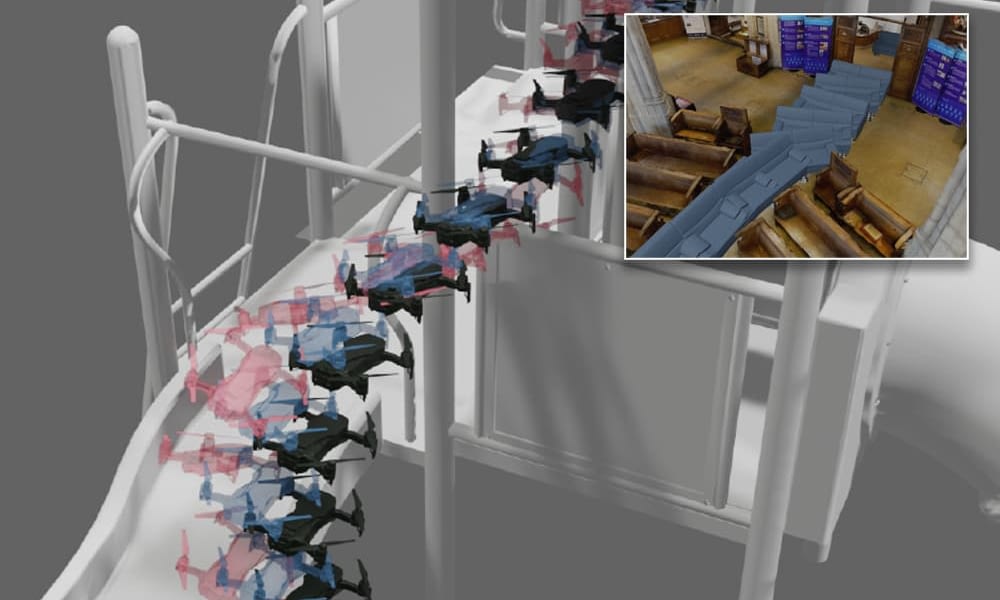
Researchers from Stanford University have devised a new way of training drones to navigate photorealistic and highly accurate environments, by leveraging the recent avalanche of interest in Neural Radiance Fields (NeRF).
Drones can be trained in virtual environments mapped directly from real-life locations, with no need for specialized 3D scene reconstruction. In this image from the project, wind disturbance has been added as a potential obstacle for the drone, and we can see the drone being momentarily diverted from its trajectory and compensating at the last moment to avoid a potential obstacle. Source: https://mikh3x4.github.io/nerf-navigation/

Drones can be trained in virtual environments mapped directly from real-life locations, with no need for specialized 3D scene reconstruction. In this image from the project, wind disturbance has been added as a potential obstacle for the drone, and we can see the drone being momentarily diverted from its trajectory and compensating at the last moment to avoid a potential obstacle. Source: https://mikh3x4.github.io/nerf-navigation/

The method offers the possibility for interactive training of drones (or other types of objects) in virtual scenarios that automatically include volume information (to calculate collision avoidance), texturing drawn directly from real-life photos (to help train drones’ image recognition networks in a more realistic fashion), and real-world lighting (to ensure a variety of lighting scenarios get trained into the network, avoiding over-fitting or over-optimization to the original snapshot of the scene).
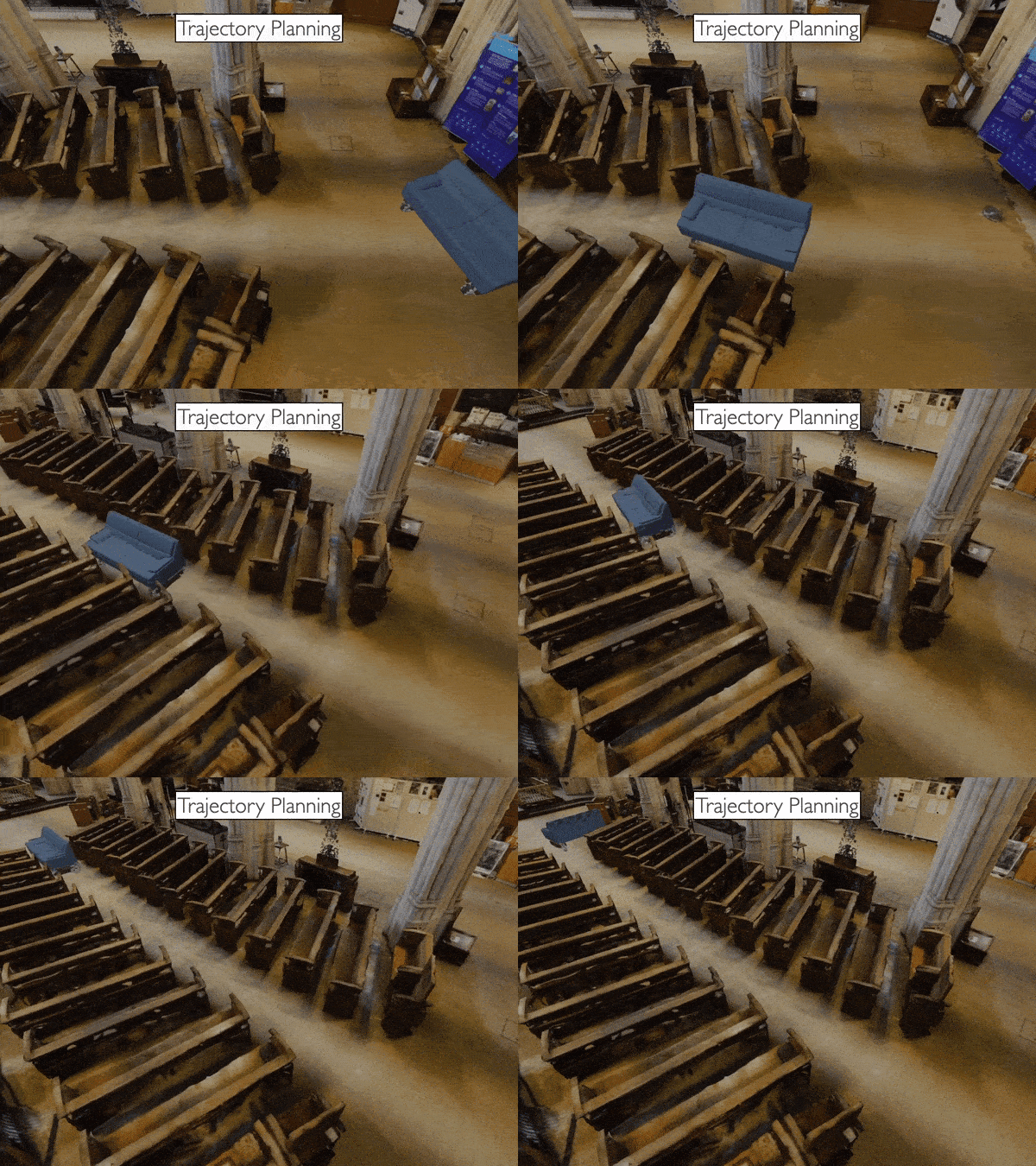
A couch-object navigates a complex virtual environment which would have been very difficult to map using geometry capture and retexturing in traditional AR/VR workflows, but which was recreated automatically in NeRF from a limited number of photos taken at the location. Source: https://www.youtube.com/watch?v=5JjWpv9BaaE

A couch-object navigates a complex virtual environment which would have been very difficult to map using geometry capture and retexturing in traditional AR/VR workflows, but which was recreated automatically in NeRF from a limited number of photos. Source: https://www.youtube.com/watch?v=5JjWpv9BaaE

Typical NeRF implementations do not feature trajectory mechanisms, since most of the slew of NeRF projects in the last 18 months have concentrated on other challenges, such as scene relighting, reflection rendering, compositing and disentanglement of captured elements. Therefore the new paper’s primary innovation is to implement a NeRF environment as a navigable space, without the extensive equipment and laborious procedures that would be necessary to model it as a 3D environment based on sensor capture and CGI reconstruction.

NeRF as VR/AR

The new paper is titled Vision-Only Robot Navigation in a Neural Radiance World, and is a collaboration between three Stanford departments: Aeronautics and Astronautics, Mechanical Engineering, and Computer Science.

The work proposes a navigation framework that provides a robot with a pre-trained NeRF environment, whose volume density delimits possible paths for the device. It also includes a filter to estimate where the robot is inside the virtual environment, based on image-recognition of the robot’s on-board RGB camera. In this way, a drone or robot is able to ‘hallucinate’ more accurately what it can expect to see in a given environment.

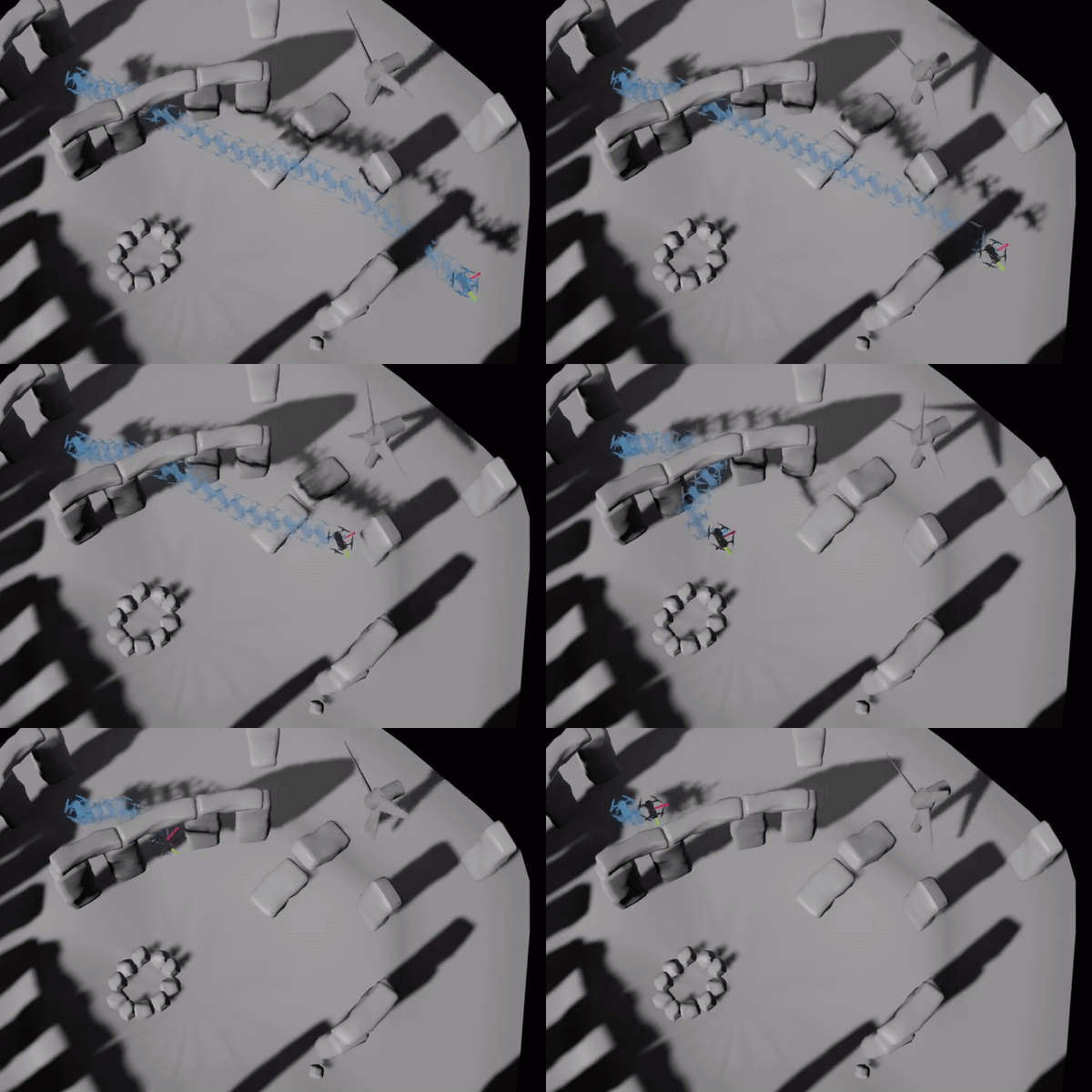
The project's trajectory optimizer navigates through a NeRF model of Stonehenge that was generated through photogrammetry and image interpretation into a Neural Radiance environment. The trajectory planner calculates a number of possible paths before establishing an optimal trajectory over the arch.

The project’s trajectory optimizer navigates through a NeRF model of Stonehenge that was generated through photogrammetry and image interpretation (in this case, of mesh models) into a Neural Radiance environment. The trajectory planner calculates a number of possible paths before establishing an optimal trajectory over the arch.

Because a NeRF environment features fully modeled occlusions, the drone can learn to calculate obstructions more easily, since the neural network behind the NeRF can map the relationship between occlusions and the way that the drone’s onboard vision-based navigation systems perceive the environment. The automated NeRF generation pipeline offers a relatively trivial method of creating hyper-real training spaces with only a few photos.
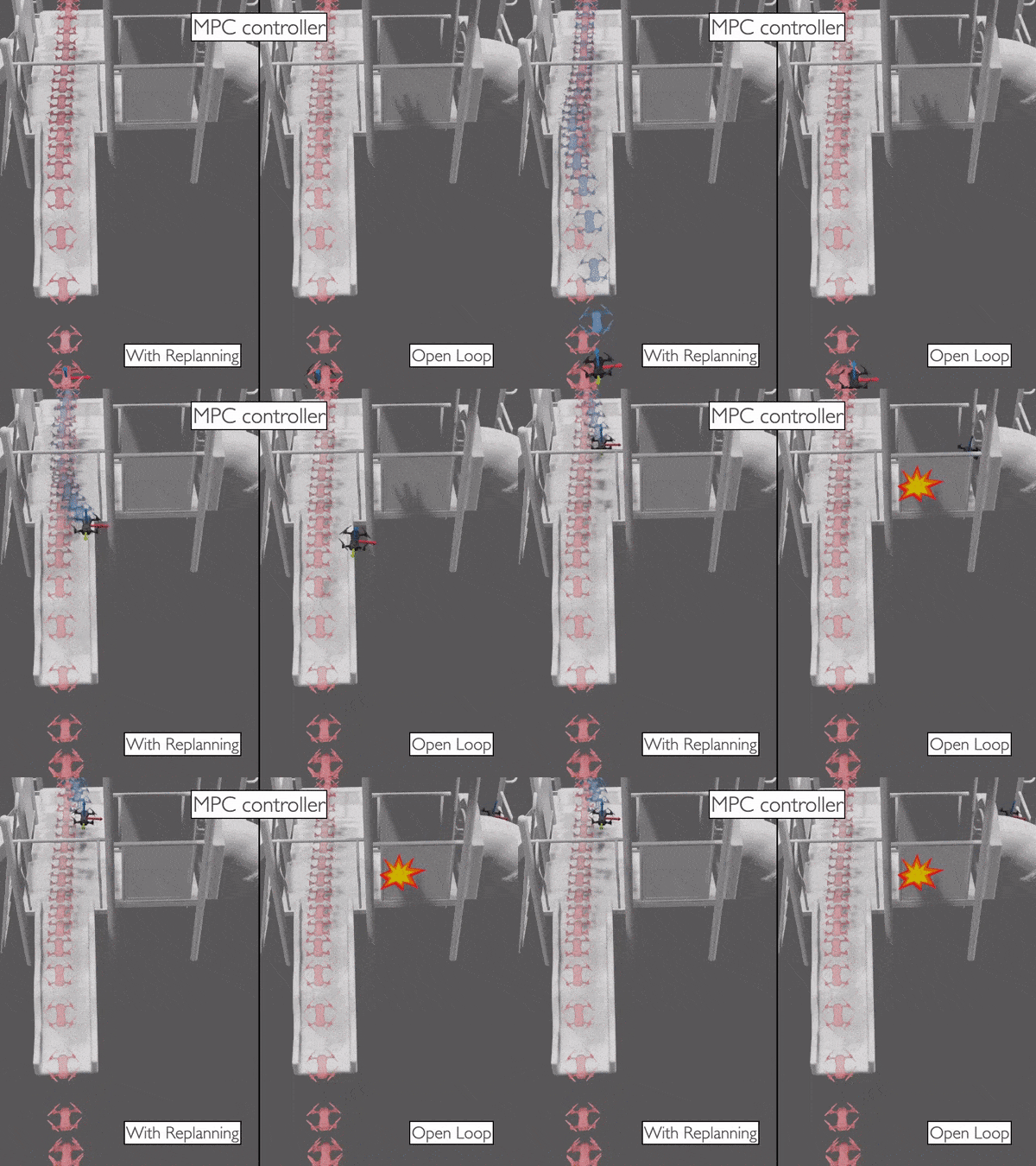
The online replanning framework developed for the Stanford project facilitates a resilient and entirely vision-based navigation pipeline.

The online replanning framework developed for the Stanford project facilitates a resilient and entirely vision-based navigation pipeline.

The Stanford initiative is among the first to consider the possibilities of exploring a NeRF space in the context of a navigable and immersive VR-style environment. Neural Radiance fields are an emerging technology, and currently subject to multiple academic efforts to optimize their high computing resource requirements, as well as to disentangle the captured elements.

Nerf Is Not (Really) CGI

Because a NeRF environment is a navigable 3D scene, it’s become a misunderstood technology since its emergence in 2020, often widely-perceived as a method of automating the creation of meshes and textures, rather than replacing 3D environments familiar to viewers from Hollywood VFX departments and the fantastical scenes of Augmented Reality and Virtual Reality environments.

NeRF extracts geometry and texture information from a very limited number of image viewpoints, calculating the difference between images as volumetric information. Source: https://www.matthewtancik.com/nerf

NeRF extracts geometry and texture information from a very limited number of image viewpoints, calculating the difference between images as volumetric information. Source: https://www.matthewtancik.com/nerf

In fact, the NeRF environment is more like a ‘live’ render space, where an amalgamation of pixel and lighting information is retained and navigated in an active and running neural network.

The key to NeRF’s potential is that it only requires a limited number of images in order to recreate environments, and that the generated environments contain all necessary information for a high-fidelity reconstruction, without the need for the services of modelers, texture artists, lighting specialists and the hordes of other contributors to ‘traditional’ CGI.

Semantic Segmentation

Even if NeRF effectively constitutes ‘Computer-Generated Imagery’ (CGI), it offers an entirely different methodology, and a highly-automated pipeline. Additionally, NeRF can isolate and ‘encapsulate’ moving parts of a scene, so that they can be added, removed, sped up, and generally operate as discrete facets in a virtual environment – a capability that is far beyond the current state-of-the-art in a ‘Hollywood’ interpretation of what CGI is.
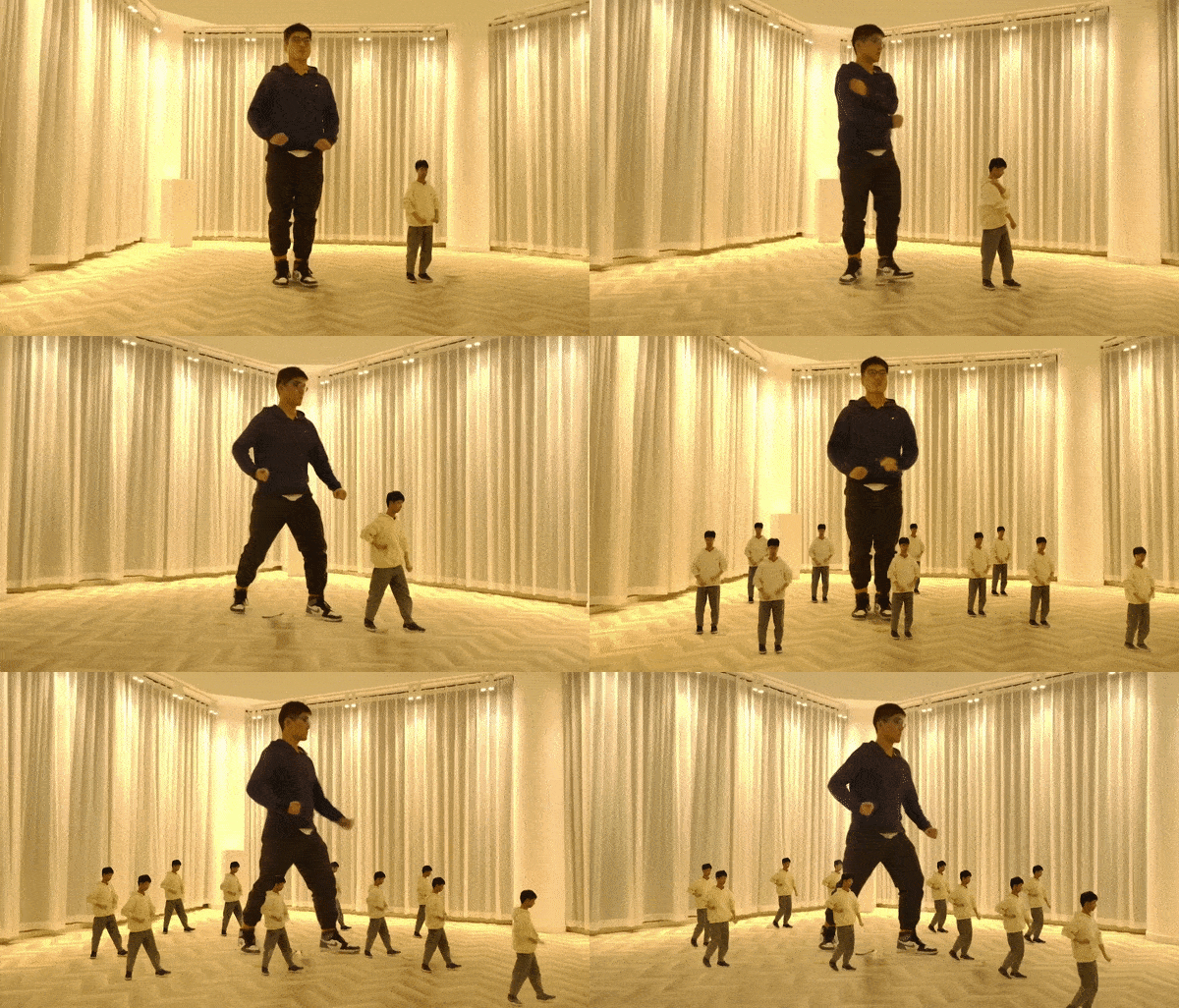
ST-NeRF

A collaboration from Shanghai Tech University, released in summer of 2021, offers a method to individuate moving NeRF elements into ‘pastable’ facets for a scene. Source: https://www.youtube.com/watch?v=Wp4HfOwFGP4

Negatively, NeRF’s architecture is a bit of a ‘black box’; it’s not currently possible to extract an object from a NeRF environment and directly manipulate it with traditional mesh-based and image-based tools, though a number of research efforts are beginning to make breakthroughs in deconstructing the matrix behind NeRF’s neural network live render environments.


Credit: Source link

Previous Post

Fintech and the Growth of Islamic Finance

Next Post

Tiger Global backs African fintech Mono in $15M Series A round – TechCrunch

New York Tech Editorial Team

New York Tech Editorial Team

New York Tech Media is a leading news publication that aims to provide the latest tech news, fintech, AI & robotics, cybersecurity, startups & leaders, venture capital, and much more!

Next Post
Tiger Global backs African fintech Mono in $15M Series A round – TechCrunch

Tiger Global backs African fintech Mono in $15M Series A round – TechCrunch

  • Trending
  • Comments
  • Latest
Meet the Top 10 K-Pop Artists Taking Over 2024

Meet the Top 10 K-Pop Artists Taking Over 2024

March 17, 2024
Panther for AWS allows security teams to monitor their AWS infrastructure in real-time

Many businesses lack a formal ransomware plan

March 29, 2022
Zach Mulcahey, 25 | Cover Story | Style Weekly

Zach Mulcahey, 25 | Cover Story | Style Weekly

March 29, 2022
How To Pitch The Investor: Ronen Menipaz, Founder of M51

How To Pitch The Investor: Ronen Menipaz, Founder of M51

March 29, 2022
10 Raunchy Movies on Netflix You Won’t Regret Watching

10 Raunchy Movies on Netflix You Won’t Regret Watching

May 20, 2024
Japanese Space Industry Startup “Synspective” Raises US $100 Million in Funding

Japanese Space Industry Startup “Synspective” Raises US $100 Million in Funding

March 29, 2022
Startups On Demand: renovai is the Netflix of Online Shopping

Startups On Demand: renovai is the Netflix of Online Shopping

2
Robot Company Offers $200K for Right to Use One Applicant’s Face and Voice ‘Forever’

Robot Company Offers $200K for Right to Use One Applicant’s Face and Voice ‘Forever’

1
Menashe Shani Accessibility High Tech on the low

Revolutionizing Accessibility: The Story of Purple Lens

1

Netgear announces a $1,500 Wi-Fi 6E mesh router

0
These apps let you customize Windows 11 to bring the taskbar back to life

These apps let you customize Windows 11 to bring the taskbar back to life

0
This bipedal robot uses propeller arms to slackline and skateboard

This bipedal robot uses propeller arms to slackline and skateboard

0
Automat-it Vanta partnership

Automat-it And Vanta Partner To Transform Compliance Into A Growth Engine For AWS Startups

March 5, 2026
PointFive DeepWaste

DeepWaste AI Expands Cost Optimization to GPU Waste, Misconfigurations, and Provisioning Leakage

March 5, 2026
Reclaim Security team

Reclaim Security Raises $26M to Close the Remediation Gap With AI-Driven Automation

March 4, 2026
woman in green top posing beside a mirror wall

Inside the AI Shift: How Dolica Gopisetty Helps Enterprises Turn Hype into Real Transformation

February 25, 2026
New CISO Whisperer report highlights shift toward identity, integrity, and automation oversight

New CISO Whisperer report highlights shift toward identity, integrity, and automation oversight

February 23, 2026
AIUP and AINT*: FINQ Launches the First ETFs Fully Managed by Artificial Intelligence

AIUP and AINT*: FINQ Launches the First ETFs Fully Managed by Artificial Intelligence

February 11, 2026

Recommended

Automat-it Vanta partnership

Automat-it And Vanta Partner To Transform Compliance Into A Growth Engine For AWS Startups

March 5, 2026
PointFive DeepWaste

DeepWaste AI Expands Cost Optimization to GPU Waste, Misconfigurations, and Provisioning Leakage

March 5, 2026
Reclaim Security team

Reclaim Security Raises $26M to Close the Remediation Gap With AI-Driven Automation

March 4, 2026
woman in green top posing beside a mirror wall

Inside the AI Shift: How Dolica Gopisetty Helps Enterprises Turn Hype into Real Transformation

February 25, 2026

Categories

  • AI & Robotics
  • Benzinga
  • Cybersecurity
  • FinTech
  • New York Tech
  • News
  • Startups & Leaders
  • Venture Capital

Tags

AI AI QSRs Allseated AWS B2B marketing Business CISO CISO Whisperer coding Collaborations Companies To Watch cryptocurrency Cybersecurity Entrepreneur Fetcherr Finance FINQ Fintech hi-tech Hi Auto Investing Investors investorsummit Israel israelitech Leaders LinkedIn Leaders Metaverse Mindset Minnesota omri hurwitz OurCrowd PointFive PR QSR Real Estate start- up startupnation Startups Startups On Demand startuptech Tech Tech leaders Unlimited Robotics VC
  • Contact Us
  • Privacy Policy
  • Terms and conditions

© 2024 All Rights Reserved - New York Tech Media

No Result
View All Result
  • News
  • FinTech
  • AI & Robotics
  • Cybersecurity
  • Startups & Leaders
  • Venture Capital

© 2024 All Rights Reserved - New York Tech Media