
New York Tech Media
  • News
  • FinTech
  • AI & Robotics
  • Cybersecurity
  • Startups & Leaders
  • Venture Capital
No Result
View All Result
  • News
  • FinTech
  • AI & Robotics
  • Cybersecurity
  • Startups & Leaders
  • Venture Capital
No Result
View All Result
New York Tech Media
No Result
View All Result
Home AI & Robotics

World’s first living and self-replicating robots reproduce like Pac-Man

New York Tech Editorial Team by New York Tech Editorial Team
November 29, 2021
in AI & Robotics
0
World’s first living and self-replicating robots reproduce like Pac-Man
Share on FacebookShare on Twitter

Formed from the stem cells of the African clawed frog (Xenopus laevis) from which it takes its name, xenobots are less than a millimeter (0.04 inches) wide. The tiny blobs were first unveiled in 2020 after experiments showed that they could move, work together in groups and self-heal.

Now the scientists that developed them at the University of Vermont, Tufts University and Harvard University’s Wyss Institute for Biologically Inspired Engineering said they have discovered an entirely new form of biological reproduction different from any animal or plant known to science.

“I was astounded by it,” said Michael Levin, a professor of biology and director of the Allen Discovery Center at Tufts University who was co-lead author of the new research.

“Frogs have a way of reproducing that they normally use but when you … liberate (the cells) from the rest of the embryo and you give them a chance to figure out how to be in a new environment, not only do they figure out a new way to move, but they also figure out apparently a new way to reproduce.”

Robot or organism?

Stem cells are unspecialized cells that have the ability to develop into different cell types. To make the xenobots, the researchers scraped living stem cells from frog embryos and left them to incubate. There’s no manipulation of genes involved.

“Most people think of robots as made of metals and ceramics but it’s not so much what a robot is made from but what it does, which is act on its own on behalf of people,” said Josh Bongard, a computer science professor and robotics expert at the University of Vermont and lead author of the study.

“In that way it’s a robot but it’s also clearly an organism made from genetically unmodified frog cell.”

Bongard said they found that the xenobots, which were initially sphere-shaped and made from around 3,000 cells, could replicate. But it happened rarely and only in specific circumstances. The xenobots used “kinetic replication” — a process that is known to occur at the molecular level but has never been observed before at the scale of whole cells or organisms, Bongard said.

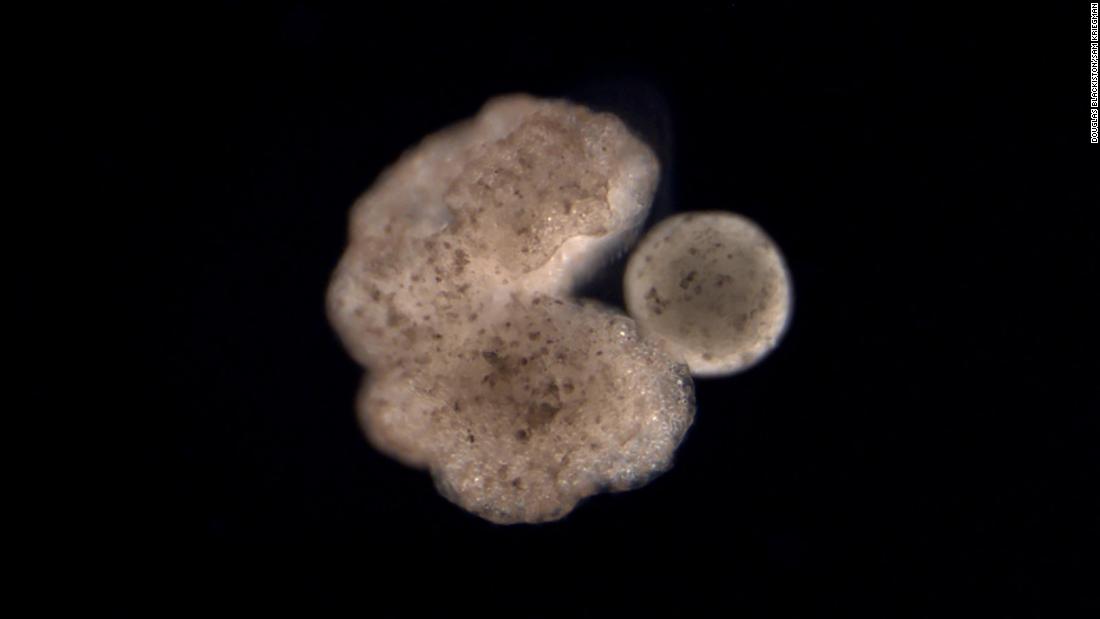
With the help of artificial intelligence, the researchers then tested billions of body shapes to make the xenobots more effective at this type of replication. The supercomputer came up with a C-shape that resembled Pac-Man, the 1980s video game. They found it was able to find tiny stem cells in a petri dish, gather hundreds of them inside its mouth, and a few days later the bundle of cells became new xenobots.

The parent rotates a large ball of stem cells that is maturing into a new xenobot.

“The AI didn’t program these machines in the way we usually think about writing code. It shaped and sculpted and came up with this Pac-Man shape,” Bongard said.

“The shape is, in essence, the program. The shape influences how the xenobots behave to amplify this incredibly surprising process.”

The xenobots are very early technology — think of a 1940s computer — and don’t yet have any practical applications. However, this combination of molecular biology and artificial intelligence could potentially be used in a host of tasks in the body and the environment, according to the researchers. This may include things like collecting microplastics in the oceans, inspecting root systems and regenerative medicine.

While the prospect of self-replicating biotechnology could spark concern, the researchers said that the living machines were entirely contained in a lab and easily extinguished, as they are biodegradable and regulated by ethics experts.

The research was partially funded by the Defense Advanced Research Projects Agency, a federal agency that oversees the development of technology for military use.

“There are many things that are possible if we take advantage of this kind of plasticity and ability of cells to solve problems,” Bongard said.

The study was published in the peer-reviewed scientific journal PNAS on Monday.

Credit: Source link

Previous Post

Fintech startup 8-fig, with U.S. headquarters in Austin, raises $50M

Next Post

Horizon Technology Finance Provides Additional $5 Million Venture Loan to Everstream Analytics

New York Tech Editorial Team

New York Tech Editorial Team

New York Tech Media is a leading news publication that aims to provide the latest tech news, fintech, AI & robotics, cybersecurity, startups & leaders, venture capital, and much more!

Next Post
Horizon Technology Finance Provides Additional $5 Million Venture Loan to Everstream Analytics

Horizon Technology Finance Provides Additional $5 Million Venture Loan to Everstream Analytics

  • Trending
  • Comments
  • Latest
Meet the Top 10 K-Pop Artists Taking Over 2024

Meet the Top 10 K-Pop Artists Taking Over 2024

March 17, 2024
Panther for AWS allows security teams to monitor their AWS infrastructure in real-time

Many businesses lack a formal ransomware plan

March 29, 2022
Zach Mulcahey, 25 | Cover Story | Style Weekly

Zach Mulcahey, 25 | Cover Story | Style Weekly

March 29, 2022
How To Pitch The Investor: Ronen Menipaz, Founder of M51

How To Pitch The Investor: Ronen Menipaz, Founder of M51

March 29, 2022
10 Raunchy Movies on Netflix You Won’t Regret Watching

10 Raunchy Movies on Netflix You Won’t Regret Watching

May 20, 2024
Japanese Space Industry Startup “Synspective” Raises US $100 Million in Funding

Japanese Space Industry Startup “Synspective” Raises US $100 Million in Funding

March 29, 2022
Startups On Demand: renovai is the Netflix of Online Shopping

Startups On Demand: renovai is the Netflix of Online Shopping

2
Robot Company Offers $200K for Right to Use One Applicant’s Face and Voice ‘Forever’

Robot Company Offers $200K for Right to Use One Applicant’s Face and Voice ‘Forever’

1
Menashe Shani Accessibility High Tech on the low

Revolutionizing Accessibility: The Story of Purple Lens

1

Netgear announces a $1,500 Wi-Fi 6E mesh router

0
These apps let you customize Windows 11 to bring the taskbar back to life

These apps let you customize Windows 11 to bring the taskbar back to life

0
This bipedal robot uses propeller arms to slackline and skateboard

This bipedal robot uses propeller arms to slackline and skateboard

0
Automat-it Vanta partnership

Automat-it And Vanta Partner To Transform Compliance Into A Growth Engine For AWS Startups

March 5, 2026
PointFive DeepWaste

DeepWaste AI Expands Cost Optimization to GPU Waste, Misconfigurations, and Provisioning Leakage

March 5, 2026
Reclaim Security team

Reclaim Security Raises $26M to Close the Remediation Gap With AI-Driven Automation

March 4, 2026
woman in green top posing beside a mirror wall

Inside the AI Shift: How Dolica Gopisetty Helps Enterprises Turn Hype into Real Transformation

February 25, 2026
New CISO Whisperer report highlights shift toward identity, integrity, and automation oversight

New CISO Whisperer report highlights shift toward identity, integrity, and automation oversight

February 23, 2026
AIUP and AINT*: FINQ Launches the First ETFs Fully Managed by Artificial Intelligence

AIUP and AINT*: FINQ Launches the First ETFs Fully Managed by Artificial Intelligence

February 11, 2026

Recommended

Automat-it Vanta partnership

Automat-it And Vanta Partner To Transform Compliance Into A Growth Engine For AWS Startups

March 5, 2026
PointFive DeepWaste

DeepWaste AI Expands Cost Optimization to GPU Waste, Misconfigurations, and Provisioning Leakage

March 5, 2026
Reclaim Security team

Reclaim Security Raises $26M to Close the Remediation Gap With AI-Driven Automation

March 4, 2026
woman in green top posing beside a mirror wall

Inside the AI Shift: How Dolica Gopisetty Helps Enterprises Turn Hype into Real Transformation

February 25, 2026

Categories

  • AI & Robotics
  • Benzinga
  • Cybersecurity
  • FinTech
  • New York Tech
  • News
  • Startups & Leaders
  • Venture Capital

Tags

AI AI QSRs Allseated AWS B2B marketing Business CISO CISO Whisperer coding Collaborations Companies To Watch cryptocurrency Cybersecurity Entrepreneur Fetcherr Finance FINQ Fintech hi-tech Hi Auto Investing Investors investorsummit Israel israelitech Leaders LinkedIn Leaders Metaverse Mindset Minnesota omri hurwitz OurCrowd PointFive PR QSR Real Estate start- up startupnation Startups Startups On Demand startuptech Tech Tech leaders Unlimited Robotics VC
  • Contact Us
  • Privacy Policy
  • Terms and conditions

© 2024 All Rights Reserved - New York Tech Media

No Result
View All Result
  • News
  • FinTech
  • AI & Robotics
  • Cybersecurity
  • Startups & Leaders
  • Venture Capital

© 2024 All Rights Reserved - New York Tech Media