A Houston startup has developed a revolutionary COVID-19 test that can measure immunity levels and determine whether or when people need a new vaccine or booster to protect themselves from the disease.
The instant test could be on the market soon, if the Food and Drug Administration grants the new device fast-track approval. Knowing personal immunity levels could become increasingly important in the face of new variants, like omicron.
Instant tests to measure COVID-19 immunity and figure out who needs a booster could be on the market soon, if the Food and Drug Administration fast-tracks approval for a Houston startup’s new device.
Knowing personal immunity levels could become increasingly important in the face of new variants, like omicron, when people need to decide whether or when they need a new vaccine or booster shot.
The affordable, first-of-its-kind fingerstick blood test is offered by Brevitest, a company developed at Fannin Innovation Studios, a life sciences incubator in River Oaks. Researchers invented a new method for measuring antibodies, using cloud computing to process results and delivering them in 15 minutes to determine if an immune system needs a boost.
Doctors, companies and public health officials can use the tests to determine the COVID immunity levels for individuals, workforces or entire communities so they can employ more targeted strategies for slowing the disease. Since the technology is protected by patents, Brevitest can license the unique device and potentially become one of the most significant startups to emerge from Houston’s life sciences community in a decade.
Leo Linbeck III, the CEO and co-founder of Brevitest, said his company’s technology builds on recent research that has determined how many antibodies per unit of blood people need to fight off or minimize a coronavirus infection. The new test lets people know where they stand, whether from a vaccination or natural immunity to determine if they need a booster or difference vaccine
Brevitest can adapt the test to detect antibodies for any variant, including omicron. Once approved, the company could begin deploying the device across the country within a few months to carry out millions of tests a week.
The Centers for Disease Control and Prevention — worried about vaccines wearing off — recently authorized COVID-19 booster shots six months after vaccination, prioritizing those over 65 years old. But individual needs vary widely and some people lose antibodies quicker than others.
“Everyone’s biology is different, and the data seems to indicate that it could be anywhere from three months to 12 months when you see the antibody level begin to wane,” Linbeck told me. “That’s particularly problematic for older people who tend to have less of an immune response or those who are immunosuppressed or immunocompromised.”
Fast tests to detect SARS-CoV-2 antibodies have been on the market since early in the pandemic, but they only offer positive or negative results and don’t measure anitbodies.
Doctors who have patients with weak immune systems have relied on a precise blood test called an enzyme-linked immunosorbent assay, or ELISA, that are currently done at central laboratories. But those results can take several days to return.
“We’re trying to build a point-of-care ELISA because the way we look at it, either you can have accuracy that will take time or you can have speed, and then you lose accuracy,” explained Dr. Dev Chatterjee, a co-founder and co-inventor. “The question we asked ourselves is, is there a way we can marry the two?”
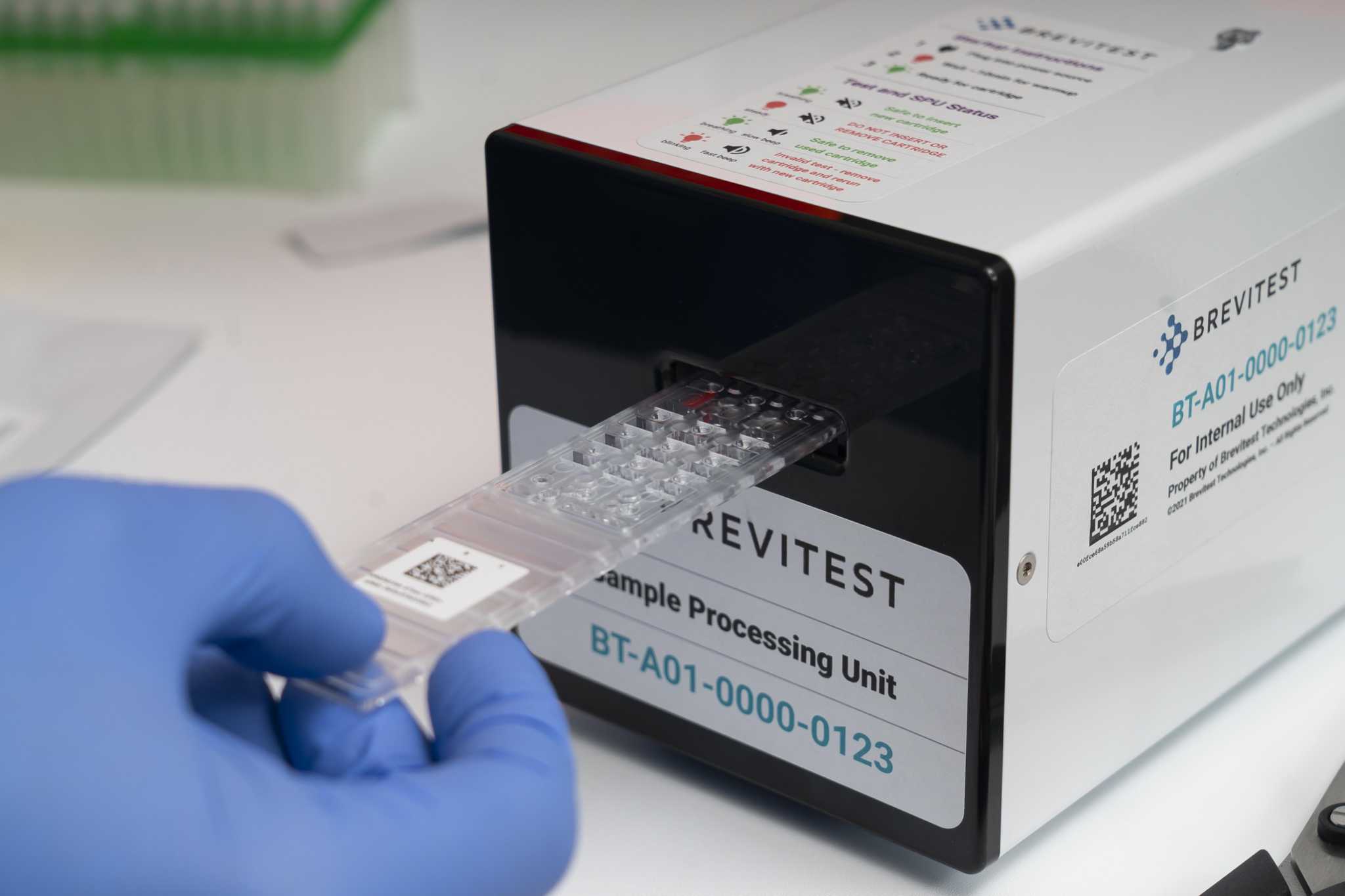
The Brevitest device allows a technician to place a small blood sample on a custom-designed cartridge, which is inserted into a shoebox-sized device that produces digital diagnostic data, the same as the precision test.
The device sends the data to the cloud, where it is processed using proprietary software Linbeck wrote. Patients receive an alert and can access the results with their phones, which also allows them to compare their result with the latest COVID immunity data.
The new company can make a profit at the same $43 reimbursement rate insurance companies pay for a central lab test, Linbeck said. Brevitest is offering tests at its lab in Houston.
Until recently, researchers were unsure how many antibodies someone needed to fend off the virus. But that changed in September when the journal Nature Medicine published a new study that used the World Health Organization standard to measure antibody levels and showed a correlation between antibody levels and infection rates.
Healthy people can use the test to determine if they need a booster or should wait a few months to take full advantage of their vaccine or illness-induced antibodies.
“There’s some evidence that if you wait longer and you let your antibody count drop, when you get that vaccine (booster), you get a bigger bump. You get more antibody production than you would if you had taken it while you still have active antibody response,” he added.
Linbeck, Chatterjee and co-inventor Dr. Atul Varadhachary founded Brevitest in 2013 to create an office-based blood testing system that would generate precision blood test results quicker. The National Institutes of Health provided a grant during the test’s early development, and the Centers for Disease Control asked Brevitest to develop an Ebola test during the 2014 outbreak.
Chatterjee and Varadhachary said the scientific challenge was far more formidable than expected. Designing a new cartridge that prepared the blood for scanning in a new way took years. Linbeck, an engineer, worked on reliability and durability to meet exacting medical standards.
“Once you actually get down to developing for the real world versus creating something for the lab, there is a whole ocean of problems that you have to solve,” Chatterjee explained.
When the COVID-19 pandemic began, the company refocused on measuring SARS-CoV-2 antibodies.
Brevitest is one of four life science start-ups spun out of Fannin Innovation Studio, Linbeck’s biotechnology development company. He is best known as the executive chairman of the Linbeck Group, a construction company founded by his grandfather that built many of the structures at the Texas Medical Center.
Linbeck and Varadhachary started Fannin to commercialize discoveries made at TMC. But Brevitest was Fannin’s homegrown effort to address the lengthy delay in returning accurate blood test results, a goal of many companies.
The most famous attempt to develop a rapid diagostic device is Theranos, a Silicon Valley-based company that promised a full blood workup from a tiny vial using a handheld device. Linbeck, Chatterjee and Varadhachary say Theranos’s claims never made any sense to them, and the company’s founder, Elizabeth Holmes, is in federal court this week fighting federal fraud charges.
In contrast to Theranos, Brevitest only claims to conduct one test per fingerstick and will release its testing data for outside review, Chatterjee said.
Brevitest will never replace the broad tests best done by a central lab, for things like annual physicals, because they require a large amount of blood and the big machines are more efficient, Linbeck said. But the team foresees doctors and clinics using Brevitest to routinely monitor patients with compromised immune systems or to track specific biomarkers for cancer and other infectious diseases.
Most breakthrough research in health care and medical devices never makes it out of the lab because investors lack the patience required to bring a product to market. Fannin was one of the first places I visited when I became a business columnist seven years ago to learn about their unique business plan.
I was fascinated by their strategy of licensing bio-medical discoveries and gathering researchers under the studio’s umbrella to keep administrative overhead low until they had a commercial product. Linbeck said the investor community needs to have more conversations about the best way to finance life science startups.
“There’s a lot of misconceptions about the way that this stuff works,” he said. “Having been down in the weeds, I have a greater level of humility and respect around just how difficult this is. The human body doesn’t like to be tinkered with, which is great news for us from an evolutionary standpoint, but it’s not so great from a medical innovation development standpoint.”
From an investor perspective, Linbeck said the most significant challenge was finding the right people to manage the transition from the research lab to a for-profit company. Fannin recruits and trains people with medical and life science skills who are interested in entrepreneurship.
“This is about making a big pile of money because that’s also what will sustain us over the long haul,” Linbeck said. “That means that we get involved early, and it takes longer, but when the payoff happens, I think it’ll be really-big multiples.”
Energy projects and technology investments can pay off big, too, and take less time. But Linbeck said he doesn’t mind the wait to build a business that saves lives.
“Anything really important and high impact takes a decade,” he said. “It just does.”
Tomlinson writes commentary about business, economics and politics.
twitter.com/cltomlinson
chris.tomlinson@chron.com
Credit: Source link