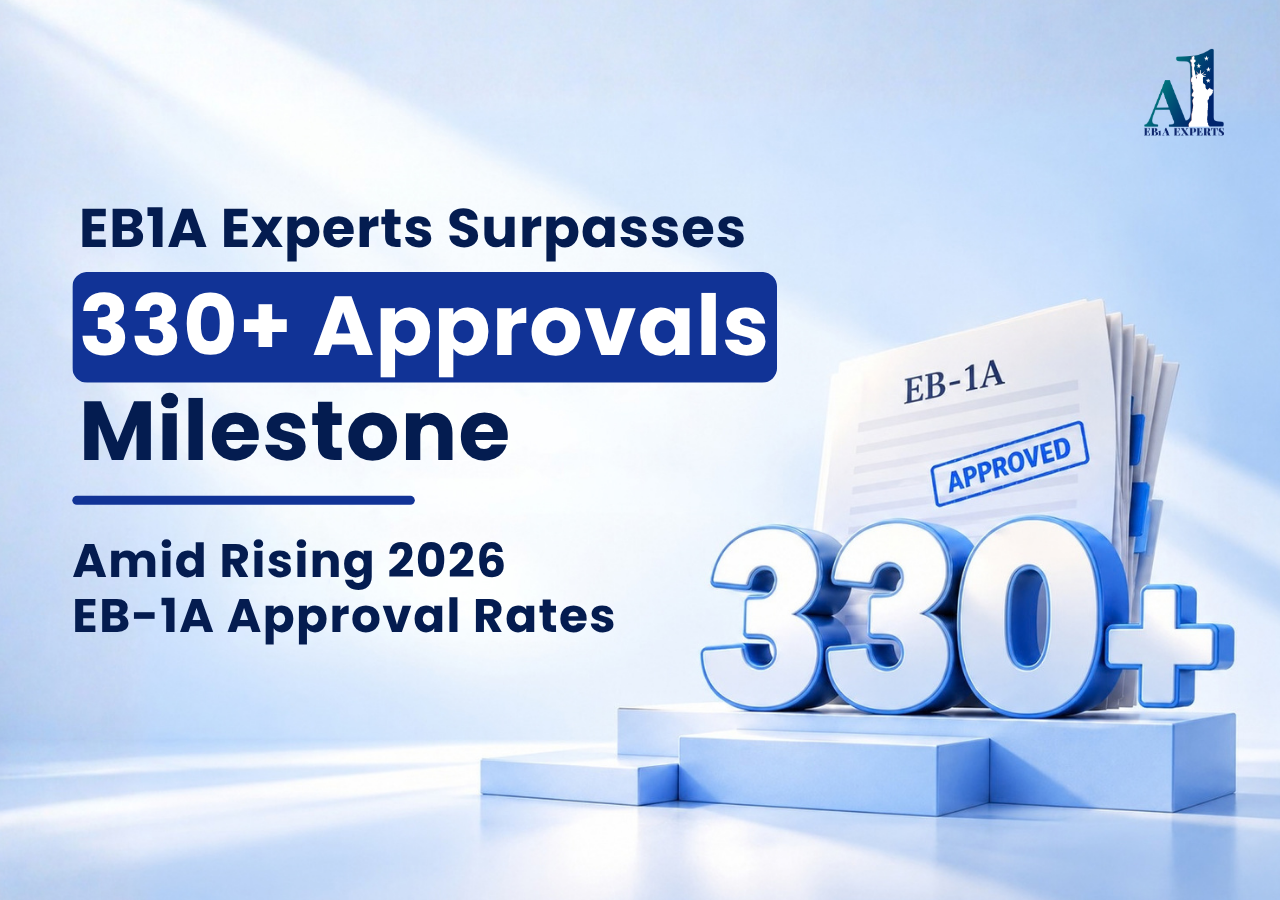
The EB1A Experts 300 approvals mark announced in May 2026 has been passed. The strategy firm based in San Francisco has recorded a total of over 330 approvals in the categories of EB-1A, EB-2 NIW, and O-1A since it made the announcement on September 17th, which marks an update of the number of approvals it recorded after the wire release on that day. It is noteworthy that this EB1A Experts update comes at a time that USCIS approved petitions for extraordinary ability at its lowest rate ever.
What Milestone Was Reached?
At present, EB1A Experts has achieved a total of more than 330 approvals on three merit-based visas, namely EB-1A extraordinary ability green card, EB-2 National Interest Waiver, and O-1A temporary work visa. According to EB1A Experts, it has reached 300 approvals by the month of May 2026, thus, it has around 30 approvals within four months’ time. This information has been provided by EB1A Experts as of September 2026.
Beyond 300+ Green Card Approvals: What the Count Includes
Discussions of the previous benchmark typically referred to it as 300+ green cards and the language does not emphasize a difference that is worth noting. The EB-1A and EB-2 NIW are immigrant visa petitions that result in permanent residence status. An O-1A is a temporary work visa used by many individuals as a stepping stone on their way to filing an EB-1A or EB-2 NIW.
The approved applications are those from the domains of artificial intelligence and machine learning engineering, cybersecurity, data science, fintech, cloud computing, research, product management, and entrepreneurship. Most of these applicants are Indian engineers, who have come here due to employment backlogs and not hiring preferences, as per the company. The July 2026 Visa Bulletin listed that EB-2 India was unavailable, whereas the EB-1 India final action date remained at October 15, 2022.
“Behind every successful case is a story of meaningful impact. Helping professionals articulate that impact clearly is what transforms strong achievements into compelling narratives.”
Raghu Reddy Suram, Founder and CEO, EB1A Experts
How Does This Compare to Industry Trends?
This is happening against the backdrop of an increasingly tight regulatory regime. The third quarter of 2026 saw USCIS issue 1,348 grants and 2,832 denials, giving rise to a grant percentage of 32.2 and denial percentage of 67.8. It is the fourth consecutive quarter of decline.
| Period | EB-1A approval rate (USCIS) |
| FY2023 (full year) | ~70.5% |
| FY2024 (full year) | ~60.7% |
| FY2025 (full year) | ~66.9% |
| Q1 FY2026 | ~47.5% |
| Q2 FY2026 | ~41.7% |
| Q3 FY2026 | ~32.2% |
Source: USCIS Immigration and Citizenship Statistics, I-140 Quarterly Series. The rate is approvals divided by total (approvals plus denials) for the time period shown. Quarterly numbers apply to petitions decided during that quarter, not petitions filed. Numbers should be checked against the latest USCIS release prior to republication.
Another perspective emerges through case tracking on private platforms, which must not be confused with the above. One such platform registered a regular-processing rate of 43 percent in February 2026, which was up from a minimum of 31 percent reached in September 2025, while for premium processing the rate was 89 percent. The February sample comprised 293 cases, self-reported, which represents a tiny and highly selective portion of a category USCIS makes decisions on in the thousands quarterly.
The rise in the tracker rates and the fall in the official rates are not inconsistent but rather are so due to different scope. February 2026 belongs to Q2 FY2026 period, when the two rates—tracker’s 43 percent and official 41.7 percent—differe less than two points. Looking at the entire year, the trend in the official rates is downward, while the gap in premium processing rates can be attributed to who files in this way, not to any change in the standards of 8 C.F.R. § 204.5(h).
The RFEs have been kept pace. It is seen that in 40 to 50 percent of EB-1A self-petitions, there are RFEs. This February tracker showed 49 percent RFEs. It is to be noted that an RFE is a call for more evidence and not a preliminary refusal. Even after giving answers, many petitions are accepted.
The other important figure is the one about the backlog of petitions. As of June 2026, USCIS had a backlog of 28,874 petitions, which is the highest ever, while 6,036 new petitions of EB-1A were received during that quarter.
What Does It Reflect About the Approach?
EB1A Experts identifies itself as a strategy firm as opposed to a law firm with all statutory filing and representation performed by licensed immigration attorneys in the United States through its legal associations. EB1A Experts identifies the focus of its efforts in evidence organization, profile building, and story-telling, which are the components that will influence the decision at the second level of evaluation. According to the two-stage analysis framework set out in Kazarian v. USCIS, 596 F.3d 1115 (9th Cir. 2010), the officer counts the criteria and evaluates the record as a whole.
EB1A Experts Case Results and the Final Merits Test
It is in the second stage when denials usually occur. A petition may fulfill three out of the ten criteria but will fail in the final merits assessment because of lack of evidence of sustained recognition. According to the firm, its usual defense is the corroboration of claims regarding original contributions as being adapted by another party apart from the petitioners’ own organization, and regarding leading roles as having organizational significance.
EB1A Experts states an approval rate of 80 to 85 percent for EB-1A petitions and 100 percent approval rate for O-1A petitions among their clientele. These statistics are internal metrics referring to a self-selecting clientele that has undergone a readiness review before filing a petition, and are not directly comparable to the USCIS national rates. Also, EB1A Experts states that they answer Requests for Evidence within 15 days of receipt.
The methodology is based on the founder’s personal experience. Raghu Reddy Suram spent over 1,800 hours crafting his EB-1A petition for himself, recognizing the discrepancy between how technical professionals characterize their work and how the USCIS interprets this characterization to create his company which addresses this gap. The organization uses a proprietary tool for evidence mapping called Turing AI, along with a self-service portal LevelUp where a free assessment of one’s profile according to the ten regulatory factors can be received.
“Extraordinary professionals often underestimate the value of their own work. Our role is to help them clearly articulate that impact in a way that resonates with USCIS and reflects the true significance of their contributions.”
Raghu Reddy Suram, Founder and CEO, EB1A Experts
What’s Next?
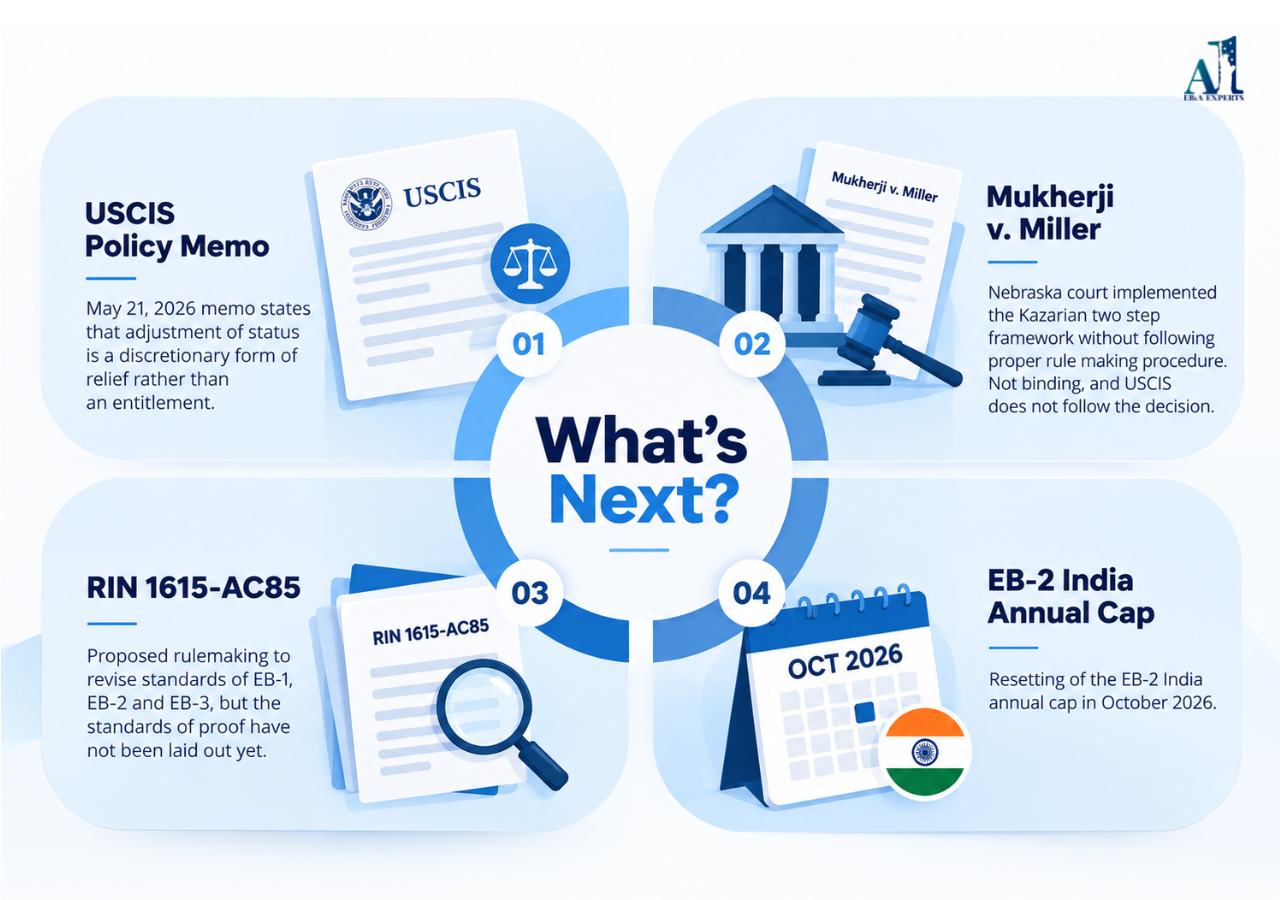
There are three pending issues which will affect the next two quarters, none of which are clear. The first of these is a policy memo that has been issued by USCIS on May 21, 2026 that states that adjustment of status is a discretionary form of relief rather than an entitlement, something that is contrary to INA 245 as per immigration lawyers and advocacy groups.
The second issue relates to the court decision in Mukherji v. Miller in Nebraska in which the Kazarian two step framework was implemented without following proper rule making procedure; this however is not binding in nature and USCIS does not follow the decision. Lastly, USCIS has highlighted another rule making procedure in the form of RIN 1615-AC85 which seeks to revise the standards of EB-1, EB-2 and EB-3; however, the standards of proof have not been laid out yet. There will be resetting of the EB-2 India annual cap in October 2026.
EB1A Experts Company News: Partnerships and Expansion
According to the company, the next stage will revolve around collaborations, not staffing. Some of these categories have been identified as those dealing with immigration laws, global mobility companies, start-up accelerators, educational institutions, research organizations, technology consulting firms, and professional organizations. The goal here is to reach the professionals early, before the gathering of evidence takes place.
“Immigration today is connected to career mobility, talent retention, innovation, and global competitiveness. Professionals need guidance that helps them understand not only the legal pathway but also the strategy behind presenting their work effectively.”
Raghu Reddy Suram, Founder and CEO, EB1A Experts
FAQs
What milestone did EB1A Experts just cross?
According to EB1A Experts, there have been over 330 wins in the EB-1A, EB-2 NIW, and O-1A classifications after September 2026, which has seen a rise from 300 plus in May 2026. The EB-1A and EB-2 NIW classifications lead to permanent residency whereas O-1A is temporary.
How does this compare to industry-wide approval trends?
This recent milestone has been achieved despite the overall declining trend in the percentage of EB-1A approvals by USCIS. According to USCIS, there have been four successive quarterly declines in EB-1A approvals, from 66.9 percent in FY2025 to 32.2 percent in Q3 FY2026, where they approved 1,348 and denied 2,832 EB-1A petitions. EB-1B/1C are still above
What does this reflect about the firm’s approach?
According to the firm, their success is due to its use of evidence strategy that has been developed prior to filing and not in reaction to an RFE. The firm claims that it concentrates on the second part of the Kazarian two-step approach which involves making a decision based on the sustained reputation.
What’s next for the firm?
For EB1A Experts, their future planning is set out through partnerships with expansion into immigration law firms, universities, accelerators, and global mobility providers. Currently, EB1A experts are eyeing the following events:
– May 2026 Adjustment of Status Memorandum
– Mukherji v. Miller case
– RIN 1615-AC85 Rulemaking
– October 2026 EB-2 India reset
Book a consultation with them for better insights.
About EB1A Experts
EB1A Experts LLC is an immigration profile strategy company that helps talented individuals with their employment-based immigration processes such as EB-1A, EB-2 NIW, and O-1A. EB1A Experts LLC was established by Raghu Reddy Suram, an EB-1A green card holder. It offers services such as profile development, evidence organization, and narrative strategy among others. When need be, the company collaborates with licensed immigration lawyers to offer legal advice. The company is located at 548 Market St., San Francisco, California, USA.
Media Contact
EB1A Experts LLC
548 Market St.,
San Francisco, CA
+1 (513) 450-4166
eb1aexperts.com
Legal Notice
The information included in this press release has been offered for general informational purposes only and should not be taken as legal advice. The approval rates as mentioned in terms of company figures are based on EB1A Experts’ record-keeping and not on any published or verified statistics by U.S. Citizenship and Immigration Services.