

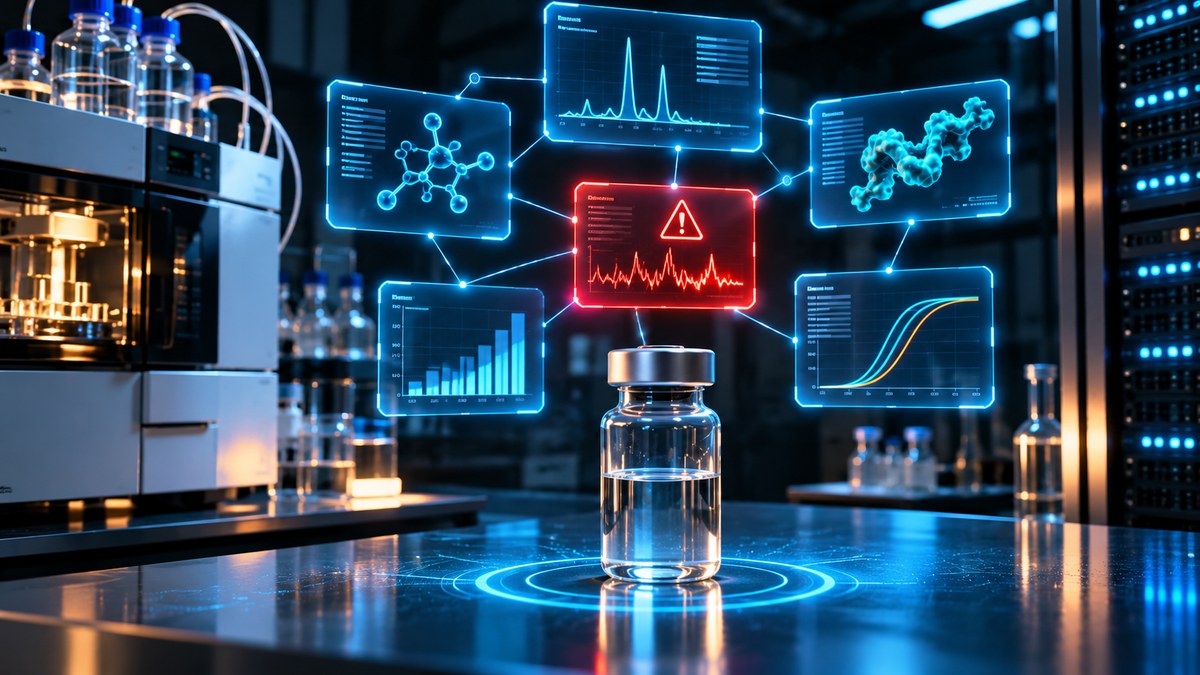
A researcher opens a laboratory database to investigate an unexpected peptide measurement. The experiment was completed six months earlier, and the original scientist has since moved to another project. The final report contains a polished graph, a numerical result, and a brief explanation of the findings. Unfortunately, none of those records explains why several original observations were excluded from the analysis.
In a laboratory relying primarily on handwritten notebooks and disconnected spreadsheets, reconstructing that decision could require days of investigation. In a properly managed digital research environment, the original observations, subsequent modifications, and reasons for analytical decisions may be available through connected electronic records.
This difference illustrates an important development in scientific technology. Digital laboratory infrastructure is changing how researchers investigate discrepancies, preserve experimental evidence, and evaluate the reliability of scientific conclusions.
For peptide research, where molecular identity, analytical methods, and experimental conditions influence the interpretation of results, these technological capabilities can make scientific errors easier to recognize before they become accepted conclusions.
From Static Laboratory Notebooks to Connected Scientific Records
Traditional laboratory notebooks remain useful tools for documenting observations. Their limitations become more apparent, however, when research involves multiple instruments, large datasets, collaborative teams, and analytical procedures that evolve over time.
A handwritten entry may describe an experiment without containing the original instrument output. A spreadsheet may summarize measurements without preserving the settings used to generate them. A separate document might explain an analytical decision without clearly identifying which version of the dataset it describes.
Electronic laboratory notebooks and laboratory information management systems address parts of this fragmentation by connecting research activities with associated digital records.
Although these technologies perform different functions, their combined use can help laboratories associate experimental observations with sample identifiers, analytical files, research personnel, and relevant documentation.
For scientists investigating peptides, this connection provides an opportunity to examine the complete history of an observation rather than relying exclusively on its final presentation.
The effectiveness of such systems depends on their configuration and use. Simply replacing paper notebooks with electronic documents does not guarantee better research records.
Why Peptide Research Generates Complex Information
Peptides are chains of amino acids whose molecular characteristics can vary considerably. Researchers may investigate their chemical identity, structural properties, interactions with biological systems, or behavior under defined laboratory conditions.
Each investigation can generate multiple forms of evidence. Analytical measurements might be accompanied by instrument files, reference material documentation, computational outputs, experimental observations, and statistical analyses.
Interpreting these records requires an understanding of the scientific question behind each measurement. A molecular identification result, for instance, cannot independently establish every other characteristic of a research material.
Educational websites such as Peptides Reno provide a starting point for readers interested in understanding the terminology surrounding peptide research. Technical conclusions, however, require examination of the original scientific evidence and its associated limitations.
Digital research systems help organize these different categories of information without requiring researchers to reduce complex investigations to a single numerical result.
When an unexpected observation emerges, scientists can examine the relevant records individually and determine which aspects of the investigation require additional scrutiny.
Audit Trails Reveal Changes That Final Reports Cannot Show
One important capability of appropriately configured electronic laboratory software is the preservation of changes made to research records.
An audit trail can document activities such as the creation, modification, or deletion of electronic information. Depending on the system and its configuration, it may also preserve information about the individual responsible for a change and when that change occurred.
These records become particularly valuable when a laboratory investigates differences between original observations and reported findings.
In December 2018, the United States Food and Drug Administration published guidance addressing data integrity in pharmaceutical current good manufacturing practice environments. The guidance emphasizes reliable and accurate data alongside strategies for preventing and detecting integrity problems.
Although pharmaceutical manufacturing requirements should not automatically be applied to every exploratory research setting, the underlying distinction remains useful. A final analytical report does not necessarily contain enough information to reconstruct the decisions that produced it.
Preserving relevant changes allows qualified researchers to examine whether modifications were justified, accidental, or indicative of a broader problem with the research process.
An audit trail cannot determine the scientific validity of a decision by itself. It supplies evidence that supports informed investigation.
The Problem With Spreadsheets That Lose Their History
Spreadsheets are widely accessible and flexible, making them practical tools for organizing laboratory measurements. Their familiarity can also conceal important weaknesses when they become the primary repository for complex research evidence.
A researcher might accidentally overwrite a value, modify a calculation, or rearrange a portion of a dataset without recognizing that the change affects subsequent analyses.
Another team member may create a separate copy of the spreadsheet, introduce different modifications, and circulate results that no longer correspond to the original version.
Version history and controlled access can help reduce these problems, but they must be implemented consistently. Laboratories also need to establish which files represent authoritative records and how subsequent analyses relate to those records.
Consider a hypothetical research team comparing observations across several peptide-related experiments. If one spreadsheet expresses a measurement using a different unit from the others, an automated calculation could produce a misleading comparison without generating an obvious software error.
Connected research records make it easier to trace such discrepancies back to their original sources, provided that the necessary contextual information has been retained.
Metadata Gives Scientific Measurements Their Meaning
A numerical observation becomes more useful when researchers understand its origin and context. Metadata supplies information that helps describe research records, including their creation, organization, and relationship to other scientific evidence.
In a laboratory environment, relevant metadata might identify the analytical method associated with a result, the software version used for processing, or the particular research record from which an observation originated.
Without adequate metadata, scientists may encounter datasets containing impressive quantities of information that cannot be interpreted confidently.
This challenge is especially relevant when reviewing metabolic research resources, where findings involving different molecules and experimental models can appear superficially similar despite addressing substantially different scientific questions.
Evidence obtained from an experimental model should not automatically be treated as evidence of human clinical effectiveness. Digital records can help preserve the distinctions between research settings, but their interpretation still requires appropriate scientific expertise.
Metadata also helps computational systems identify relationships between records. Consistent descriptions make it easier to search historical observations, associate related analytical files, and identify datasets suitable for further examination.
FAIR Data Principles and the Long-Term Value of Research
In March 2016, a multidisciplinary group of researchers published the FAIR Guiding Principles for Scientific Data Management and Stewardship in the journal Scientific Data.
The principles describe four objectives for scientific information: findability, accessibility, interoperability, and reusability. They address challenges encountered by both human researchers and computational systems attempting to discover and use scientific records.
For laboratory technology developers, these objectives provide a useful framework for considering how research information should be organized beyond its immediate use.
A dataset that cannot be located after an experiment has ended offers limited value to future investigators. Similarly, records stored in inaccessible formats may become difficult to examine when original software is replaced or technical infrastructure changes.
Interoperability concerns the ability of information to work across appropriate systems and environments. Reusability requires sufficient context for another investigator to determine whether the information is suitable for a different research purpose.
These considerations encourage laboratories to treat their digital research records as long-term scientific assets rather than temporary byproducts of experimental activities.
Artificial Intelligence Cannot Repair Missing Scientific Context
Artificial intelligence introduces additional possibilities for examining research records. Computational tools can assist with searching large collections of documents, identifying unusual patterns, and organizing information that would otherwise require extensive manual review.
However, the reliability of these applications remains closely connected to the information available to them.
A system examining incomplete laboratory records may identify an apparent relationship without recognizing that essential contextual information is missing. It may also generate a convincing explanation for a discrepancy without possessing sufficient evidence to establish its cause.
For this reason, laboratories should distinguish computational assistance from independent scientific verification.
An AI-generated interpretation can help researchers formulate questions. It cannot replace original analytical evidence, appropriately designed investigations, or qualified evaluation of conflicting results.
Organizations can also benefit from distinguishing their educational objectives from claims about laboratory performance. Background pages, including Peptides Reno’s educational approach, may help readers understand an organization’s stated purpose, but they cannot independently establish the validity of particular scientific findings.
The same distinction applies to automated research summaries, regardless of how professionally those summaries are presented.
Digital Records Help Laboratories Investigate Unexpected Findings
Unexpected observations are a normal feature of scientific research. Some indicate previously unrecognized biological or chemical behavior, while others arise from technical errors, inconsistent analytical conditions, or problems with data processing.
Distinguishing these possibilities requires access to the evidence surrounding the observation.
Digital systems can help researchers examine related records chronologically and compare the conditions associated with different experimental results. This may reveal changes in analytical software, inconsistencies in recorded identifiers, or differences between the original measurements and processed outputs.
Such investigations can also uncover weaknesses in how a laboratory organizes its information. Repeated difficulties locating original records may indicate that documentation practices require improvement.
Importantly, identifying a technical inconsistency does not automatically invalidate an entire research project. It identifies an issue that qualified scientists must evaluate according to its relationship with the reported findings.
Preserving the evidence behind that evaluation allows other researchers to understand how the final scientific interpretation was reached.
Scientific Software Requires Its Own Quality Controls
Laboratory software introduces technological dependencies that must be considered alongside its benefits.
Access permissions may be configured incorrectly. Automated transfers between instruments and databases may omit relevant information. Software updates can change how records are displayed or processed. Data exports may preserve numerical values while losing important relationships between different research records.
These possibilities explain why laboratories cannot assume that electronic information is inherently more reliable than paper-based documentation.
Appropriate oversight includes evaluating how systems preserve records, controlling authorized access, maintaining suitable backups, and ensuring that important research information remains retrievable.
Researchers also need sufficient training to understand the limitations of the software they use. A technically advanced platform offers limited protection when users misunderstand its functions or maintain undocumented alternative processes outside the system.
The objective is to build an information environment in which scientific decisions can be examined using evidence that remains complete, understandable, and appropriately protected.
The Laboratory of Tomorrow Will Be Judged by Its Evidence
Scientific technology is frequently discussed in terms of instrument sensitivity, computational power, and automation. These developments can expand the kinds of questions researchers are able to investigate.
Yet the usefulness of those capabilities ultimately depends on whether the resulting evidence can be understood and evaluated.
Digital laboratory records give research organizations additional ways to preserve observations, investigate discrepancies, and maintain continuity between scientific projects. Their value increases when laboratories combine technological capabilities with sound research practices and qualified interpretation.
For peptide research and other molecular sciences, the most useful digital infrastructure is not necessarily the system producing the largest volume of data. It is the system that allows researchers to establish where their evidence came from, how it changed, and what conclusions it can reasonably support.
As laboratories become increasingly dependent on connected instruments and computational analysis, preserving those relationships will remain a defining responsibility of scientific information management.