

New York Tech Media
  • News
  • FinTech
  • AI & Robotics
  • Cybersecurity
  • Startups & Leaders
  • Venture Capital
No Result
View All Result
  • News
  • FinTech
  • AI & Robotics
  • Cybersecurity
  • Startups & Leaders
  • Venture Capital
No Result
View All Result
New York Tech Media
No Result
View All Result
Home AI & Robotics

Meta Developed Touch Sensitive Robot Skin Because You Know, Zuck Wants To Be Human

New York Tech Editorial Team by New York Tech Editorial Team
November 6, 2021
in AI & Robotics
0
Meta Developed Touch Sensitive Robot Skin Because You Know, Zuck Wants To Be Human
Share on FacebookShare on Twitter
touch robotic
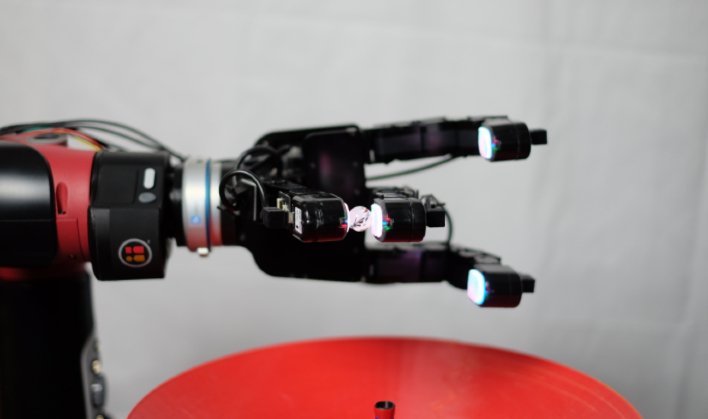
Meta has not made it a secret it intends to expand its metaverse to include new projects and products. It seems Mark Zuckerberg wants one of those new ventures to include helping robots experience and understand the world as flesh and blood humans do, through touch interaction. Or maybe Zuck pines to be human. Either way, this is some interesting research.

Facebook and its new parent company Meta have been making headlines as of late as it continues to try and recover from the backlash incurred from the leaked internal documents from a former employee. As Meta moves forward into creating Zuckerberg’s vision of the metaverse, it is looking at new ways it can advance technology and people’s minds past its most recent woes. This includes the recent removal by Meta of its Facial Recognition system on Facebook.

The latest announcement emerging from Meta is in the combined areas of artificial intelligence (AI), robotics, and tactile sensing. As robots become more of a reality in the sense of them being able to communicate and be capable of more detailed and complicated programming, Meta wants them to also be able to communicate as humans do through touch. It outlines this endeavor as having four pillars of the touch-sensing ecosystem that include developing hardware, simulators, libraries, benchmarks, and data sets. Meta believes these pillars are necessary for building AI systems that can both understand and interact through touch. 

One of the areas included within the pillars is tactile sensing. This field in robotics is researching ways that robots can both understand and replicate human-level touch within the physical world. As this technology progresses, the hope is that it can be a standalone technology as well as be integrated with audio and visual technologies. The end result should lead to safer and kinder robots, according to Meta.

This first step in furthering the advancement of tactile sensing is to develop sensors that can collect and enable the processing of said data. Meta believes that the sensor should be small enough to mimic the fingertip of a human, which it admits is too costly for most of the academic community to fund. Next, these fingertip size sensors need to be durable and able to withstand the repeated tasks that it would likely be asked to carry out. Finally they need to be sensitive enough to collect enough data about surface texture and features, contact force and other ways a fingertip discerns exactly what it is feeling.

Meta is looking to use the full open source design of DIGIT it released in 2020. This design is cheaper to manufacture and provides hundreds of thousands more contact points than other available commercial tactile sensors currently on the market according to Meta. Meta AI has partnered with GelSight to commercially manufacture DIGIT to make it more affordable to researchers. Meta AI also has agreed to collaborate with Carnegie-Mellon-University to develop ReSkin, an open source touch-sensing “skin” with a small form factor.

TACTO is another open source technology developed by Meta AI. This technology is used for high-resolution vision-based tactile sensors to provide support to Machine Learning (ML). The use cases for this would be for when hardware is not present, which creates a platform that would bypass and negate the need for real world experiments. This could save a lot of time and money for researchers as it would lessen the wear and tear on the hardware that is being used and ensure the right hardware is being used.

Oier Mees, a doctoral research assistant in autonomous intelligent systems at the Institute of Computer Science at the University of Freiberg, says, “TACTO and DIGIT have democratized access to vision-based tactile sensing by providing low-cost reference implementations which enabled me to quickly prototype multimodal robot manipulation policies.”

In an attempt to reduce deployment time and increase the reuse of code, Meta created a library of ML models and functionality called PyTouch. The goal is to eventually be able to integrate both real-world sensors and its tactile-sensing simulator along with Sim2Real capabilities. Researchers will be able to use PyTouch “as a service” and have the ability to connect their DIGIT, download a pretrained model, and use it as a building block in their own application. 

We are only at the precipice of understanding and developing AI across many areas of research. The opportunities that both AI and ML present can produce feelings of both exhilaration and fear. Meta’s advancements in these areas can produce those same feelings as we await to see where it intends to take and use it in the future. While we can joke about how Meta is simply creating technology to make Mark Zuckerberg more human, we should also keep a watchful eye filled with amazement on all the companies researching and producing these technologies. 

Credit: Source link

Previous Post

Riot swapped a live show for a massive music video at Worlds 2021

Next Post

₹120-cr VC fund: STPI to make investment in start-ups shortly

New York Tech Editorial Team

New York Tech Editorial Team

New York Tech Media is a leading news publication that aims to provide the latest tech news, fintech, AI & robotics, cybersecurity, startups & leaders, venture capital, and much more!

Next Post
₹120-cr VC fund: STPI to make investment in start-ups shortly

₹120-cr VC fund: STPI to make investment in start-ups shortly

  • Trending
  • Comments
  • Latest
Meet the Top 10 K-Pop Artists Taking Over 2024

Meet the Top 10 K-Pop Artists Taking Over 2024

March 17, 2024
Panther for AWS allows security teams to monitor their AWS infrastructure in real-time

Many businesses lack a formal ransomware plan

March 29, 2022
Zach Mulcahey, 25 | Cover Story | Style Weekly

Zach Mulcahey, 25 | Cover Story | Style Weekly

March 29, 2022
How To Pitch The Investor: Ronen Menipaz, Founder of M51

How To Pitch The Investor: Ronen Menipaz, Founder of M51

March 29, 2022
10 Raunchy Movies on Netflix You Won’t Regret Watching

10 Raunchy Movies on Netflix You Won’t Regret Watching

May 20, 2024
Japanese Space Industry Startup “Synspective” Raises US $100 Million in Funding

Japanese Space Industry Startup “Synspective” Raises US $100 Million in Funding

March 29, 2022
Startups On Demand: renovai is the Netflix of Online Shopping

Startups On Demand: renovai is the Netflix of Online Shopping

2
Robot Company Offers $200K for Right to Use One Applicant’s Face and Voice ‘Forever’

Robot Company Offers $200K for Right to Use One Applicant’s Face and Voice ‘Forever’

1
Menashe Shani Accessibility High Tech on the low

Revolutionizing Accessibility: The Story of Purple Lens

1

Netgear announces a $1,500 Wi-Fi 6E mesh router

0
These apps let you customize Windows 11 to bring the taskbar back to life

These apps let you customize Windows 11 to bring the taskbar back to life

0
This bipedal robot uses propeller arms to slackline and skateboard

This bipedal robot uses propeller arms to slackline and skateboard

0
laptop on glass table

Automat-it Cuts Deployment Friction as Monce Scales AI Order Processing on AWS

April 13, 2026
Lee's Famous Recipe Chicken

Why Lee’s Famous Recipe Chicken Is Betting on Hi Auto to Quietly Rewire the Drive-Thru

April 9, 2026
computer generated image of letters

San Francisco Tribune Lists 11 HumanX Startups Moving AI Closer to the Operating Core

April 8, 2026
Impala CEO and Highrise AI CEO

The Industrialization of AI Infrastructure: What Impala and Highrise AI Reveal About the Next Scaling Frontier

April 7, 2026
Employee Time Tracking

What is an Employee Time Tracking Solution? A Definite Guide for 2026

March 31, 2026
Voltify founders

Voltify Raises $30 Million Seed Round as It Challenges $1 Trillion Rail Electrification Model

March 31, 2026

Recommended

laptop on glass table

Automat-it Cuts Deployment Friction as Monce Scales AI Order Processing on AWS

April 13, 2026
Lee's Famous Recipe Chicken

Why Lee’s Famous Recipe Chicken Is Betting on Hi Auto to Quietly Rewire the Drive-Thru

April 9, 2026
computer generated image of letters

San Francisco Tribune Lists 11 HumanX Startups Moving AI Closer to the Operating Core

April 8, 2026
Impala CEO and Highrise AI CEO

The Industrialization of AI Infrastructure: What Impala and Highrise AI Reveal About the Next Scaling Frontier

April 7, 2026

Categories

  • AI & Robotics
  • Benzinga
  • Cybersecurity
  • FinTech
  • New York Tech
  • News
  • Startups & Leaders
  • Venture Capital

Tags

AI AI QSRs Allseated Automat-it AWS B2B marketing Business CISO CISO Whisperer Collaborations Companies To Watch cryptocurrency Cybersecurity Entrepreneur Fetcherr Finance FINQ Fintech Funding Announcement hi-tech Hi Auto Impala Investing Investors investorsummit Israel israelitech Leaders LinkedIn Leaders Metaverse Mindset Minnesota omri hurwitz PointFive PR QSR Real Estate start- up startupnation Startups Startups On Demand Tech Tech leaders Unlimited Robotics VC
  • Contact Us
  • Privacy Policy
  • Terms and conditions

© 2024 All Rights Reserved - New York Tech Media

No Result
View All Result
  • News
  • FinTech
  • AI & Robotics
  • Cybersecurity
  • Startups & Leaders
  • Venture Capital

© 2024 All Rights Reserved - New York Tech Media