

New York Tech Media
  • News
  • FinTech
  • AI & Robotics
  • Cybersecurity
  • Startups & Leaders
  • Venture Capital
No Result
View All Result
  • News
  • FinTech
  • AI & Robotics
  • Cybersecurity
  • Startups & Leaders
  • Venture Capital
No Result
View All Result
New York Tech Media
No Result
View All Result
Home Cybersecurity

300.000+ users downloaded malware droppers from Google Play

New York Tech Editorial Team by New York Tech Editorial Team
December 1, 2021
in Cybersecurity
0
300.000+ users downloaded malware droppers from Google Play
Share on FacebookShare on Twitter

Since August 2021, malware peddlers have managed to spread four families of Android banking trojans via malware droppers introduced in Google Play. They did it by employing a series of tricks to bypass the app store’s restrictions, evade automatic detection, and trick users into believing the apps they downloaded are legitimate and innocuous.

According to researchers from fraud prevention outfit ThreatFabric, the malware droppers posed as PDF scanners, QR code scanners, cryptocurrency apps, self-training, authenticator, and security apps, and were collectively downloaded over 310,000 times.

The silver lining in this situation is that not all the users who downloaded them were ultimately saddled with banking trojans: the delivery of the malware was reserved only for users in specific regions of interest and was performed manually.

droppers Google Play

Source: ThreatFabric

The tactics employed by the attackers

The different banking trojan families delivered through these campaigns are dubbed Anatsa, Alien, Hydra and Ermac. Each of them targets a multitude of banking, cryptocurrency-related, mobile payment and email apps.

The campaigns generally unfurl like this:

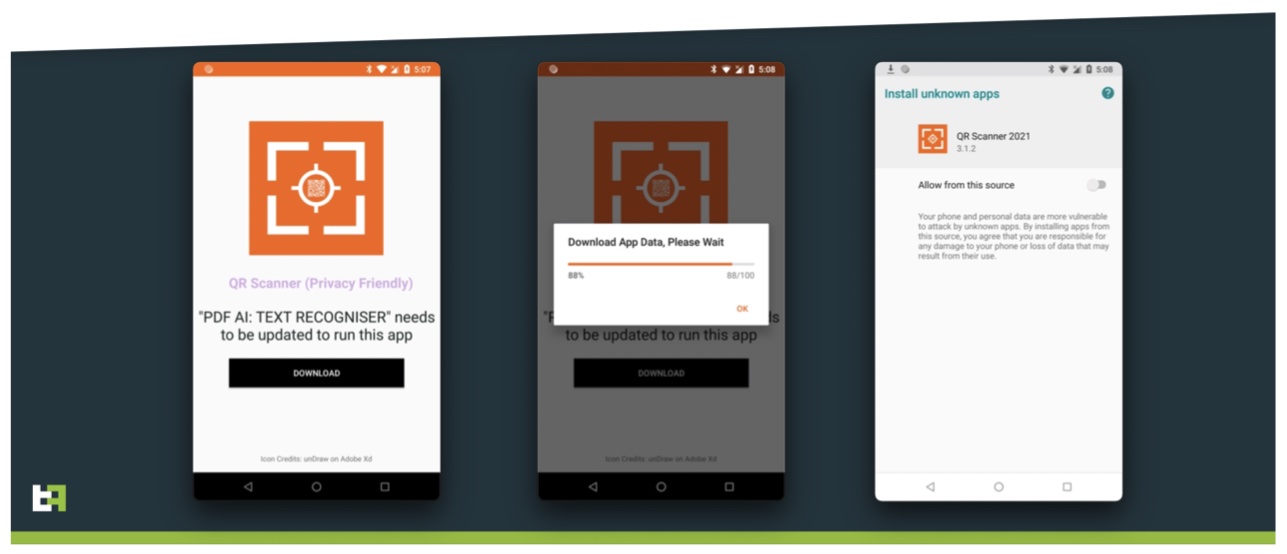
1. Malware peddlers introduce droppers into Google Play, masquerading as helpful apps that are actually working (and thus incentivize users to leave positive reviews)
2. Once these apps are installed and run for the first time, they send device information (device ID, device name, locale, country, Android SDK version) to a command and control (C2) server
3. Depending on that information, some users are asked to update the app so they can continue using it
4. If they agree and brush aside warnings that downloading content from a source that isn’t Google Play is a dangerous proposition, the banking trojan (still masquerading as the initial app) is installed on the device and asks for a wider set of permissions, which will allow it to steal credentials by capturing everything shown on the user’s screen and logging keystrokes, and the attackers to access the device remotely.
droppers Google Play

Source: ThreatFabric

The crooks behind these campaigns have figured out a number of tricks that prevent the droppers from getting immediately detected/blocked by Google Play and AV solutions, and the malicious payloads from landing into security researchers’s hands.

They have:

  • Significantly reduced the malicious footprint of dropper apps (they don’t ask for specific suspicious permissions, e.g. Accessibility Service privileges
  • The C2 backend matches the theme of the dropper app (e.g., a working fitness-themed website for a workout-focused app)
  • The configuration file delivered by the C2 to the dropper contains filter rules based on device model. “[The] actors have set restrictions, with mechanisms to ensure that the payload is installed only on the victim’s device and not on testing environments. To achieve this, criminals use a multitude of techniques, which range from location checks to incremental malicious updates, passing by time-based de-obfuscation and server-side emulation checks,” the researchers noted.

Potential victims are tricked into downloading the initial droppers because the usual advice for vetting apps – checking out user comments, avoiding apps with a small number of downloads, checking out the app website – doesn’t work here.

“Actors behind it took care of making their apps look legitimate and useful. There are large numbers of positive reviews for the apps. The number of installations and presence of reviews may convince Android users to install the app,” they concluded.

Android users who suspect they might have been infected through these campaigns should review the IoCs (the dropper apps’ names and packages names) and see whether they have one of these packages installed on their smartphones.

Credit: Source link

Previous Post

Fortnite’s new ‘Party Worlds’ put the focus firmly on socializing

Next Post

Slush 2021 live blog: all the latest updates from the Helsinki startup event

New York Tech Editorial Team

New York Tech Editorial Team

New York Tech Media is a leading news publication that aims to provide the latest tech news, fintech, AI & robotics, cybersecurity, startups & leaders, venture capital, and much more!

Next Post
Slush 2021 live blog: all the latest updates from the Helsinki startup event

Slush 2021 live blog: all the latest updates from the Helsinki startup event

  • Trending
  • Comments
  • Latest
Meet the Top 10 K-Pop Artists Taking Over 2024

Meet the Top 10 K-Pop Artists Taking Over 2024

March 17, 2024
Panther for AWS allows security teams to monitor their AWS infrastructure in real-time

Many businesses lack a formal ransomware plan

March 29, 2022
Zach Mulcahey, 25 | Cover Story | Style Weekly

Zach Mulcahey, 25 | Cover Story | Style Weekly

March 29, 2022
10 Raunchy Movies on Netflix You Won’t Regret Watching

10 Raunchy Movies on Netflix You Won’t Regret Watching

May 20, 2024
How To Pitch The Investor: Ronen Menipaz, Founder of M51

How To Pitch The Investor: Ronen Menipaz, Founder of M51

March 29, 2022
Japanese Space Industry Startup “Synspective” Raises US $100 Million in Funding

Japanese Space Industry Startup “Synspective” Raises US $100 Million in Funding

March 29, 2022
Startups On Demand: renovai is the Netflix of Online Shopping

Startups On Demand: renovai is the Netflix of Online Shopping

2
Robot Company Offers $200K for Right to Use One Applicant’s Face and Voice ‘Forever’

Robot Company Offers $200K for Right to Use One Applicant’s Face and Voice ‘Forever’

1
Menashe Shani Accessibility High Tech on the low

Revolutionizing Accessibility: The Story of Purple Lens

1

Netgear announces a $1,500 Wi-Fi 6E mesh router

0
These apps let you customize Windows 11 to bring the taskbar back to life

These apps let you customize Windows 11 to bring the taskbar back to life

0
This bipedal robot uses propeller arms to slackline and skateboard

This bipedal robot uses propeller arms to slackline and skateboard

0
laptop on glass table

Automat-it Cuts Deployment Friction as Monce Scales AI Order Processing on AWS

April 13, 2026
Lee's Famous Recipe Chicken

Why Lee’s Famous Recipe Chicken Is Betting on Hi Auto to Quietly Rewire the Drive-Thru

April 9, 2026
computer generated image of letters

San Francisco Tribune Lists 11 HumanX Startups Moving AI Closer to the Operating Core

April 8, 2026
Impala CEO and Highrise AI CEO

The Industrialization of AI Infrastructure: What Impala and Highrise AI Reveal About the Next Scaling Frontier

April 7, 2026
Employee Time Tracking

What is an Employee Time Tracking Solution? A Definite Guide for 2026

March 31, 2026
Voltify founders

Voltify Raises $30 Million Seed Round as It Challenges $1 Trillion Rail Electrification Model

March 31, 2026

Recommended

laptop on glass table

Automat-it Cuts Deployment Friction as Monce Scales AI Order Processing on AWS

April 13, 2026
Lee's Famous Recipe Chicken

Why Lee’s Famous Recipe Chicken Is Betting on Hi Auto to Quietly Rewire the Drive-Thru

April 9, 2026
computer generated image of letters

San Francisco Tribune Lists 11 HumanX Startups Moving AI Closer to the Operating Core

April 8, 2026
Impala CEO and Highrise AI CEO

The Industrialization of AI Infrastructure: What Impala and Highrise AI Reveal About the Next Scaling Frontier

April 7, 2026

Categories

  • AI & Robotics
  • Benzinga
  • Cybersecurity
  • FinTech
  • New York Tech
  • News
  • Startups & Leaders
  • Venture Capital

Tags

AI AI QSRs Allseated Automat-it AWS B2B marketing Business CISO CISO Whisperer Collaborations Companies To Watch cryptocurrency Cybersecurity Entrepreneur Fetcherr Finance FINQ Fintech Funding Announcement hi-tech Hi Auto Impala Investing Investors investorsummit Israel israelitech Leaders LinkedIn Leaders Metaverse Mindset Minnesota omri hurwitz PointFive PR QSR Real Estate start- up startupnation Startups Startups On Demand Tech Tech leaders Unlimited Robotics VC
  • Contact Us
  • Privacy Policy
  • Terms and conditions

© 2024 All Rights Reserved - New York Tech Media

No Result
View All Result
  • News
  • FinTech
  • AI & Robotics
  • Cybersecurity
  • Startups & Leaders
  • Venture Capital

© 2024 All Rights Reserved - New York Tech Media