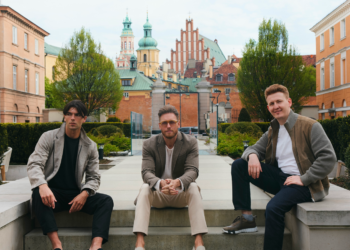



Flush from their $1.9 billion sale of Flatiron Health, Nat Turner and Zach Weinberg are now building an investment firm with part-time focus and full-time results.
Every three weeks on a Monday morning, Nat Turner flies from New York to Orange County, California to start a work “sprint.” He’s up at 4:30 AM local time the next day — jet lag is his ally — and talking to startup founders on the East Coast by 5. Before 6:30, he relocates to the offices of Santa Ana-based Collectors. By 7, he’s on the phone back to New York, attending the weekly partner meeting of his new venture capital fund, Operator Partners.
Two hours later, Turner starts his day job: CEO of Collectors, the sports collectibles authenticator he purchased for $850 million in February and took private with other investors. As recently as this spring, Turner wasn’t planning on a quick return to the corner office. The 32-year-old had just stepped down from his role leading Flatiron Health, the electronic medical record company he co-founded, after three years of running it for Roche post-acquisition. Over the summer, however, he got sucked in as his plans proved impossible to implement ad hoc. “It got to the point where they were like, this is your vision, this is your problem,” he says.
For a typical venture capital investor, a full-time gig running a 1,000-plus person company across the country from your Manhattan office would mean a quick transition to partner emeritus, or an adviser role. Not at Operator Partners, the fund Turner cofounded with his Flatiron Health collaborator Zach Weinberg and two others last year. At Operator, Turner’s double duty is normal, part of a fresh approach to investing that they claim provides a competitive edge.
Olivia Benjamin and Zach Goldstein, Under 30 list alumni for 2021, work on Operator Partners full-time. Says Benjamin: “We are most useful for the liftoff phase.”
Tanya Malott
In 2020, after years of personally investing in startups, Turner and Weinberg teamed up with two friends, former AdTech entrepreneur Amit Avner and Gil Shklarski, the ex-CTO of Flatiron, to start Operator. They each plunked down enough of their own money to invest a combined $20 million to $25 million in early-stage startups each year. So far, they have written checks to more than 100 companies, across the tech spectrum, but excluding – somewhat ironically — AdTech. They hired two rising stars of the New York venture community, Zach Goldstein and Olivia Benjamin, both Forbes Under 30 alums, to keep the trains running and grow the firm.
With no outside capital and few rules, Operator Partners is making waves as a new type of VC firm, where board seats don’t matter, and ownership stakes are flexible. In this financial fringe, billion-dollar funds are friends, not behemoth foes; multi-taskers are valued at a premium.
In
2010, Turner and Weinberg sold their first startup, an ad tech company they’d launched as college students at the University of Pennsylvania’s Wharton School called Invite Media, to Google for $81 million. Both 24 years old, they suddenly had the money — and track record — to find a welcome anywhere in New York’s small tech startup scene, a place where fledgling enterprises like Foursquare, Warby Parker and WeWork were just getting going. Turner and Weinberg began investing in friends and friends-of-friends’ businesses one $25,000 check at a time.
In 2012, Taykey founder Amit Avner sent this fateful introduction connecting Gil Shklarski to Nat Turner and Zach Weinberg; Shklarski joined Flatiron Health as CTO.
Courtesy of Amit Avner
There was little strategy. Gravitating to highly technical, unpolished young entrepreneurs, Turner and Weinberg made early bets on high-growth startups including pet toy subscription service Bark & Co, skilled labor workforce manager Workrise and Medicare provider Clover Health. (The latter’s CEO, Vivek Garipalli, invested in Flatiron and served on its board as a close adviser; he went on an expletive-filled tirade to Forbes in February and has faced an investigation by the Securities and Exchange Commission.)
In 2013, Weinberg heard from Avner, whom he’d befriended at an advertising conference, about another young entrepreneur named William Hockey, who was crashing on Avner’s couch. Hockey and his cofounder Zach Perret’s idea revolved around credit cards; they passed. But a few months later, Hockey and Perret returned to pitch software connecting other online services to someone’s bank accounts, called Plaid. This time, it took Turner and Weinberg only 30 minutes to invest at a $10 million valuation. When Plaid raised fresh funding at a valuation of $13.4 billion this past April, their holding stood at a 1,300x unrealized gain. “We’re stupid sometimes,” Weinberg jests about initially passing. “A lot of early-stage startup investing is just doing it, just being there.”
Then, they mostly stopped. The reason: the rigors of running Flatiron Health, the startup they launched themselves in 2012 as a dashboard to sit on top of electronic health records at hospitals and doctors’ offices. In 2014, they took the bold step to acquire their own medical-records company, expanding Flatiron’s employee base from 17 employees to 135. Investors including GV, BoxGroup and First Round poured in $130 million to help fuel the purchase. With so much now at stake, diverting precious hours to other people’s startups didn’t seem right — to the founders they backed, nor their own investors and employees.
When they sold Flatiron to Roche three years ago for $1.9 billion, however, Turner and Weinberg decided they were ready to jump back in — this time with more money, more cachet and, as young fathers, a better handle on how to multitask. They reconnected with Avner, an Under 30 alum from the class of 2014 for his social audience startup Taykey, which he sold in December 2017. After a few months of skiing and traveling, Avner was in negotiations with a handful of established venture capital firms about joining them as an investor — a prospect Turner and Weinberg were also considering. The three chose a different option: To join forces and play by their own rules, to be the kinds of investors they would want themselves as entrepreneurs.
Gil Shklarski brings the engineering management chops to Operator. “This is not a nine-to-five job, but we are all accepting the need to be super available,” he says.
Jov Vachon
Adding Shklarski, who knew Avner from their time together in the Israel Defense Forces, the four partners settled on a few guiding principles. They’d be investors that founders could contact at any time or hour. They’d make a constant stream of introductions to potential customers and hires they knew or met.
To bring some traditional VC firm rigor to their process, they tapped Benjamin and Goldstein, both 29, and already rising stars at Bain Capital Ventures and Union Square Ventures. Their marching orders: “bottle up the magic” of Operator’s highly successful, but unorthodox, founding partners, even as they unabashedly pursued other projects.
In an industry famous for irregular schedules, Operator pushes the envelope. Aside from a weekly team call, Operator’s partners function semi-independently, checking in over WhatsApp, Telegram and Zoom. Entrepreneurs don’t book time with Operator’s partners through executive assistants — they just text, learning first-hand what types of questions merit an instant response. Turner and Weinberg read pitches during lunch and over the weekends to keep their evening two hours of no-phone time with their young children sacrosanct. Asked his weekly routine, Weinberg demurs: “It varies wildly, which is actually the interesting part.”
O
perator Partners is playing in a frothy venture capital environment that has seen more money than ever flow into early-stage startups. Angel investors and seed-stage check-writers poured a record $11 billion into startups in the nine months through September, according to data from the PitchBook-NVCA Venture Monitor report. In the same timeframe, fund managers launched no fewer than 240 micro-funds (less than $50 million in size). Hedge funds and other non-traditional players are also getting into the early-stage game, with 857 U.S. VC deals including such investors over 2021’s first nine months, already up 27% from last year’s total.
In such a feeding frenzy, Operator Partners hopes to be like jello, always finding room. Whereas traditional venture firms — even ones led by recent entrepreneurs — have formal or informal ownership minimums, below which a startup is deemed to have too little upside to be worth the trouble, Operator’s approach is to wait, or encourage, another firm to lead a round, then take some share of what’s left. The firm can write about 40 to 50 checks per year this way, ranging from $200,000 to $1 million, without other funds crying foul.
EARLY RISERS
In just a year-plus, Operator Partners has backed a handful of billion-dollar startups at their early stages. Mark-ups are for the firm’s initial investments, estimated from PitchBook data.
“It enables them to be Switzerland,” says former Midas List investor Josh Kopelman, who backed Turner and Weinberg at their previous companies and now sends deals their way. One likely winner: Kandji, a startup helping businesses manage their employees’ iPhones and work computers that raised $100 million in November. “I can be transparent with them, and they’re transparent with me.”
Without board director responsibilities and with no ulterior motives (like angling to lead a later investment round), Operator Partners can also maintain a less formal, more peer-to-peer relationship with its portfolio CEOs. “People wouldn’t bother a board member to go into an Excel or Google spreadsheet,” says Shklarski. The partners pride themselves on their real talk feedback, whether a founder’s “doing something stupid” or needs emotional support. “I’ve had conversations with founders about how to fall asleep,” Weinberg says. “Weird stuff like that.”
That candor was compelling for April Koh, CEO of New York-based Spring Health. When she raised funding at a $2 billion valuation in September, Koh knew she wanted mega-firm Tiger Global to take the lead. But a longtime follower of Weinberg’s on Twitter, where he opines frequently on topics from hiring to Covid-19 response to politics and a fan of Flatiron Health’s impact on New York’s digital health scene, Koh, reached out to Operator Partners to join the deal.
Koh turns to Tiger for advice on the macroeconomic landscape, or data on healthcare trends. For day-to-day tactics, she’ll sooner ping someone at Operator or an angel investor. “Zach is a no-nonsense, very direct person. I run ideas by him, and if he thinks they don’t make sense, he tells me,” she says. “Honestly, it’s really refreshing.”
One area Operator partner Amit Avner isn’t interested in: adtech. “When you do something for a really long time in a specific industry, you see all the problems, and it’s really hard for you to dream.”
Jon Vachon
Such a setup is fine by the bigger firms. They know that Operator will stay in its lane. It’s from increasingly muscular angel investors that the group faces their emerging closest competition. Founders making personal investments in their peers is nothing new. But record inflows of capital mean entrepreneurs are cashing out earlier for more money, and many find it tempting to raise their own funds. Some stick to a small scale; others play with capital calls similar to a firm. Plaid’s Perret was reported this spring to be raising a personal $30 million vehicle; Qualtrics billionaire and Utah Jazz owner Ryan Smith helps put together multi-hundred-million-dollar rounds.
Turner points to Perret as an entrepreneur who infrequently — but consistently — has turned to him for advice on only the highest-impact decisions. Early on, that meant setting up Plaid’s first payroll system and hiring a head of engineering. Now it’s comparing notes on fellow investors, or hiring specific roles like a general counsel. The way Perret speaks to Turner, versus the way Perret speaks to VCs, is simply a different language, Plaid’s billionaire CEO says. “You have to have been a founder in order to give a certain style of advice,” Perret says. “There’s a level of tactical depth where you have to have done it before.”
According to Zachariah Reitano, CEO of $5 billion-valued telehealth startup Ro, discerning founders increasingly see their investors like Marvel’s Avengers: each should specialize in something or bring their own superpower. Operator Partners meet his criteria. “They interact with founders as if they were a member of your executive team,” Reitano says. “They want to win in everything they do, but they don’t have to prove that they’re good at their jobs.”
Whether they’re winning so far is hard to say just yet. After all, they have been in business for less than two years. Operator has already enjoyed several modest exits, including ecommerce software firm Weav, acquired in August by Brex for $50 million. But Operator has yet to cash out on most of its portfolio standouts, which include 50-plus companies marked up since their initial check, according to a source with knowledge. Operator’s overall portfolio is currently valued at more than 3x its capital invested, per the source. “We just focus on great companies,” shrugs Turner about the firm’s financial model for success.
A wedding setup at 74Wythe, Zach Weinberg’s event space in Brooklyn.
Eryc Perez de Tagle Photography
In the current frenzied environment, Operator’s been elbowed out of several deals and passed on others due to sky-high prices. Mostly, it’s kept business as usual, as have its fellow VCs. “You make a decision and kind of go, alright, call me in 2030 and we’ll see how this works,” Weinberg says.
Then there’s the question of what other jobs they might take. Turner lasted little more than three months as a full-time VC before becoming CEO at Collectors Universe. (He’s also still chairman of Flatiron Health.) Weinberg’s exploring several projects in biotech he says he could end up cofounding as an executive chairman or running as CEO; he also now co-owns a nightclub and event space in Brooklyn’s Williamsburg neighborhood near the waterfront. Avner is chairman of several Israeli companies, including one he recently cofounded to combat diabetes. Shklarski, who left Flatiron in May, is the only one of the four founding partners without another job — yet.
Fittingly for the CEO of a card authenticator, Nat Turner’s private sports card collection is what friends call the most impressive in America.
Courtesy of Nat Turner
The day-to-day responsibilities of firm-building to fall upon Operator’s most junior partners, Benjamin and Goldstein. They ensure internal communications on prospective deals keep flowing and set expectations with entrepreneurs on what they can and can’t expect from Operator’s high-profile founders. For their trouble, the two younger Operator investors are included in the profit sharing from the firm’s resources, which are pooled by its founders without a formal investment time horizon or fund size. “They have a long track record of taking care of the people that they work with,” Benjamin says.
Investors who know them and founders who work with them express similar confidence that Operator Partners won’t juggle too much. “I would argue that they have far more skin in the game than VCs who are leveraging other people’s capital,” says Kopelman, who notes that other firm leaders such as Thrive Capital’s Josh Kushner and Founders Fund’s Peter Thiel cofounded and worked double duty with some of their most successful investments early on. At Kandji, CEO Adam Pettit says the fact the investors are working on their own projects keeps their perspective fresh. “We have a lot of investors say, ‘we’re ex-operators,’ but they’re very close to it. They weren’t operators twenty years ago.”
Above all, Operator Partners’ cheat code might be simple: its partners simply structured it to maximize their own nerdy brands of fun. “Money has an interesting effect on people,” observes Reitano at Ro. “With them, it actually allows them to
be more of who they are.” Veteran New York investor David Tisch, another longtime collaborator, agrees: “Nat likes basketball cards, and Zach likes to start Twitter fights,” he jokes. “They’re both doing exactly what they wake up and want to do.”
MORE FROM FORBES
Credit: Source link