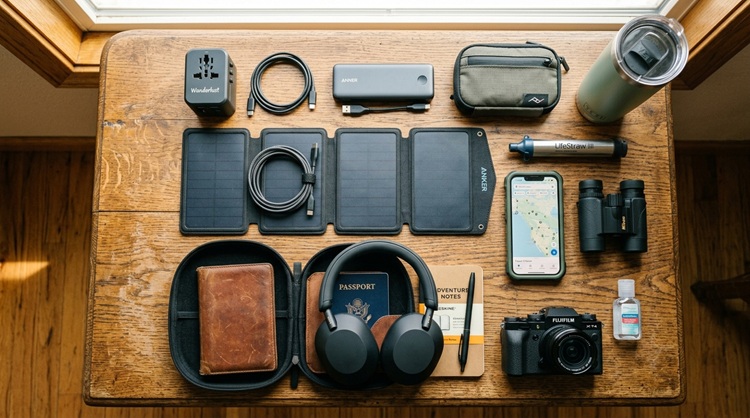
Travel gear has a habit of looking useful online and then becoming dead weight after day two. The best kit is not the flashiest. It is the stuff that solves repeated problems: flat batteries, lost cables, poor sleep, messy bags, weak Wi-Fi and uncomfortable journeys.
Before buying anything, think about your actual trip. A long-haul flight, a weekend city break and a month of remote work do not need the same bag. The right approach is to build a small travel kit around the friction points you already know you face.
The Practical Packing Rule
Every item should earn its place. Ask three questions: will I use it more than once, will it save time or stress, and is there a smaller item that does the same job? If the answer is weak, leave it at home.
A curated list of essential travel gadgets can be useful when you treat it as a filter rather than a shopping list. Pick the items that match the way you move, then ignore the rest.
Power Comes First
A reliable power setup should sit at the top of your list. Your phone is usually your ticket, wallet, map, banking tool, camera and emergency contact device. A small power bank is more useful than most bulky travel accessories because it protects all of those functions at once.
Look for enough capacity to recharge your phone at least once. You do not need a brick-sized battery unless you are camping, flying for more than a day, or working from places where sockets are hard to find. Also, check the output speed. A cheap power bank that takes hours to revive a phone can be frustrating when you only have a short stopover.
Keep Cables Under Control
Most travellers do not need more cables. They need fewer duplicates and a better way to store them. A small pouch with one charging cable, one backup, one plug and any adapters is enough for most trips. Label cables if you travel with work gear or family devices.
Universal adapters are useful, but they are not all equal. Some are too loose in the sockets. Others block nearby outlets. A compact adapter with USB-C and USB-A ports can reduce the number of plugs you carry. Check the countries you are visiting rather than assuming a single adapter covers everything.
Comfort Gear That Actually Helps
Comfort items are where bags get bloated. A neck pillow, eye mask, headphones, blanket and tablet stand may all sound useful, but you probably do not need all of them. Pick based on the longest uncomfortable part of the journey.
- For overnight flights, prioritise sleep: eye mask, ear protection and a soft layer.
- For train journeys, prioritise posture: a tablet stand or small laptop riser can help.
- For family trips, prioritise battery life and cable organisation.
- For remote work, prioritise a light mouse, backup storage and a secure connection plan.
Security And Backup Items
A Bluetooth tracker, RFID wallet or small lock will not solve every travel issue, but each can reduce hassle. The key is not to rely on gadgets instead of common sense. Keep passports, cards and cash split between safe places. Back up important documents digitally before leaving. Use device passcodes and enable tracking on your phone and laptop.
One more useful habit is to pack your tech pouch the same way every time. Keep charging items together, comfort items together, and document backups separate. When something has a fixed place, you notice its absence more quickly, especially during early departures.
Travel tech should make your trip lighter, not more complicated. If a gadget adds setup steps, needs its own charger or creates another thing to worry about, it is probably not worth the space. Build a kit around power, organisation, comfort and security, then stop there.