

New York Tech Media
  • News
  • FinTech
  • AI & Robotics
  • Cybersecurity
  • Startups & Leaders
  • Venture Capital
No Result
View All Result
  • News
  • FinTech
  • AI & Robotics
  • Cybersecurity
  • Startups & Leaders
  • Venture Capital
No Result
View All Result
New York Tech Media
No Result
View All Result
Home AI & Robotics

A robot made these colorful cave maps

New York Tech Editorial Team by New York Tech Editorial Team
February 3, 2022
in AI & Robotics
0
A robot made these colorful cave maps
Share on FacebookShare on Twitter

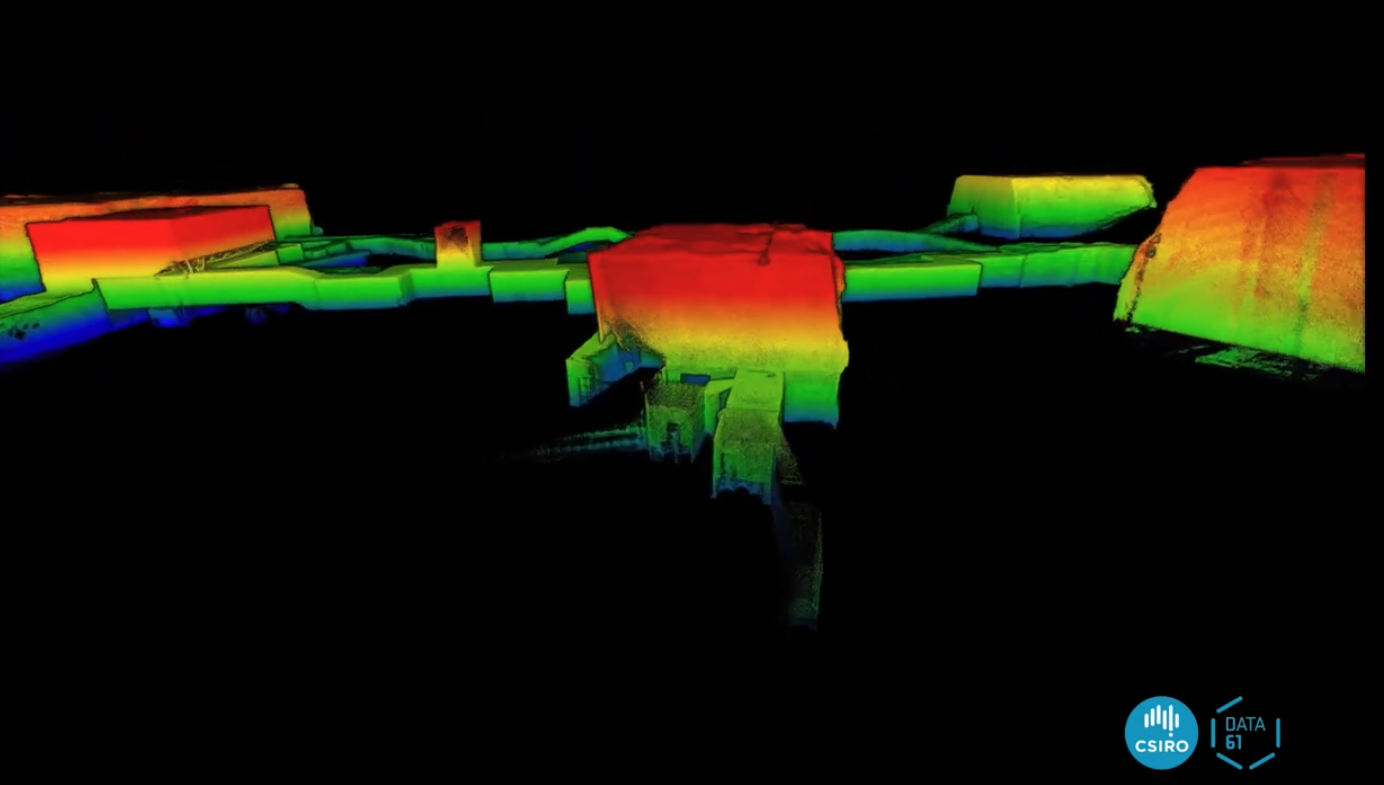
Last week, the team that took second place in a DARPA competition called the Subterranean Challenge released two videos recorded from runs last year through the Louisville Mega Cavern. These videos, recorded as part of the competition to find, identify, and map underground spaces, offer a glimpse into the world of machine-generated mapping of three-dimensional spaces.

Each video also looks like how we might imagine a world as perceived by a robot. Rooms are mapped in dots of color, with real spaces assembled the way a computer perceives space. It is the visual equivalent of running a hand along stucco—texture rendered into form.

For the Subterranean Challenge, held in late September of 2021, an international array of teams built and then used robots to explore underground obstacle courses. These courses, set in place by DARPA beforehand (the exact parameters were concealed from participants until the start of the competition), simulated the kind of rescue and military work robots may undertake in the future.

For the final challenge, robots had to navigate environments stimulating tunnels, natural caves, and built underground urban environments. As DARPA described it, the “Challenge seeks novel approaches to rapidly map, navigate, and search underground environments during time-sensitive combat operations or disaster response scenarios.”

The second-place team in the challenge, called CSIRO Data61, is part of Australia’s national science agency; the question of how robots can better explore underground spaces is a truly global one.

What that means in practice is not just robots that can explore an underground space, but robots that can render a useful map for the humans who will follow the robots into the dark.

Robots see in lasers and light, and sometimes employ other sensors like radar, too. To make this information useful to human observers, a robot must then convert the numbers from that data back into something visual, rendering a map and a model of its immediate surroundings. 

One way of converting that data to a map is Simultaneous Localization and Mapping, or SLAM. It’s a process whereby a robot creates a map, making note of where it is in relation to its surroundings. 

“Our fleet uses a common sensing, mapping and navigation system across all robots, built around our Wildcat SLAM technology,” Navinda Kottege of CSIRO told IEEE spectrum. “This is what enables coordination between robots, and provides the accuracy required to locate detected objects. This had allowed us to easily integrate different robot platforms into our fleet.”

In the SLAM fly-through, data from four different robots is stitched together into one coherent whole. Rooms, hallways, and obstacles are all revealed through a pointillist pattern of laser scans, through lidar mounted on the robots. It feels like an archeological excavation, which is a common use for lidar technology.

Using a processing technique called PaintCloud, a more realistically colored map presentation can be built on top of the existing lidar point clouds. 

In the PaintCloud version, the lidar structure of the map is coated in the browns and grays of the actual physical space. Lights stand out more clearly, while objects hauntingly merge with their surroundings. In one section, a thermal mannequin can be clearly seen propped against a wall. Wearing a bright yellow-green high visibility jacket and with a blue head, the mannequin is clearly visible in the paint. Yet because this is a paint scheme applied to a lidar model, the mannequin’s form is made of points of reflected light. It blends uncomfortably with the cavern wall, as the sharp delineation between body and surrounding is still beyond the mapping tool’s capabilities.

For humans sent after a robot, both techniques create a usable picture and guide. Even with the structural weirdness of putting color on lidar-measured distance points, a human following along could be able to use the map to identify and, hopefully, rescue a person in a high-vis jacket.

As a bonus, mapping the cave in such an uncanny way means the humans going in would see a sight less haunting than that already revealed by robot.

Watch the PaintCloud video below:


Credit: Source link

Previous Post

Biden nominee faces scrutiny over fintech work, compensation

Next Post

Cloud computing market to reach $287.03B by 2025

New York Tech Editorial Team

New York Tech Editorial Team

New York Tech Media is a leading news publication that aims to provide the latest tech news, fintech, AI & robotics, cybersecurity, startups & leaders, venture capital, and much more!

Next Post
Cloud adoption growing steadily, but cost and regulatory challenges remain

Cloud computing market to reach $287.03B by 2025

  • Trending
  • Comments
  • Latest
Meet the Top 10 K-Pop Artists Taking Over 2024

Meet the Top 10 K-Pop Artists Taking Over 2024

March 17, 2024
Panther for AWS allows security teams to monitor their AWS infrastructure in real-time

Many businesses lack a formal ransomware plan

March 29, 2022
Zach Mulcahey, 25 | Cover Story | Style Weekly

Zach Mulcahey, 25 | Cover Story | Style Weekly

March 29, 2022
10 Raunchy Movies on Netflix You Won’t Regret Watching

10 Raunchy Movies on Netflix You Won’t Regret Watching

May 20, 2024
How To Pitch The Investor: Ronen Menipaz, Founder of M51

How To Pitch The Investor: Ronen Menipaz, Founder of M51

March 29, 2022
Japanese Space Industry Startup “Synspective” Raises US $100 Million in Funding

Japanese Space Industry Startup “Synspective” Raises US $100 Million in Funding

March 29, 2022
Startups On Demand: renovai is the Netflix of Online Shopping

Startups On Demand: renovai is the Netflix of Online Shopping

2
Robot Company Offers $200K for Right to Use One Applicant’s Face and Voice ‘Forever’

Robot Company Offers $200K for Right to Use One Applicant’s Face and Voice ‘Forever’

1
Menashe Shani Accessibility High Tech on the low

Revolutionizing Accessibility: The Story of Purple Lens

1

Netgear announces a $1,500 Wi-Fi 6E mesh router

0
These apps let you customize Windows 11 to bring the taskbar back to life

These apps let you customize Windows 11 to bring the taskbar back to life

0
This bipedal robot uses propeller arms to slackline and skateboard

This bipedal robot uses propeller arms to slackline and skateboard

0
laptop on glass table

Automat-it Cuts Deployment Friction as Monce Scales AI Order Processing on AWS

April 13, 2026
Lee's Famous Recipe Chicken

Why Lee’s Famous Recipe Chicken Is Betting on Hi Auto to Quietly Rewire the Drive-Thru

April 9, 2026
computer generated image of letters

San Francisco Tribune Lists 11 HumanX Startups Moving AI Closer to the Operating Core

April 8, 2026
Impala CEO and Highrise AI CEO

The Industrialization of AI Infrastructure: What Impala and Highrise AI Reveal About the Next Scaling Frontier

April 7, 2026
Employee Time Tracking

What is an Employee Time Tracking Solution? A Definite Guide for 2026

March 31, 2026
Voltify founders

Voltify Raises $30 Million Seed Round as It Challenges $1 Trillion Rail Electrification Model

March 31, 2026

Recommended

laptop on glass table

Automat-it Cuts Deployment Friction as Monce Scales AI Order Processing on AWS

April 13, 2026
Lee's Famous Recipe Chicken

Why Lee’s Famous Recipe Chicken Is Betting on Hi Auto to Quietly Rewire the Drive-Thru

April 9, 2026
computer generated image of letters

San Francisco Tribune Lists 11 HumanX Startups Moving AI Closer to the Operating Core

April 8, 2026
Impala CEO and Highrise AI CEO

The Industrialization of AI Infrastructure: What Impala and Highrise AI Reveal About the Next Scaling Frontier

April 7, 2026

Categories

  • AI & Robotics
  • Benzinga
  • Cybersecurity
  • FinTech
  • New York Tech
  • News
  • Startups & Leaders
  • Venture Capital

Tags

AI AI QSRs Allseated Automat-it AWS B2B marketing Business CISO CISO Whisperer Collaborations Companies To Watch cryptocurrency Cybersecurity Entrepreneur Fetcherr Finance FINQ Fintech Funding Announcement hi-tech Hi Auto Impala Investing Investors investorsummit Israel israelitech Leaders LinkedIn Leaders Metaverse Mindset Minnesota omri hurwitz PointFive PR QSR Real Estate start- up startupnation Startups Startups On Demand Tech Tech leaders Unlimited Robotics VC
  • Contact Us
  • Privacy Policy
  • Terms and conditions

© 2024 All Rights Reserved - New York Tech Media

No Result
View All Result
  • News
  • FinTech
  • AI & Robotics
  • Cybersecurity
  • Startups & Leaders
  • Venture Capital

© 2024 All Rights Reserved - New York Tech Media