

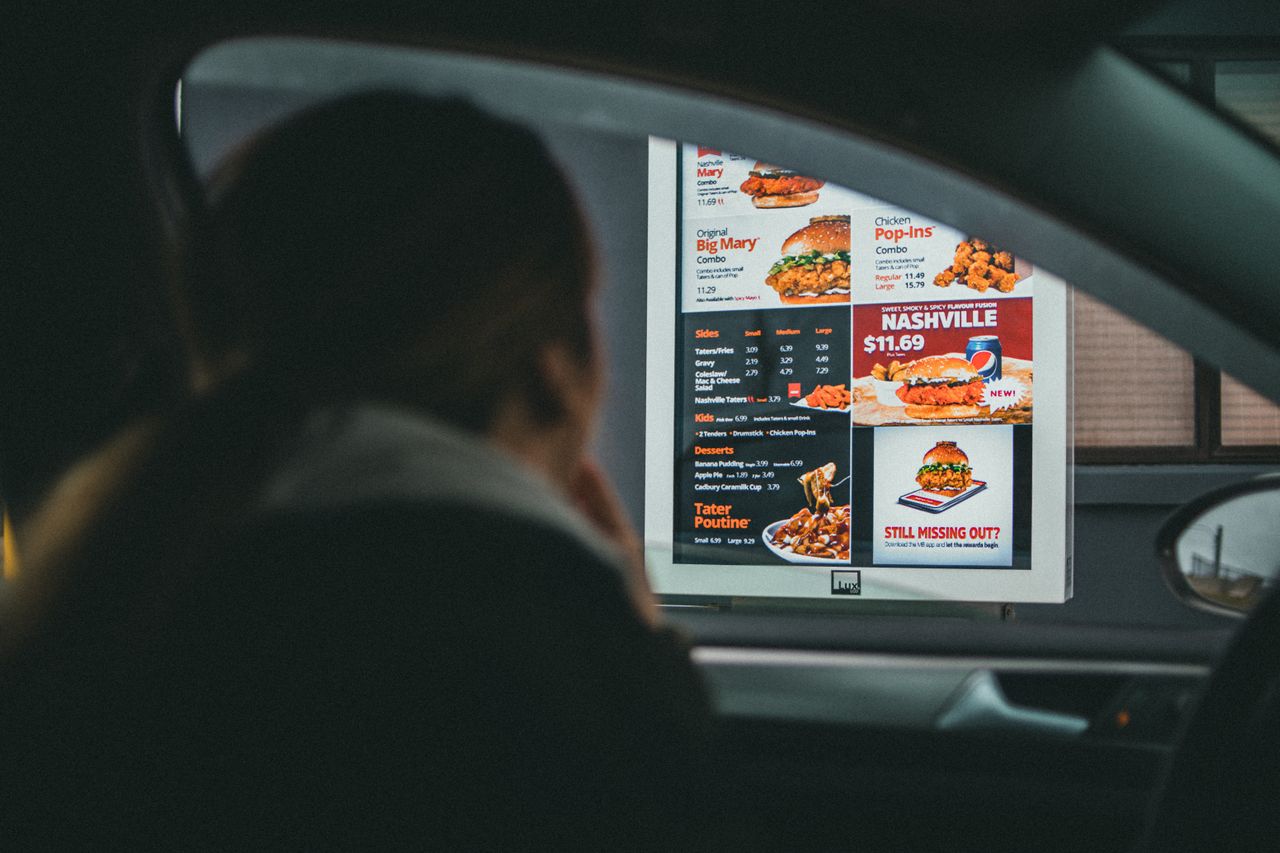
The next time a customer pulls into a drive-thru, the voice taking the order may not belong to a person. Restaurant chains are increasingly deploying AI order-takers, including systems that can switch between English and Spanish, spotlighting an overlooked problem: understanding speech is much harder when the speaker is sitting in a moving car.
McDonald’s, for example, is expanding its use of AI across restaurant operations, with its Archy drive-thru assistant now reported to be capable of taking orders in both English and Spanish. The system is reported to be about 90% accurate across those languages. For the companies building these systems, however, bilingual capability is only one part of the challenge.
The drive-thru is arguably one of the most difficult real-world environments for voice AI because almost nothing about the conversation is controlled.
A Voice AI System Has To Hear Through the Car
A customer might be speaking through an open window while another vehicle is idling a few feet away. There can be wind, rain, road traffic, music playing inside the car, children talking in the back seat or multiple passengers speaking at once. The microphone itself is usually positioned outside the vehicle, adding another layer between the customer’s voice and the AI.
That makes the drive-thru fundamentally different from a conventional customer-service call. There is no quiet room, consistent microphone, or predictable speaker.
Hi Auto, which is built specifically for drive-thru ordering, has made this environmental problem central to its technology. Its system uses AI to filter noise, recognize speech, and carry on two-way conversations while integrating with existing restaurant microphones, headsets, and point-of-sale systems.
English Isn’t Just English
Even when the signal is clear, language creates another challenge.
A voice AI system operating across the U.S., U.K., Australia and New Zealand encounters different accents, vocabulary, pronunciations and conversational habits. Someone in one market may phrase an order very differently from someone thousands of miles away, despite both speaking English.
Recent research has also highlighted that voice AI performance can vary across regional English accents, raising questions about whether systems designed around dominant speech patterns work equally well for everyone.
That localization problem is becoming more visible as restaurant chains expand AI ordering internationally. Popeyes UK, for example, has deployed Hi Auto’s AI Order Taker across its drive-thru network. The system was recognized with the Best Use of AI award at the 2026 Restaurant Marketer & Innovator Awards, with Hi Auto citing its ability to handle varied accents, background noise, and complex menu modifications.
Then Comes the “Actually, Change That” Problem
Understanding the words is only the beginning. A drive-thru order is rarely delivered as one clean sentence.
A customer might ask for a chicken sandwich, add fries, remove an ingredient, change the drink and then suddenly say, “Actually, make that two.” Another customer might ask for “no pickles” several seconds after mentioning the sandwich. Someone else might use slang, abbreviate a menu item or interrupt the system mid-response.
That requires conversational memory rather than simple speech-to-text. The AI has to understand what has already been ordered, determine what the latest statement changes and maintain the correct state of the transaction.
Taco Bell’s voice AI deployment illustrates the complexity. Its technology partner says the system is designed to handle road noise, accents, slang, humor, mid-order changes and complex customizations. Taco Bell has expanded the technology to more than 890 U.S. restaurants.
The Real Test Happens at Scale
The difference between a convincing voice-AI demo and a production system is what happens when thousands of unpredictable conversations arrive every day.
Hi Auto says its AI Order Taker now operates at roughly 1,000 stores across the U.S., U.K., Australia and New Zealand, serving more than 200 franchisees and handling more than 100 million drive-thru orders annually. The company reports 93%+ order completion and 96% accuracy across that footprint.
That scale matters because the hardest drive-thru conversation is rarely the perfectly articulated order. It is the one delivered through traffic noise, with a child talking in the background, a regional accent, three substitutions and one last-second “actually.”
For voice AI, that messy conversation is not an edge case. It is the job.