


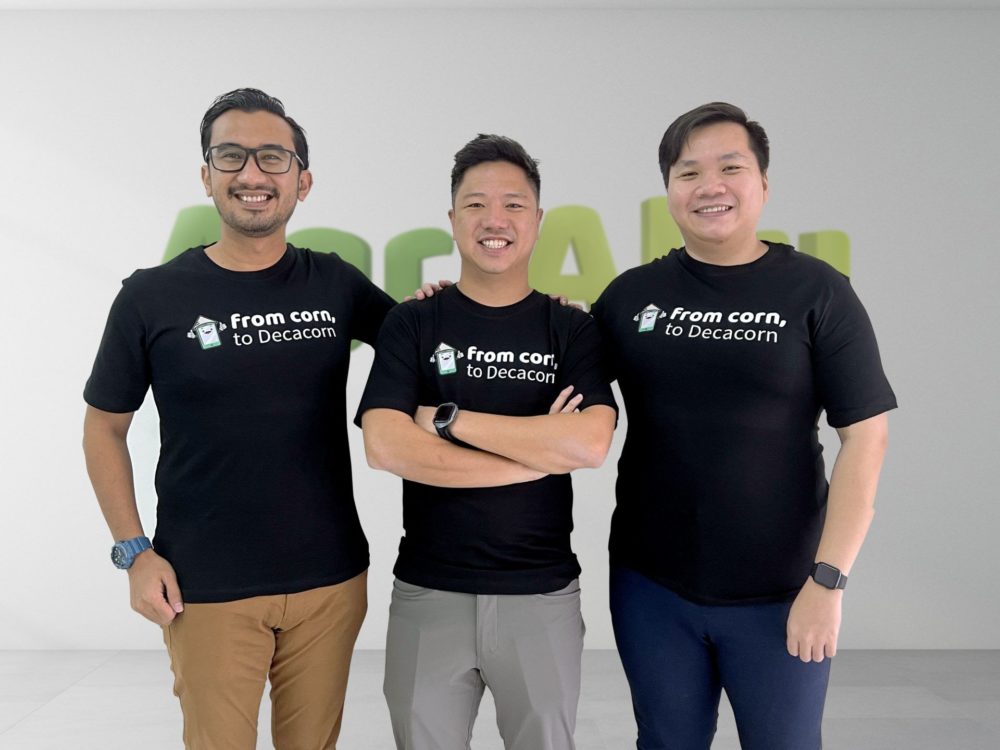
AgriAku, an online ag marketplace looking to democratize and streamline the crop input supply chain in Indonesia, has raised $6 million in pre-Series A funding. Go-Ventures, the VC arm of Gojek – the pan-Southeast Asian transportation, food delivery, and payments ‘super app’ — led the round.
Investing alongside Go-Ventures were two funds operating under the VC unit of the country’s majority state-owned telecommunications company Telkom Group — MDI Arise and MDI Centauri, as well as Mercy Corps Social Venture Fund and several unnamed business angels.
AgriAku’s online marketplace aggregates demand for fertilizer, seed, and other ag inputs from smallholder farmers via their local ag stores (toko tani, in Indonesian) and matches it with distributors and wholesalers. This gives farmers better access to a variety of products as well as better prices. It also digitizes the process.
AgriAku will use the pre-Series A funds for product and tech development, hiring, and expanding the company’s presence across Indonesia, says Kolonas.
Why an ag inputs marketplace in Indonesia?
“The idea of the marketplace is that it democratizes what it means to be a seller and a buyer,” AgriAku co-founder and president Irvan Kolonas told AFN. The aim is to get better prices for both sides of the trade by increasing the number of available products at the toko tani, widening the pool of prospective buyers and sellers, and making it easier for them to transact, he added.
While taking some of the process online, the toko tani are still a key part of the chain, which Kolonas learned after trying out a few different business models before landing on AgriAku.
“We did direct-to-farmer, even farmer retail stores; we tried a model where we bought products and sold them on to toko tanis; 1P models. And we eventually found that the best one was the pure marketplace model, the Tokopedia model, where you don’t carry any inventory,” he said. (Tokopedia is Indonesia’s leading e-commerce platform, which merged with Gojek.)
All roads led to the marketplace model because it negates competition with incumbent retailers in the supply chain, and it’s also less expensive than trying to sell direct to farmers. Instead, getting the traditional retailers on side, and using them as mitras (agents) to sell to farmers, made much more sense.
“These toko tanis are actually community leaders that have built decades’ of relationships with farmers in their areas. Trying to replicate that in a matter of months is going to be costly,” Kolonas explained. “So instead of trying to sell to millions of farmers, we’re selling to thousands of toko tanis.”
Bringing tech to the table
Timing was also key. When Kolonas first started working in the agriculture industry, technology was not a core component of his plans, and there were only a few agrifoodtech startups in Indonesia such as eFishery and 8Villages.
In 2012, he launched a social enterprise targeting the country’s small-scale corn farmers. “I didn’t have a tech angle — and that was my mistake — and I was asset heavy because I was building corn-drying facilities as close to the farmers as possible. It was a full-stack, single-commodity business, and we struggled to raise funding,” he says, adding that they focused on raising from impact funds.
But in the background, Indonesia’s agrifood tech ecosystem was developing rapidly and it was what Kolonas calls the “second wave of Indonesian agrifoodtech” in the mid-2010s that underscored the potential for e-commerce as Gojek and Tokopedia started ramping up their delivery businesses.
Kolonas says that AgriAku is part of a “third wave” in Indonesian agtech that’s bringing more specialized B2B players into the fold and offering differentiation from the incumbent, “second-wave” players like Tanihub and Sayurbox that link foodservice businesses with sellers of ag produce.
Those more mature startups, according to Kolonas, decided at an early stage to work on offtake and produce distribution — often only interacting with intermediaries and not farmers directly because the key crops grown in Indonesia, like rice, cacao, coffee, corn, and cassava, need some form of primary processing before entering the consumer market.
AgriAku is hoping to have a more direct impact on farmers by “focusing on the space that no-one has really touched on,” which is ag inputs.
“They are commodity-agnostic — whether I sell corn seeds or fruit seeds, it requires generally the same capabilities,” he says. “Inputs are the only part of the industry where we can impact farmers in a way that’s commodity-agnostic,” he said.
Strategic investors and additional services
AgriAku makes money by charging users a fee for transacting on its platform. Eventually, the startup plans to offer additional paid services to upstream stakeholders such as distributors and manufacturers.
This might include “data services [that enable] them to have better transparency over their supply chains,” Kolonas says. “Logistics and financing are going to be big anchors for us as well. So it’s not too different from any other marketplace in terms of how we monetize.”
Kolonas said he was intentional in selecting ‘strategic’ investors that could help to unlock other opportunities for the company too, such as Go-Ventures’ whose parent has a stake in Bank Jago – a licensed national bank that is integrated with Gojek’s digital payments services.
“We will create products with them that will finance our toko tanis and eventually farmers themselves,” Kolonas said.
Regarding other investors on the cap table, Kolonas said he wanted to pick a local state-owned company [MDI-Telkom] because we believe agriculture will continue to be tightly linked with the government in Indonesia,” he says. “Second, we wanted a local VC with a regional outlook. [Gojek] has a very regional way of operating. Plus, Aditya [Kamath, partner at Go-Ventures] is a good friend; he’s known me for pretty much the last decade, is very impact-focused, and cares a lot about helping farmers.”
In terms of operational synergies between AgriAku and Go-Ventures’ parent, there’s the latter’s stake in Bank Jago – a licensed national bank that is integrated with Gojek’s digital payments services.
Credit: Source link