Latitude, the startup behind text game AI Dungeon, is expanding into a new artificial intelligence-powered game platform called Voyage. The company announced the closed beta on Friday, opening a waitlist for current AI Dungeon users. It’s the next step for a company that began with a university hackathon project, but that ultimately hopes to help other people create their own games using trained AI models.
AI Dungeon, which launched as AI Dungeon 2 in 2019, is powered by OpenAI’s GPT-2 and GPT-3 text generation algorithms. To start, you generate some introductory text or write your own adventure setup. Then you can enter any command you want and a Dungeons & Dragons-style virtual game master will improvise some text describing the outcome. It’s very weird and a lot of fun, but it’s light on traditional game mechanics — more like an interactive fiction engine.
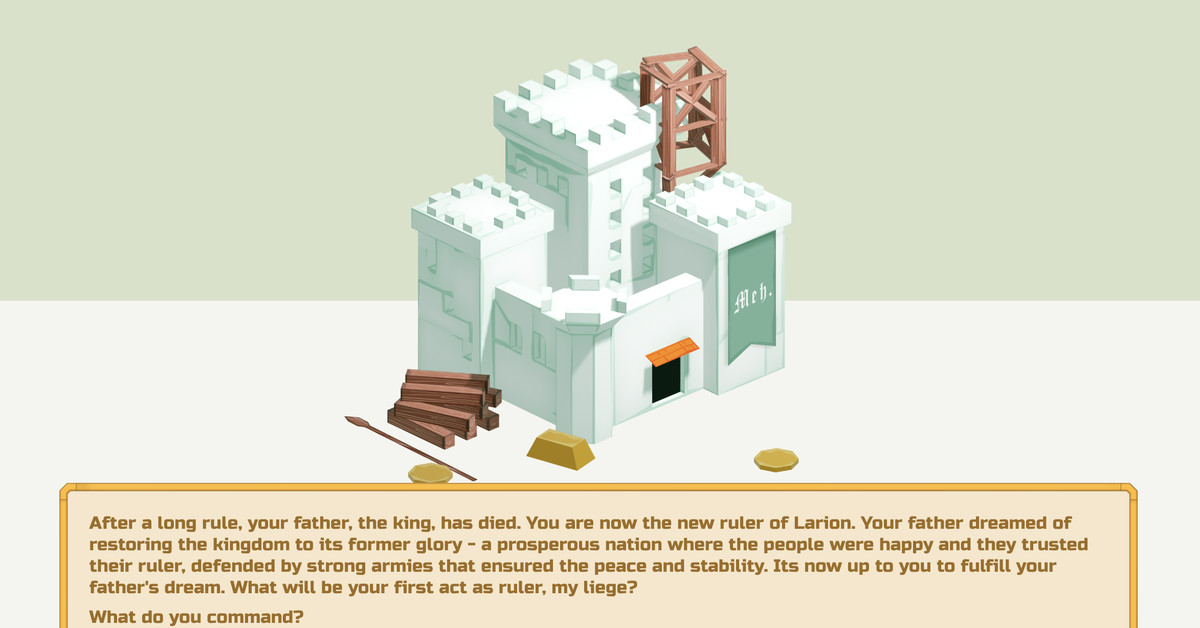
Voyage features more structured games. There’s a Reigns-inspired experiment called Medieval Problems, where you’re the ruler of a kingdom and enter freeform text commands for your advisors, then see the outcome reflected in success ratings. It’s still a lot like AI Dungeon, but with a clearer framing for what you’re supposed to do and a system for evaluating success — although after playing with the game, that system seems pretty forgiving and more than a bit random.


Pixel This, meanwhile, is a party game where one person enters a phrase, the AI generates a pixelated picture of it, and that image slowly increases in resolution until another player guesses it. It’s a bit like the art app Dream paired with a Pictionary-style mechanic.
Latitude CEO Nick Walton describes Voyage as a natural evolution for Latitude. For the company, “AI games are kind of restarting at the beginning” — with text adventures reminiscent of Zork or Colossal Cave Adventure. “Now we’re moving into 2D images where you’ve got some level of visuals in.” AI Dungeon, which is included in Voyage, recently added AI-produced pictures created with the Pixray image generator.
The eventual goal is to add game creation tools, not just games, to Voyage. “Our long-term vision is enabling creators to make things that are dynamic and alive in a way that existing experiences aren’t, and also be able to create things that would have taken studios of a hundred people in the past,” says Walton. There’s no precise roadmap, but Latitude plans to spend the first half of next year working on the system.
Creative tools could help Voyage find a long-term business plan. AI Dungeon is currently free for a set of features powered by GPT-2 and subscription-based for access to the higher-quality GPT-3 algorithm. Following the Voyage beta, Latitude plans to introduce a subscription for it as well.
But Voyage’s new games don’t yet have the versatility or replayability of AI Dungeon — they’re still clearly the products of a company trying to crack games based on machine learning. “This approach is one of the things that I think is going to be really beneficial in terms of being able to iterate and find out what experiences people enjoy,” Walton says. “With traditional games, you can kind of take existing models and create a game that you’re pretty sure people will enjoy. But this space is so different, and it’s hard to necessarily know.” The question is how much people will want to pay to be part of that process.
As Latitude’s mission expands, it will likely need to exercise caution with OpenAI’s application programming interface (API). The organization approves GPT-3 projects on an individual basis, and projects must adhere to content guidelines intended to prevent misuse. Latitude has struggled with these restrictions in the past, since AI Dungeon gives users a lot of freedom to shape their own stories — resulting in some users creating disturbing sexual scenarios that alarmed OpenAI. (It’s also dealt with security issues around user commands.) The startup spent months working on filter systems that accidentally blocked more innocuous fictional content before striking a deal where some user commands would be sent to a non-OpenAI algorithm.
Pixel This and Medieval Problems are more closed systems with fewer obvious moderation risks, but introducing creative tools risks chipping away at OpenAI’s control of GPT-3, which may pose its own set of issues. Walton says that over time, Latitude hopes to shift more of its games onto other algorithms. “We will have some more structure and systems so that it’s not just directly consuming the [OpenAI] API in the same way. And at the same time, I think most of our models will probably be ones that we host ourselves,” he says. That includes models based on emerging open source projects — which have had trouble competing with OpenAI’s work but have advanced since their early days. “I don’t think that gap will be around that long,” says Walton.
Lots of games use procedural generation that remixes developer-created building blocks to create huge quantities of content, and most video game “AI” is a comparatively simple set of instructions. A company like Latitude, by contrast, uses algorithms that are trained to produce text or images fitting a pattern from a data set. (Think of them as super-advanced autocomplete systems.) Right now that can make the resulting experiences highly unpredictable, and their absurdity is often part of their charm — outside gaming, other companies like NovelAI have also harnessed text generation for creative work.
But Latitude is still figuring out how to make systems where players can expect fair and consistent outcomes. Text generation algorithms don’t have any built-in sense of whether an action succeeds or fails, for instance, and systems for making those judgments may not agree with normal human intuition. Image generation algorithms are great for producing weird art, but in a game like Pixel This, players can’t necessarily predict how recognizable a given picture will be.
For now, Latitude’s solution is to lean into the chaos. “If you try and make something super serious with AI where people are going to expect to have a high level of coherence, it’s going to have a hard time, at least until the technology gets better,” Walton says. “But if you kind of embrace that aspect of it and kind of let it be crazier and wacky, then I think you make a fun experience and people get delighted by those surprises.”
Credit: Source link