

New York Tech Media
  • News
  • FinTech
  • AI & Robotics
  • Cybersecurity
  • Startups & Leaders
  • Venture Capital
No Result
View All Result
  • News
  • FinTech
  • AI & Robotics
  • Cybersecurity
  • Startups & Leaders
  • Venture Capital
No Result
View All Result
New York Tech Media
No Result
View All Result
Home AI & Robotics

Electric robots are mapping the seafloor, Earth’s last frontier

New York Tech Editorial Team by New York Tech Editorial Team
October 27, 2021
in AI & Robotics
0
Electric robots are mapping the seafloor, Earth’s last frontier
Share on FacebookShare on Twitter
Getting a fuller picture would enable us to navigate ships more safely, create more accurate climate models, lay down telecommunication cables, build offshore windfarms and protect marine species — all part of what’s known as the “blue economy,” projected to be worth $3 trillion by 2030.

Underwater robotic vehicles equipped with sensors are helping gather that data quicker and more cheaply than ever before. But many of these vehicles rely on batteries with a limited lifespan, and need to return to a boat or the shore to recharge, making it difficult for them to map more remote parts of the sea.

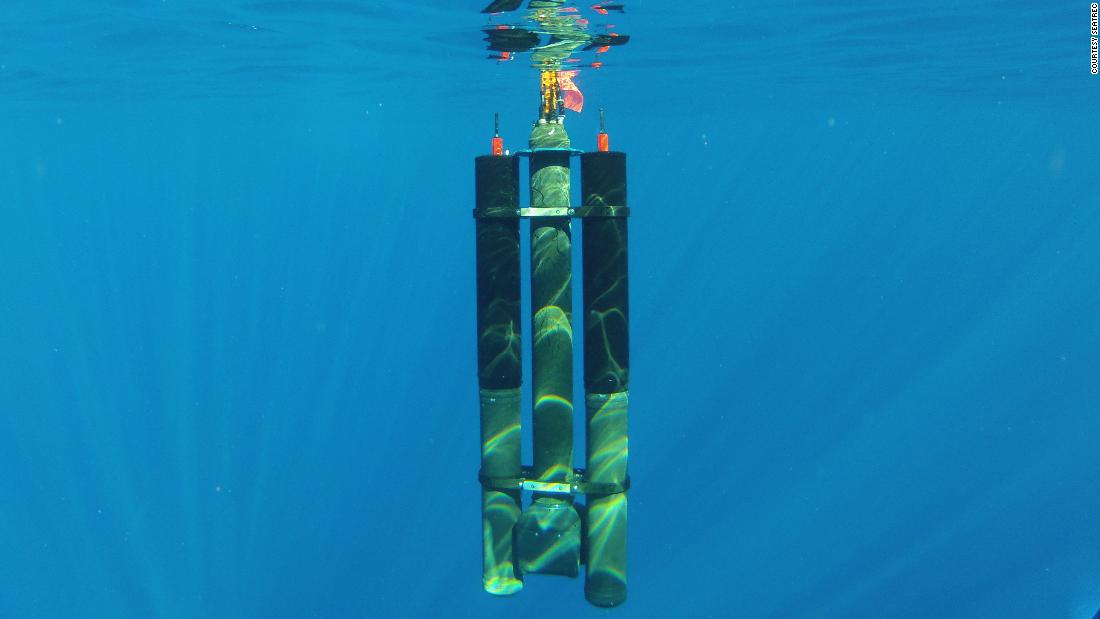
A five-year-old startup called Seatrec is rising to the challenge, founded by oceanographer Yi Chao. While working at NASA, he developed technology to power ocean robots by harnessing “the naturally occurring temperature difference” of the sea, Chao told CNN Business.

The power module can be installed on existing data-gathering robots or Seatrec’s own floating device. This dives a kilometer down to examine the chemistry and shape of the seabed, using sonar to create a map of the surrounding area. The robot returns to the surface to send back its findings via satellite.
Seatrec's float uses differences in ocean temperature to power itself.

As the float moves between colder and warmer parts of the ocean, material inside the module either melts or solidifies, causing pressure that in turn creates thermal energy and powers the robot’s generator.

“They get charged by the sea, so they can extend their lifetime almost indefinitely,” Chao said.
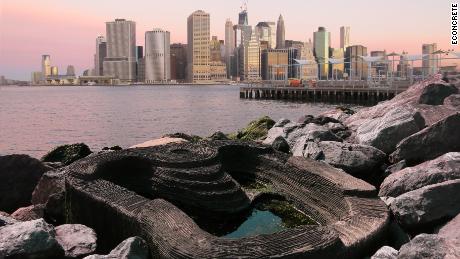
This underwater concrete attracts marine life and gets stronger at the same time

A basic float model typically costs around $20,000. Attaching Seatrec’s energy system adds another $25,000, Chao said.

But the access to free, renewable energy and the ability to stay in the water longer makes data gathering up to five times cheaper in the long run, according to Chao. He said the startup is making fewer than 100 devices per year, primarily for marine researchers, but the technology is easily scalable — Seatrec’s energy module can also be can be retrofitted onto existing mapping devices to extend their range.

Picking up the pace

New technologies that can extend the reach of data-gathering devices are crucial for mapping more remote parts of the deep sea, according Jamie McMichael-Phillips, director of the Nippon Foundation-GEBCO Seabed 2030 Project.

“One of the huge challenges we have is quite simply physics,” said McMichael-Phillips. “Unlike mapping the Earth’s surface where we can use a camera [or] satellites, at sea, light does not penetrate through the water column. So we’re pretty much limited to using sonar systems.”

How 3D printing could help save Hong Kong's coral

Launched in 2017, the Seabed 2030 Project has increased awareness about the importance of the ocean floor, and given researchers and companies a clear goal to work towards: map the entire seafloor by the end of this decade.
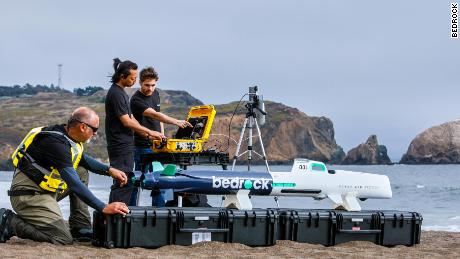
Some companies, such as XOCEAN, are surveying the ocean from the surface. Another startup, Bedrock Ocean Exploration, says it can provide surveys of seabed areas up to 10 times faster than traditional methods by using an autonomous electric submarine fitted with sonars, cameras and lasers; the data is then analyzed on Bedrock’s own cloud platform.
Bedrock Ocean Exploration uses an autonomous electric submarine fitted with sonars, cameras and lasers.

The challenge ahead

Even with the growing number of technologies accelerating seabed exploration, completing the map is still a logistical and financial challenge.

This vegan 'tech-style' startup wants to make clothes using algae
Chao estimates that it would take 3,000 of Seatrec’s floats operating over the next 10 years to fully survey the ocean. The company has raised $2 million in seed funding to scale up production of its energy harvesting system.

But this is a drop in the ocean of the capital needed to fully survey the ocean, which is estimated to be “somewhere between $3 to $5 billion,” according to McMichael-Phillips — “pretty much the same order of magnitude as the cost of sending a mission to Mars.”

Bedrock’s DiMare believes it’s time we start investing in our own planet.

“If we want to keep Earth as a place that humans can live,” he said, “we have got to get a lot smarter about what’s going on in the ocean.”

Credit: Source link

Previous Post

Google Stadia tries something new: a free 30-minute game trial

Next Post

FinTech Nium Debuts Crypto-as-a-Service Platform

New York Tech Editorial Team

New York Tech Editorial Team

New York Tech Media is a leading news publication that aims to provide the latest tech news, fintech, AI & robotics, cybersecurity, startups & leaders, venture capital, and much more!

Next Post
FinTech Nium Debuts Crypto-as-a-Service Platform

FinTech Nium Debuts Crypto-as-a-Service Platform

  • Trending
  • Comments
  • Latest
Meet the Top 10 K-Pop Artists Taking Over 2024

Meet the Top 10 K-Pop Artists Taking Over 2024

March 17, 2024
Panther for AWS allows security teams to monitor their AWS infrastructure in real-time

Many businesses lack a formal ransomware plan

March 29, 2022
Zach Mulcahey, 25 | Cover Story | Style Weekly

Zach Mulcahey, 25 | Cover Story | Style Weekly

March 29, 2022
10 Raunchy Movies on Netflix You Won’t Regret Watching

10 Raunchy Movies on Netflix You Won’t Regret Watching

May 20, 2024
How To Pitch The Investor: Ronen Menipaz, Founder of M51

How To Pitch The Investor: Ronen Menipaz, Founder of M51

March 29, 2022
Japanese Space Industry Startup “Synspective” Raises US $100 Million in Funding

Japanese Space Industry Startup “Synspective” Raises US $100 Million in Funding

March 29, 2022
Startups On Demand: renovai is the Netflix of Online Shopping

Startups On Demand: renovai is the Netflix of Online Shopping

2
Robot Company Offers $200K for Right to Use One Applicant’s Face and Voice ‘Forever’

Robot Company Offers $200K for Right to Use One Applicant’s Face and Voice ‘Forever’

1
Menashe Shani Accessibility High Tech on the low

Revolutionizing Accessibility: The Story of Purple Lens

1

Netgear announces a $1,500 Wi-Fi 6E mesh router

0
These apps let you customize Windows 11 to bring the taskbar back to life

These apps let you customize Windows 11 to bring the taskbar back to life

0
This bipedal robot uses propeller arms to slackline and skateboard

This bipedal robot uses propeller arms to slackline and skateboard

0
laptop on glass table

Automat-it Cuts Deployment Friction as Monce Scales AI Order Processing on AWS

April 13, 2026
Lee's Famous Recipe Chicken

Why Lee’s Famous Recipe Chicken Is Betting on Hi Auto to Quietly Rewire the Drive-Thru

April 9, 2026
computer generated image of letters

San Francisco Tribune Lists 11 HumanX Startups Moving AI Closer to the Operating Core

April 8, 2026
Impala CEO and Highrise AI CEO

The Industrialization of AI Infrastructure: What Impala and Highrise AI Reveal About the Next Scaling Frontier

April 7, 2026
Employee Time Tracking

What is an Employee Time Tracking Solution? A Definite Guide for 2026

March 31, 2026
Voltify founders

Voltify Raises $30 Million Seed Round as It Challenges $1 Trillion Rail Electrification Model

March 31, 2026

Recommended

laptop on glass table

Automat-it Cuts Deployment Friction as Monce Scales AI Order Processing on AWS

April 13, 2026
Lee's Famous Recipe Chicken

Why Lee’s Famous Recipe Chicken Is Betting on Hi Auto to Quietly Rewire the Drive-Thru

April 9, 2026
computer generated image of letters

San Francisco Tribune Lists 11 HumanX Startups Moving AI Closer to the Operating Core

April 8, 2026
Impala CEO and Highrise AI CEO

The Industrialization of AI Infrastructure: What Impala and Highrise AI Reveal About the Next Scaling Frontier

April 7, 2026

Categories

  • AI & Robotics
  • Benzinga
  • Cybersecurity
  • FinTech
  • New York Tech
  • News
  • Startups & Leaders
  • Venture Capital

Tags

AI AI QSRs Allseated Automat-it AWS B2B marketing Business CISO CISO Whisperer Collaborations Companies To Watch cryptocurrency Cybersecurity Entrepreneur Fetcherr Finance FINQ Fintech Funding Announcement hi-tech Hi Auto Impala Investing Investors investorsummit Israel israelitech Leaders LinkedIn Leaders Metaverse Mindset Minnesota omri hurwitz PointFive PR QSR Real Estate start- up startupnation Startups Startups On Demand Tech Tech leaders Unlimited Robotics VC
  • Contact Us
  • Privacy Policy
  • Terms and conditions

© 2024 All Rights Reserved - New York Tech Media

No Result
View All Result
  • News
  • FinTech
  • AI & Robotics
  • Cybersecurity
  • Startups & Leaders
  • Venture Capital

© 2024 All Rights Reserved - New York Tech Media