


December 20, 2021
Fintech innovation is critical for business and women in MENA
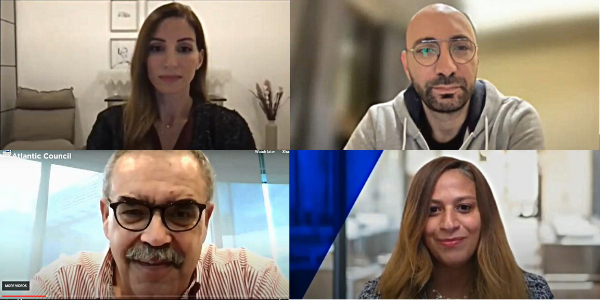
On December 14, the Atlantic Council’s empowerME Initiative held a virtual event on “MENA’s Fintech innovators: Digitizing financial services” in partnership with ABANA, the preeminent US organization for finance professionals and institutions with interest in the Middle East and North Africa. The event featured welcome remarks by Atlantic Council empowerME Director and Resident Senior Fellow Amjad Ahmad, and a conversation with tabby Co-Founder and CEO Hosam Arab, Sarwa Co-Founder and CMO Nadine Mezher, and Fawry Founder and CEO Ashraf Sabry. It was moderated by VanEck Senior Investment Analyst, Emerging Markets Equities Ola El-Shawarby.
This is the second webinar in a joint series to shed light on the changing financial technology (Fintech) landscape in the Middle East and North Africa (MENA) region, identify challenges and opportunities, and explore policy recommendations.
tabby Co-Founder and CEO Hosam Arab
- Hosam Arab emphasized his company’s strategy to be “as agnostic as possible” about where a transaction occurs, explaining that tabby’s goal is to make their product “available to everybody equally,” regardless of where purchases are conducted.
- When scaling an e-commerce startup in the MENA region in the past, Arab identified the overdependence on cash payments as a pain point that needed to be addressed. Arab described the previously slow movement away from cash dependency, emphasizing that this presented “a huge amount of obstacles for a typical e-commerce provider.”
- Arab underscored that a key component of tabby is providing financing for customers while also promoting responsible spending. Therefore, tabby customers begin with a small credit line, which can be increased with additional credits and financing based on spending and re-paying behaviors.
- Arab explained key requirements tabby looked for in bringing on new investors: regulatory relationships in each of the markets they were operating in, access to deep capital, access to debt financing, and access to merchants to leverage relationships.
- Arab sees many exciting opportunities through tabby and other new financial technology to increase the inclusion of women and other traditionally underbanked groups in the financial services sector. He highlighted tabby data that shows women currently comprising 60 percent of all tabby users and noted that women are twice as likely as men to make their payments.
- When asked about the competitive landscape in terms of other “buy now pay later” companies, Arab explained that what separates tabby’s market from those globally is the merchant and retail structure they operate under. Most of the brands tabby works with “sit under large family groups,” as opposed to individual brands that operate independently. Therefore, there is a limited number of targets they can go after.
Sarwa Co-Founder and CMO Nadine Mezher
- When describing what led to the creation of Sarwa, Nadine Mezher explained that she wanted to address the lack of affordable and accessible investing in MENA. The average consumer either used a savings account or bought real estate, Mezher explained. Unlike traditional investment or trading options that require large amounts of capital for entry, Sarwa has very minimal financial requirements for their long-term passive investment or trading products: a minimum of only one dollar is required for trading and $5 for investing.
- While discussing the role of regulators, Mezher emphasized the positive experience Sarwa has had with regulators in the United Arab Emirates and that regulators must carry out a “balancing act” of trying to protect both banks and companies as well as consumers.
- Mezher discussed the opportunities for women’s inclusion in the financial services sector, emphasizing the importance of “financial independence that can empower” and providing people—both women and men—with options. She noted that 30 percent of Sarwa users are women and that she hopes to see that percentage increase as Sarwa continues offering training and targeting women customers. She explained that the main hurdle women face is feeling like they don’t have enough information about how to invest. Despite this, Mezher pointed to Sarwa data to show how women convert faster than men once they enter the platform.
- On the topic of cryptocurrency, Mezher described a sharp rise in interest from customers about cryptocurrency and specifically Bitcoin. Although she believes that Bitcoin has potential value, Mezher noted that it is still “volatile” and “speculative as an asset.”
Fawry Founder and CEO Ashraf Sabry
- Sabry asserted that, although his company is large, their mentality is that they are still a startup, as it provides them with a “real energy into looking into new opportunities.”
- Regarding relationships with banks, Sabry described how Fawry continues to partner with banks. As he explained it, the partnership with Fawry and others in the Fintech industry helps banks to accommodate new technological changes critical for business success.
- Discussing the regulation environment, Sabry described Egypt’s regulators with positivity, emphasizing that they have been very receptive to introducing open banking and enabling instant pay networks.
- When explaining avenues in which Fawry empowers women, Sabry described their program Heya to increase opportunities for women’s financial inclusion in Egypt, noting that women tend to be more responsible with their money than men. He also expressed his optimism about the “effect of technology on the contribution of women.”
- Looking to the future, Sabry noted that Fawry is now attempting to expand the ecosystem with the hopes of understanding consumers better and offering them new financial services altogether.
Hezha Barzani is a program assistant with the Atlantic Council’s Middle East Programs.

empowerME
empowerME at the Atlantic Council’s Rafik Hariri Center for the Middle East is shaping solutions to empower entrepreneurs, women, and youth and building coalitions of public and private partnerships to drive regional economic integration, prosperity, and job creation.
Further reading
Wed, Mar 31, 2021
Family businesses in the Gulf must not be left behind
MENASource
By
Research suggests that family-owned businesses contribute about 60 percent of the gross domestic product in the GCC countries and employ more than 80 percent of its labor force.
Credit: Source link