

New York Tech Media
  • News
  • FinTech
  • AI & Robotics
  • Cybersecurity
  • Startups & Leaders
  • Venture Capital
No Result
View All Result
  • News
  • FinTech
  • AI & Robotics
  • Cybersecurity
  • Startups & Leaders
  • Venture Capital
No Result
View All Result
New York Tech Media
No Result
View All Result
Home AI & Robotics

Fully-Integrated Robotic Arm Locates and Retrieves Lost Items

New York Tech Editorial Team by New York Tech Editorial Team
October 9, 2021
in AI & Robotics
0
Fully-Integrated Robotic Arm Locates and Retrieves Lost Items
Share on FacebookShare on Twitter

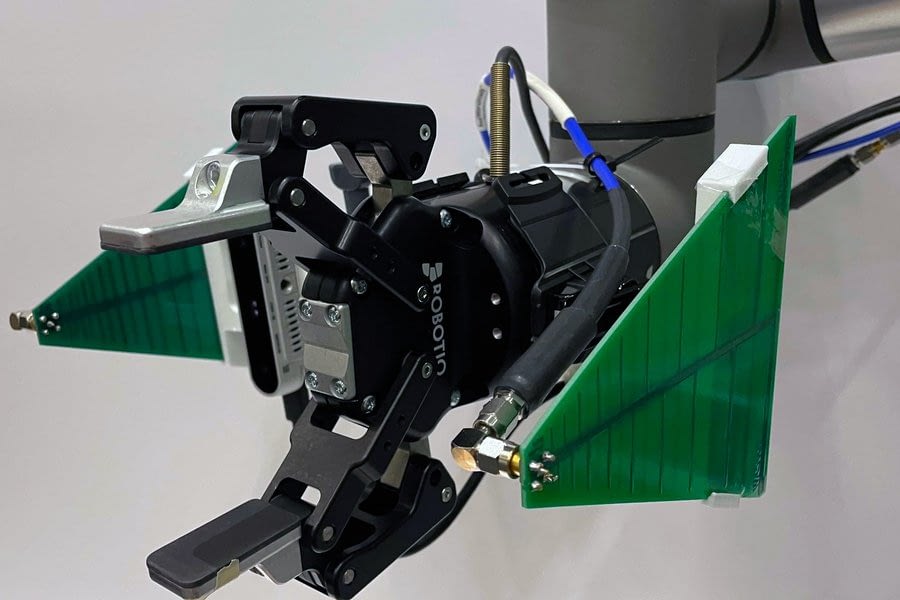
Researchers at the Massachusetts Institute of Technology have developed a fully-integrated robotic arm that fuses visual data from a camera and radio frequency (RF) information from an antenna to locate and retrieve lost objects. It can locate objects even if they are buried or out of view. 

The system is called RFusion, and the prototype relies on RFID tags, which are inexpensive, battery-less tags that reflect signals sent by an antenna. RF signals can travel through most surfaces, so RFusion can locate a tagged item even if it is buried. 

The robotic arm uses machine learning to automatically zero-in on the object’s exact location. It can then move the items on top of it, grasp the object, and verify that it is the correct object. The camera, antenna, robotic arm, and AI are fully integrated, meaning the system can operate in any environment without requiring extensive set up.

According to the researchers, RFusion could be used for applications like sorting through piles to fulfill orders in a warehouse, or to identify and install components in an auto manufacturing plant.

Fadel Adib is senior author and associate professor in the Department of Electrical Engineering and Computer Science. Adib is also director of the Signal Kinetics group in the MIT Medical Lab. 

“This idea of being able to find items in a chaotic world is an open problem that we’ve been working on for a few years. Having robots that are able to search for things under a pile is a growing need in industry today. Right now, you can think of this as a Roomba on steroids, but in the near term, this could have a lot of applications in manufacturing and warehouse environments,” said Adib. 

Other co-authors of the research include research assistant Tara Boroushaki, the lead author; electrical engineering and computer science graduate student Isaac Perper; research associate Mergen Nachin; and Alberto Rodriguez, the Class of 1957 Associate Professor in the Department of Mechanical Engineering.

The research is set to be presented at the Association for Computing Machinery Conference on Embedded Networked Sensor Systems next month. 

Training the System

The researchers used reinforcement learning to train a neural network that can optimize the robot’s trajectory to an object. 

“This is also how our brain learns. We get rewarded from our teachers, from our parents, from a computer game, etc. The same thing happens in reinforcement learning. We let the agent make mistakes or do something right and then we punish or reward the network. This is how the network learns something that is really hard for it to model,” Boroushaki explains.

The optimization algorithm in RFusion was rewarded when it limited the number of moves to localize the item and the distance traveled to pick it up. 

Testing RFusion

The researchers tested the system in several environments, including one in which a keychain was buried in a box full of clutter and a remote control hidden under a pile of items on a couch.

They took the approach of summarizing the RF measurements and limiting the visual data to the area right in front of the robot in order to not overwhelm the system. This resulted in a 96 percent success rate when retrieving objects fully hidden under a pile. 

“Sometimes, if you only rely on RF measurements, there is going to be an outlier, and if you rely only on vision, there is sometimes going to be a mistake from the camera. But if you combine them, they are going to correct each other. That is what made the system so robust,” Boroushaki says.

Matthew S. Reynolds is CoMotion Presidential Innovation Fellow and associate professor of electrical and computer engineering at the University of Washington. 

“Every year, billions of RFID tags are used to identify objects in today’s complex supply chains, including clothing and lots of other consumer goods. The RFusion approach points the way to autonomous robots that can dig through a pile of mixed items and sort them out using the data stored in the RFID tags, much more efficiently than having to inspect each item individually, especially when the items look similar to a computer vision system,” says Reynolds. “The RFusion approach is a great step forward for robotics operating in complex supply chains where identifying and ‘picking’ the right item quickly and accurately is the key to getting orders fulfilled on time and keeping demanding customers happy.”

The researchers will now look to increase the speed of the system to move it smoothly. 

Credit: Source link

Previous Post

Developing and deploying trustworthy AI in government

Next Post

Towards Automated Science Writing – Unite.AI

New York Tech Editorial Team

New York Tech Editorial Team

New York Tech Media is a leading news publication that aims to provide the latest tech news, fintech, AI & robotics, cybersecurity, startups & leaders, venture capital, and much more!

Next Post
Towards Automated Science Writing – Unite.AI

Towards Automated Science Writing - Unite.AI

  • Trending
  • Comments
  • Latest
Meet the Top 10 K-Pop Artists Taking Over 2024

Meet the Top 10 K-Pop Artists Taking Over 2024

March 17, 2024
Clubhouse will soon let you pin links to the top of rooms

Clubhouse will soon let you pin links to the top of rooms

October 23, 2021
10 Raunchy Movies on Netflix You Won’t Regret Watching

10 Raunchy Movies on Netflix You Won’t Regret Watching

May 20, 2024
Panther for AWS allows security teams to monitor their AWS infrastructure in real-time

Many businesses lack a formal ransomware plan

March 29, 2022
Zach Mulcahey, 25 | Cover Story | Style Weekly

Zach Mulcahey, 25 | Cover Story | Style Weekly

March 29, 2022
How To Pitch The Investor: Ronen Menipaz, Founder of M51

How To Pitch The Investor: Ronen Menipaz, Founder of M51

March 29, 2022
Startups On Demand: renovai is the Netflix of Online Shopping

Startups On Demand: renovai is the Netflix of Online Shopping

2
Robot Company Offers $200K for Right to Use One Applicant’s Face and Voice ‘Forever’

Robot Company Offers $200K for Right to Use One Applicant’s Face and Voice ‘Forever’

1
Menashe Shani Accessibility High Tech on the low

Revolutionizing Accessibility: The Story of Purple Lens

1

Netgear announces a $1,500 Wi-Fi 6E mesh router

0
These apps let you customize Windows 11 to bring the taskbar back to life

These apps let you customize Windows 11 to bring the taskbar back to life

0
This bipedal robot uses propeller arms to slackline and skateboard

This bipedal robot uses propeller arms to slackline and skateboard

0
corporate practice of medicine

When Business Growth Starts to Influence Clinical Decisions

September 10, 2026
man using a computer

AI Is Easy to Try. Making It Work Is Harder.

September 9, 2026
Kesewi works to a two-word standard: think simple.

One Concept, One Yes: The Studio That Stopped Offering Options

September 8, 2026
FINQ’s Autonomous Ranking Engine Produces 23.51% and 23.83% Since Inception as the S&P 500 Returns 11.61%

FINQ’s Autonomous Ranking Engine Produces 23.51% and 23.83% Since Inception as the S&P 500 Returns 11.61%

September 7, 2026
Blackstone Backs Huskeys With $27M Series A as Security Teams Struggle to Control the Modern Network Edge

Blackstone Backs Huskeys With $27M Series A as Security Teams Struggle to Control the Modern Network Edge

September 2, 2026
Deal Room and Playlist Agent

Walnut Extends AI Agents Across the Full Buyer Journey With Enterprise-Grade Platform Launch

September 2, 2026

Recommended

corporate practice of medicine

When Business Growth Starts to Influence Clinical Decisions

September 10, 2026
man using a computer

AI Is Easy to Try. Making It Work Is Harder.

September 9, 2026
Kesewi works to a two-word standard: think simple.

One Concept, One Yes: The Studio That Stopped Offering Options

September 8, 2026
FINQ’s Autonomous Ranking Engine Produces 23.51% and 23.83% Since Inception as the S&P 500 Returns 11.61%

FINQ’s Autonomous Ranking Engine Produces 23.51% and 23.83% Since Inception as the S&P 500 Returns 11.61%

September 7, 2026

Categories

  • AI & Robotics
  • Benzinga
  • Cybersecurity
  • FinTech
  • New York Tech
  • News
  • Startups & Leaders
  • Venture Capital

Tags

AI AI QSRs AI security Allseated Automat-it AWS B2B marketing Business CISO CISO Whisperer Collaborations Companies To Watch Cybersecurity Enterprise AI Entrepreneur Fetcherr Finance FINQ Fintech Funding Announcement Hi Auto Impala Investing Investors investorsummit israelitech Leaders Mate Security Metaverse Mindset Minnesota omri hurwitz Perion PointFive PR QSR Real Estate start- up startupnation Startups Startups On Demand Tech Tech leaders Unlimited Robotics VC
  • Contact Us
  • Privacy Policy
  • Terms and conditions

© 2024 All Rights Reserved - New York Tech Media

No Result
View All Result
  • News
  • FinTech
  • AI & Robotics
  • Cybersecurity
  • Startups & Leaders
  • Venture Capital

© 2024 All Rights Reserved - New York Tech Media