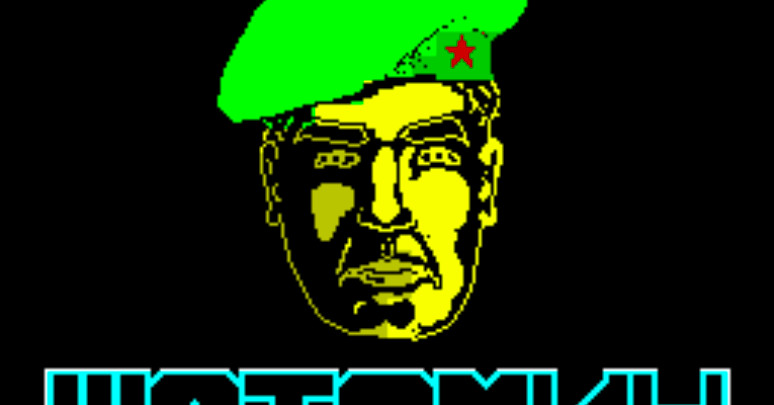
Late last year, the Slovak Design Museum released a translated collection of ’80s text adventures from the region. The games, often programmed by teenagers, capture a moment in history when the first generation of Slovak developers were learning their craft to share among their friends.
The museum didn’t always cover games. Maroš Brojo, the general manager of the Slovak Game Developers Association, pitched the multimedia collection that he now curates. “When you get the patronage of a museum… it gives you much more credibility,” he says. “Suddenly, people start to have a very different view of this actually being part of something important. Our culture and our heritage.”
The 10 games that make up this first batch of translations and re-releases were selected for their historical significance. They capture a part of the late ’80s in what was then Czechoslovakia, a Soviet satellite state. In one, Šatochín, the titular Soviet Major fights with Rambo in Vietnam. “I don’t want to say [it was] against the regime, but it’s very subversive,” says Brojo.
One of the developers behind Šatochín, Stanislav Hrda, was also involved in the translation and preservation project. He was 16 when he and some friends published Šatochín after being fascinated by the American movies that made it across the border on VHS tapes. “This game is making jokes [about] the regime… and the Soviet army,” he says. “It’s hard to win. So when you are playing, Rambo will kill you 10 times because you [were] not lucky, and you made the wrong choice. It was very funny for my friends.”
Ten may be underselling it — in my experimentation with Šatochín, the Soviet soldier lost his life in a handful of gruesome ways, including being crushed against a coral reef, within just a few minutes of starting the game. Hrda also integrated an Easter egg into the game, where binding the keys “KGB” as controls would allow the player to play as Rambo himself.
Game development was primarily a teenage hobby at the time. Because games weren’t sold in shops, there was no chance of making money out of it. Hrda and others shared these games among their friends for entertainment rather than profit. At one point, Šatochín made it into the hands of František Fuka, a developer from Prague who had previously inspired Hrda and his friends. In Hrda’s words, he told them, “Yeah, you guys made such a nice, fun game, but be prepared and take a toothbrush with you because when the police come to catch you, you must be ready.” Hrda laughs as he says it, but he admits that he was “a bit afraid” after that.
:format(webp):no_upscale()/cdn.vox-cdn.com/uploads/chorus_asset/file/23167268/Cover_1024x768.png)
But he and his friends continued to make games, calling themselves Sybilasoft. After the Velvet Revolution in 1989 led to more democratic governance and a market economy being established in Czechoslovakia, Hrda, then 18, created a real company to sell games. With financing now available, he says, programmers across Czechoslovakia were able to create “very high-quality games for the ZX Spectrum.” But in the West, people had moved on to more advanced computers, leaving the creations of Hrda, Fuka, and others to be played primarily in Eastern Europe only.
But a few years ago, Hrda was involved in an exhibition at the Design Museum that showed off these games from the ’80s, allowing people to play them on the original hardware. More exhibitions were planned — before COVID got in the way. Brojo calls the website “sort of a backup virtual exhibition, but also says that he’s pleased that it can form the beginning of a database as they continue to develop the project further. As well as the games themselves, which can be run on emulators on modern PCs, there are images of the hardware, box art, and so on from the period. Brojo says that his next goal is to add scans of ’80s and ’90s Slovak game magazines.
Along with the translations, the website also makes the games accessible to a wider audience. Brojo says that the team was lucky that much of that work had been done by ZX Spectrum fan communities like Spectrum Computing, so they didn’t have to salvage much from cassettes and the like. And finding the original developers in order to get their permission was usually straightforward. “Most of the community was very friendly, so a lot of the authors know other authors, and they were able to get us in touch with them,” he says.
The tricky part was disassembling the games so that Slovak text could be replaced with English. Programmer Slavomír Labský and translation coordinator Marián Kabát wrote about some of their experience in a post on the Slovak Design Museum’s website. Labský explains his process in taking the games apart and replacing them once the translations were delivered to him, taking into account difficulties like the short lengths of the text segments. Kabát described the challenges of contextualizing era- and location-specific references, such as those to popular folk singers.
Brojo says he hopes that the nuances of the games will come across in these translations, like the subversive writing in Šatochín. On the other hand, he mentions that the 1987 game Pepsi Cola appears to be the one that English-speaking people are most interested in on social media. Developed in part by Fuka, it tasks the player with stealing the drink’s secret recipe. Brojo assumes that the recognizability of the brand is curious to Western players. “It might be sort of a bizarre thing that we also knew Pepsi Cola in the East before 1989,” he says. “Although Pepsi Cola was actually one of the most popular soft drinks.” (It had been sold in the Soviet Union since 1972.)
But the historical value of the games isn’t the only reason they’ve been made available. Instead, Hrda just wants people to enjoy them like his friends did back when he made them. “I [hope people] will have fun with them even if those games are very old,” he laughs. “Keep playing good games, and if you are brave enough, you can try ours.”
Credit: Source link