

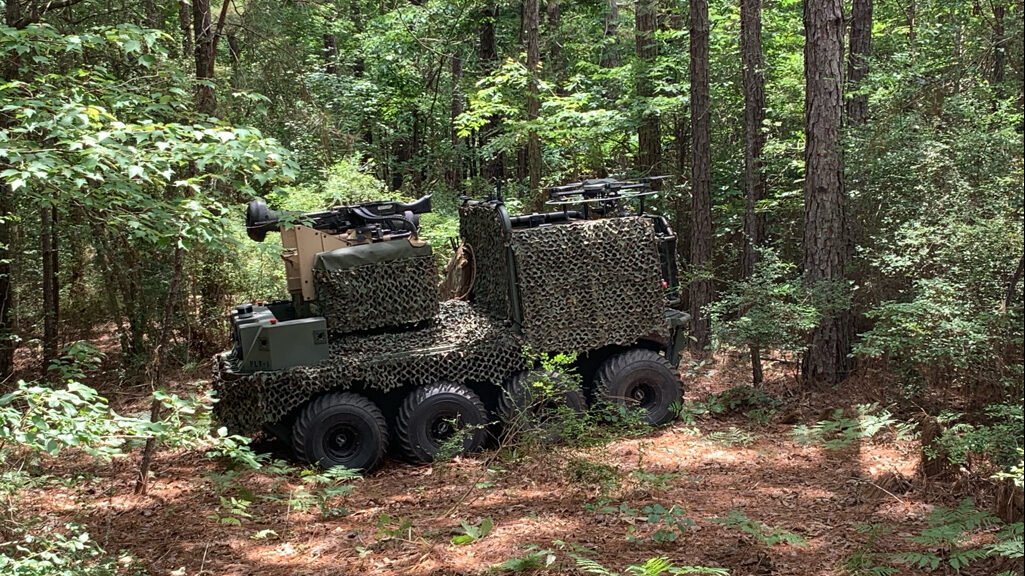
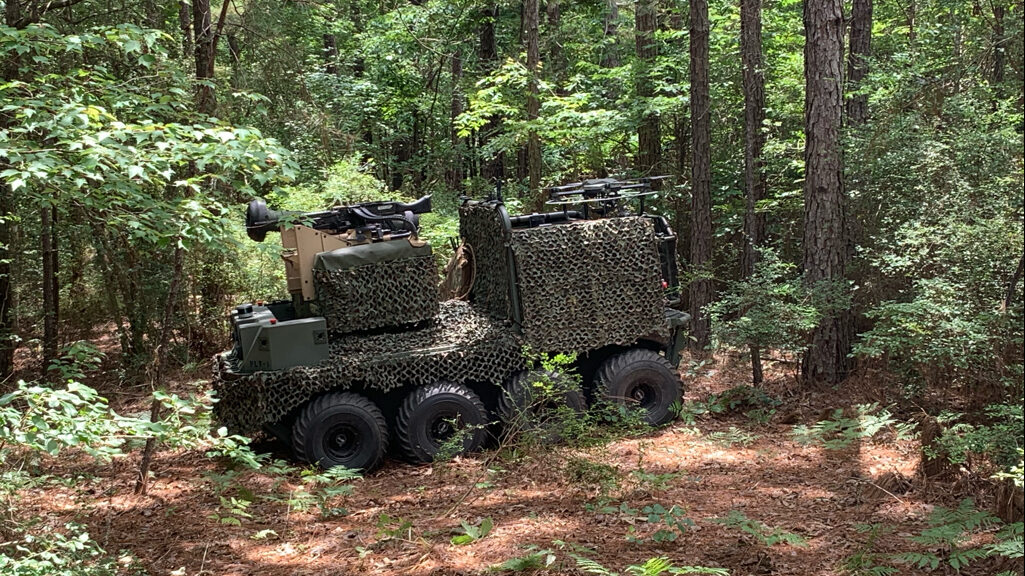
The Project Origin vehicle, a surrogate for Army Robotic Combat Vehicles, is seen at the Joint Readiness Training Center at Fort Polk, Louisiana, in September 2021. (Dan Heaton/US Army)
WASHINGTON: For the first time, US Army soldiers fought in training against an “adversary” force that included robotic vehicles during a rotation at the Joint Readiness Training Center rotation, providing the service with at times surprising early glances of how such unmanned machines could impact soldiers on the battlefield.
The recent rotation at the Joint Readiness Training Center (JRTC) pitted two American forces against each other — soldiers from the 3rd brigade of the 101st Airborne Division and the first battalion of the 509th Infantry Regiment — but with the added wrinkle that the regiment was given some robotic help from the Army’s Robotic Combat Vehicle program
The eight-wheeled robotic vehicles, made by Project Origin at US Army Development Command, undertook often-perilous missions and, more importantly, revealed information about what soldiers need from their machine compatriots, and when those machines are capable of taking on tasks formerly done by humans.
“This is how you’re going to see ground combat evolve over time… offloading the tactical risk for humans onto robots,” said Maj. Cory Wallace, the robotic combat vehicle lead for the Next Generation Combat Vehicle Cross-Functional Team.
For the September exercise, the first battalion of 509th Infantry, also known as Geronimo, used two RCV surrogates in several different battlefield scenarios, including route reconnaissance, denying helicopter landing zones and blocking a key intersection.
The Next Generation Combat Vehicle Cross-Functional Team is developing a suite of robotic combat vehicles — light, medium and heavy — as part of the service’s massive modernization effort. The RCV family of vehicles will be used to scout and fire upon enemy positions in war.
Geronimo’s use of the RCV surrogate for route reconnaissance demonstrated the combat efficacy of robots paired with soldiers, the Army said. At the JRTC rotation, the robot would drive down a reconnaissance route and come under fire by the 3/101, allowing Geronimo soldiers to identify the location of the 101st and launch indirect fires on their location.
In another mission, the surrogate blocked a key intersection. Blocking the intersection required two robots and five soldiers to operate them, whereas that same operation would take a one platoon, or about 36 soldiers — potentially endangering all of them.

The Project Origin vehicle seen through a night vision lens at the Joint Readiness Training Center in September 2021. (Dan Heaton/US Army)
“That allowed Geronimo to retask that platoon to go do other missions and mass combat power elsewhere,” Wallace said.
RCVs can also be effective platforms for establishing observation posts because, unlike soldiers, they don’t fall asleep, lose focus or get wounded and need to be evacuated in an attack.
But as the Army pivots to face near-peer competitors in China and Russia, the observation posts need to have low electronic and heat signatures so the vehicles can’t easily be identified.
“They can’t have a generator going 24/7 because you need to be able to maintain the low signature associated with the human element in order for it to perform that mission,” Wallace said. “So in order for it not to have a generator going 24/7, we’re instituting a silent watch-desired characteristic within the RCVs, where it’s able to run off battery power and maintain an extremely low heat signature.
Soldier Needs, And A Crowded Network
Adding the RCV surrogates into the combat rotation provided the Army with insights into how robots need to function in order to be successfully integrated on the battlefield. In combat, soldiers won’t have time to tie a tow bar to a robot and move it to another location.
“Robots need to be able to keep up with that formation and move at the same pace on the same terrain as the human element,” Wallace said.
Network challenges with connecting the robot and the operator also surfaced during the rotation. In previous months, the RCV team had experimented several times on a smaller scale with network traffic from a platoon or company. But the traffic from an adversary brigade and a friendly battalion on the battlefield caused heavy network congestion.
Leaders expected that to be the case during the experiment, though Wallace would not go into detail on the network issues. Connectivity between the robot and the operator will be the “limiting factor” for combat effectiveness, Wallace said.
“If the operator does not have absolute trust that the robot is going to do what he or she tells it to do at a tactically relevant distance, then it’s not going to be able to provide the effects that it’s supposed to,” Wallace said. “And in order to do that, you need to have a secure and reliable network connection.”
At one point during the battle, a small drone tethered to the RCV surrogate hovered in the air, providing situational awareness to the Geronimo force. But the loud buzzing sound of the tethered drone resulted in 101st soldiers delaying a mission three hours because they thought an enemy small drone was flying in the area, even though it was stationary.
“The audible signature is a good example of how some of the secondary and tertiary effects of robotics and autonomous systems can affect human element,” Wallace said.
Lessons like that are exactly why the Army brought the robot into the JRTC event.
“We know our adversaries are developing the same systems and same capabilities we are,” he said. “So eventually, the Army’s gonna have to figure out the tactics, techniques and procedures, and the doctrine associated with mitigating enemy robotic and autonomous system capability. So we wanted to begin that journey with this JRTC rotation.”
Credit: Source link