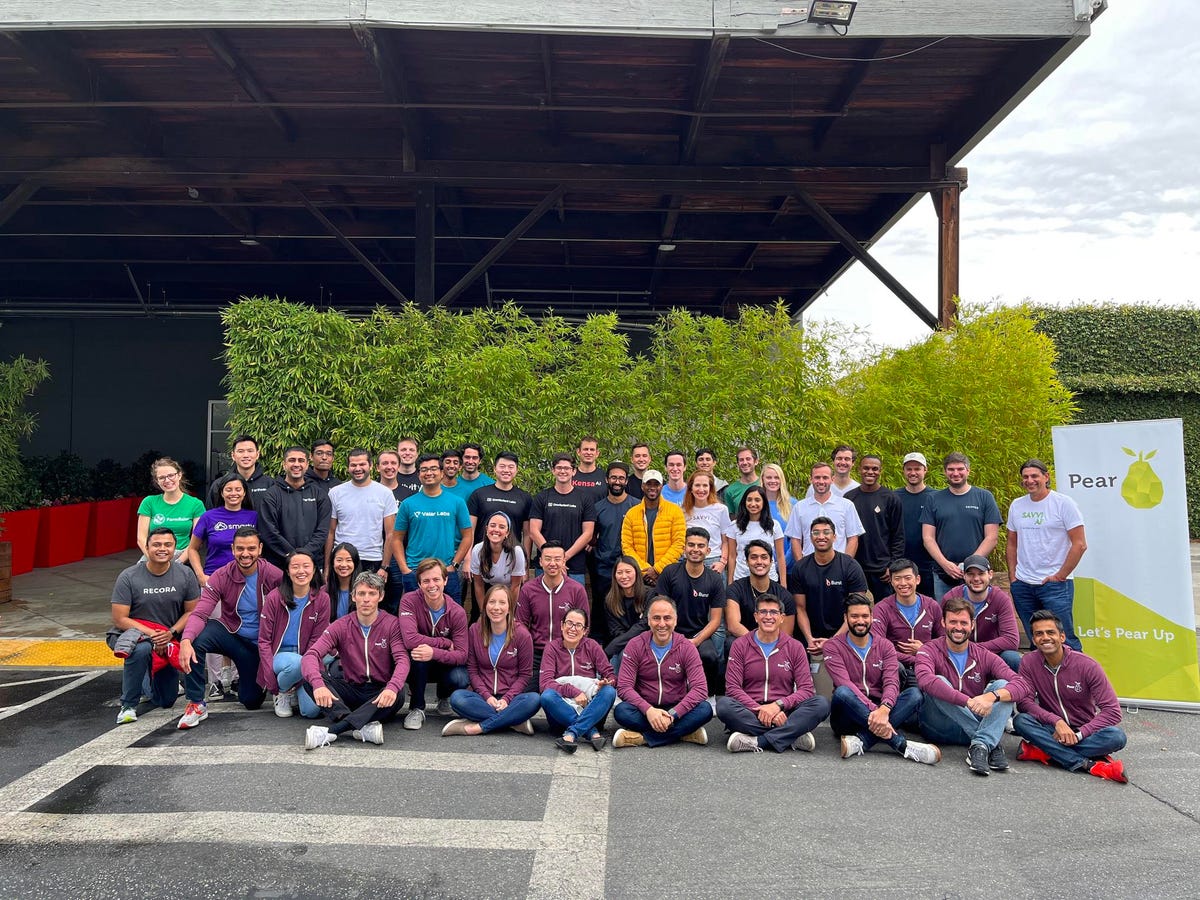
Pear Accelerator entrepreneurs and Pear VC’s team pose for a picture after wrapping up Demo Day in October.
Pear VC
After a nervy morning in mid-October spent pitching to hundreds of potential investors over Zoom, a group of startup entrepreneurs reconvened at the Ameswell Hotel in Mountain View, California. The four co-founders of Skipper, a startup that provides software tools for hotels including the Ameswell, had booked a stay, and word quickly spread among the founders about the cushy accommodations—and the friends and family discount. By demo day, six of the 13 teams in venture capital firm Pear VC’s accelerator class were living there, turning a wing of the newly-constructed luxury hotel into a temporary hacker house.
The camaraderie is a testament to the community made possible by an accelerator of Pear’s cozy size, even as its participants spent much of the three month-long period scattered across the country. “It’s been easier to rapidly and meaningfully make connections with the other founders,” says Skipper CEO Jason Shames.
Founded by Midas List newcomers Pejman Nozad and Mar Hershenson, Pear VC is an oddity in Silicon Valley for its two-pronged structure, which features both a venture investing arm and an accelerator. The latter, launched in 2014, diverges from most prominent programs through the small size of its “cohorts,” having guided about 80 companies through in its history. For context, a single class at Y Combinator, the tech industry’s most prominent accelerator program, is more than four times as large.
Fewer companies means less of a chance that even one company will be a mega-hit, as companies such as Airbnb, DoorDash and Coinbase have proven to be for Y Combinator. But Pear is betting that the increased attention its partners provide to each team will make for an elevated win rate. Even as the number of seed funds skyrockets and YC continues to expand, recently naming its first group partner focused on healthcare and biotech, Nozad and Hershenson say their approach is proving to be another viable path for budding entrepreneurs.
Because of the long time frame in which a company grows, they argue at least a decade must elapse before an accelerator’s success can be gauged. But Pear has delivered early promise: Nine of its accelerator companies have surpassed valuations of $150 million, a more than 10% success rate that compares strongly to Y Combinator, which lists on its website about 170 companies that reached that mark as of July, about a 5% rate. “We want to be the number one accelerator for small batches,” Nozad says.
The key, Hershenson adds, is in Pear’s “high touch” approach to working with startups. Founders regularly meet with Nozad and Hershenson, whose investment prowess is headlined by an early $1.9 million investment in DoorDash (the YC alum) that turned into $440 million, and Pear’s team of former entrepreneurs who have sold companies to the likes of Facebook and Instacart. And because of the small size of each class, Pear is able to tailor the program curriculum for each company.
Hunter Goble, cofounder and CEO of biotech outfit Transcera, also participated in a larger accelerator, and recalls sitting through a seminar about finding market fit: “It was not applicable to us like it might have been to a [software] startup.” Pear, he says, provided him more face time with the team, and connected him to an industry veteran in its network to answer biotech-specific questions. “They claim they customize the process for you. It’s almost unbelievable, but really we found it to be the case,” says Arman Hezarkhani, CEO and cofounder of Parthean, a Pear Accelerator startup designing a financial education app for young people.
Another founder says he was drawn to Pear’s small class size because of his firsthand experience as an investor who attended numerous larger demo days. Alex Muller and wife Maya Mikhailov sold a previous fintech business to credit card firm Synchrony, after which Muller spent a stint working with the firm’s venture arm. At those events, the large quantity and short length of pitches meant companies began to blur together, he says. “We didn’t want to be the 32nd pitch,” adds Mikhailov, whose new business Savvi AI is making low-code machine learning tools.
The pandemic forced Pear to revise its setup: Previously, it required founders to live in Silicon Valley, and for investors to attend in person. This year’s demo day was held virtually for investors, but in-person for founders, at the offices of fellow VC firm Playground in Palo Alto. (Toggling from one Zoom speaker to another last year proved to be a logistical nightmare, Nozad says.) Pear more than doubled its attendance through Zoom, Nozad says, with more than 700 investors attending this year’s event. “Our demo day presentations are four to five minutes long, and VCs really like it because they have a chance to really get to know the companies,” Nozad says. “You can’t do that with 300 teams.”
Mar Hershenson (left) and Pejman Nozad founded Pear VC in 2013. “Accelerators requires a lot of effort, not just from the founders, but from the partners,” Hershenson says. “It’s like starting companies all the time. I slept all weekend [after demo day].”
Pear VC
At the Ameswell Hotel after demo day, the hacker house energy kicked into full swing, with founders glued to their laptops sifting through the investor inquiries—in some cases totaling more than 100 emails within the first three hours. So far, seven of the companies have signed term sheets from firms that include NEA, Khosla Ventures and Forerunner Ventures (in the previous three years, 82% of companies went on to raise funding after completing the program).
Of course, keeping small and high-quality is more about the execution than a novel idea. “VC firms have dabbled at it over the years, but close to nothing has really stuck,” says Rhonda Shrader, executive director of University of California, Berkeley’s entrepreneurship program. More accelerators are starting, but fewer are lasting for five or more years, she says: “There has to be the forcing function of curriculum, really intentional networks and leadership. It’s really unsexy work to make it successful.”
Nozad says he’s heard rumblings that other VC funds are considering launching their own accelerators or startup studios, a hybrid model popularized by firms such as Atomic Labs, which launched the now-public Hims & Hers. He says there’s plenty of room for more programs in the industry, but he warns that it cannot be a side job, pointing to the past efforts that have become defunct. “You need to build a program that stands out and people want to be part of, then you need to build a team who is able to help the companies in that stage,” he says.
As evidence of its own staying power, after a one-day break following demo day, Pear launched the first expansion to its accelerator: a winter program. But, given their priority of offering startups hands-on time with the same Pear team, Nozad and Hershenson do not foresee much further expansion in the vein of successful accelerators in the past. TechStars, for example, leveraged the success of its early ten-team cohorts into a franchise that now accepts more than 500 startups each year; while recent Y Combinator class sizes have increased more than tenfold compared to its inaugural group of 32 companies.
“Unlike others, they haven’t inflated their accelerator numbers,” says Index Ventures partner Nina Achadjian, who counts Pear’s demo day as one of three that she attends. “They’re preserving the artisanal craft of seed investing and not becoming a factory of churning out seed companies.”
Credit: Source link