New York Tech Media
  • News
  • FinTech
  • AI & Robotics
  • Cybersecurity
  • Startups & Leaders
  • Venture Capital
No Result
View All Result
  • News
  • FinTech
  • AI & Robotics
  • Cybersecurity
  • Startups & Leaders
  • Venture Capital
No Result
View All Result
New York Tech Media
No Result
View All Result
Home AI & Robotics

Mimicking a human fingertip’s sensitivity and sense of direction for robotic applications

New York Tech Editorial Team by New York Tech Editorial Team
December 3, 2021
in AI & Robotics
0
Mimicking a human fingertip’s sensitivity and sense of direction for robotic applications
Share on FacebookShare on Twitter
Mimicking a human fingertip’s sensitivity and sense of direction for robotic applications
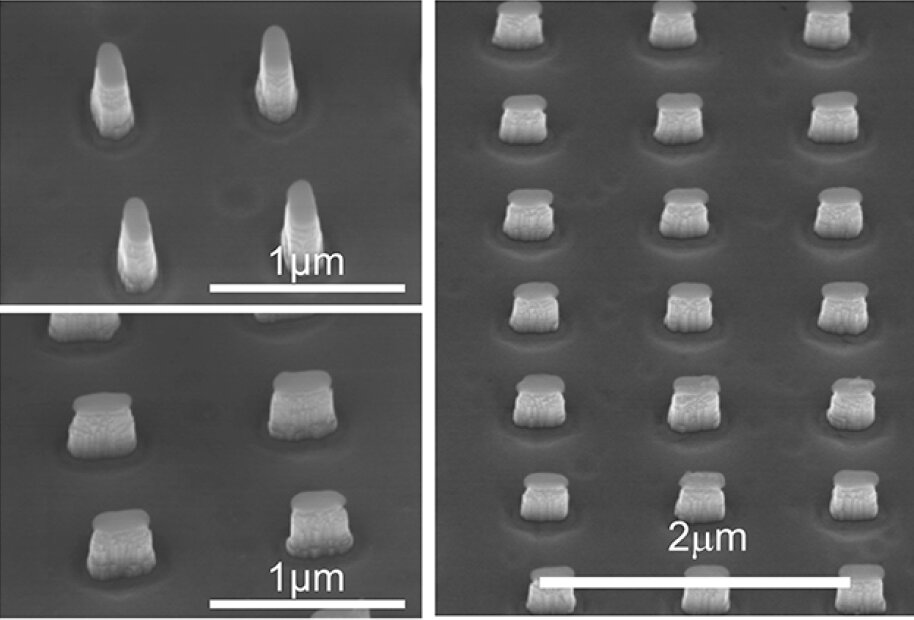
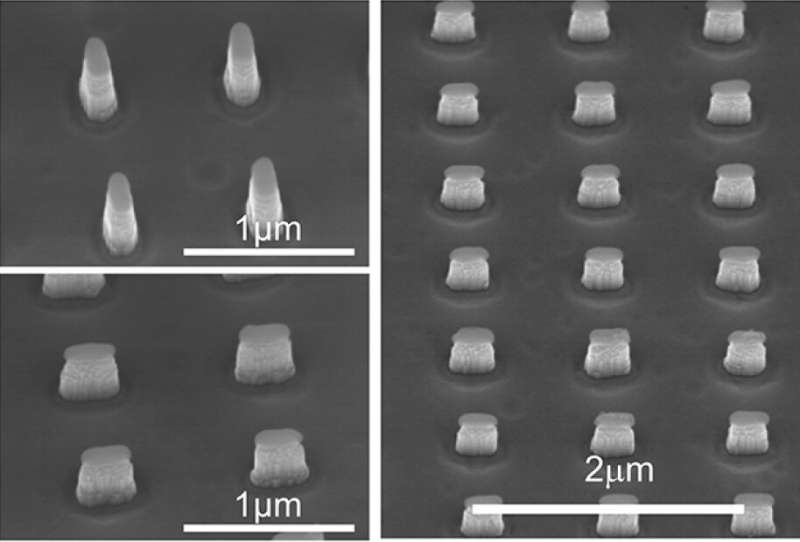
Scanning electron microscope images of the elliptically shaped nanopillar LEDs. The left two images show the high-resolution images of the two LEDs consisting of orthogonally oriented nanopillars. The right image shows a portion of a nanopillar array, each of which contains 12,500 nanopillars. Credit: University of Michigan

As robotic devices such as artificial prosthetics and human-computer interfaces are increasingly integrated into society, researchers have been looking more deeply into the sensitivity of the devices that serve the same function as hands. Human fingertips are remarkably sensitive. They can communicate details of an object as small as 40μm (about half the width of a human hair), discern subtle differences in surface textures, and apply just enough force to lift either an egg, or a 20 lb. bag of dog food without slipping. They can also manipulate objects with relative ease.

Engineers have been working to mimic this ability for eventual robotic or prosthetic uses with varying levels of success. At the University of Michigan, Prof. P.C. Ku and his group have recently reported an improved method for tactile sensing that detects directionality as well as force with a high level of sensitivity. The system’s high resolution makes it uniquely suitable for robotic and HCI applications. It is also relatively simple to manufacture.

“We are bridging the gap between humans and computers, so maybe we can teach a robot how to feel objects in a way that would be closer to our own capabilities,” said doctoral student Nathan Dvořák.

Dvořák is a member of a team led by Prof. P.C. Ku that have been developing tactile sensors for the past several years. They are the first to integrate a highly sensitive sense of touch along with directionality using asymmetric nanopillars—so a prosthetic device is able to more tightly grasp a falling object, or a human-computer interface can differentiate a rising from a falling motion.
Mimicking a human fingertip’s sensitivity and sense of direction for robotic applications
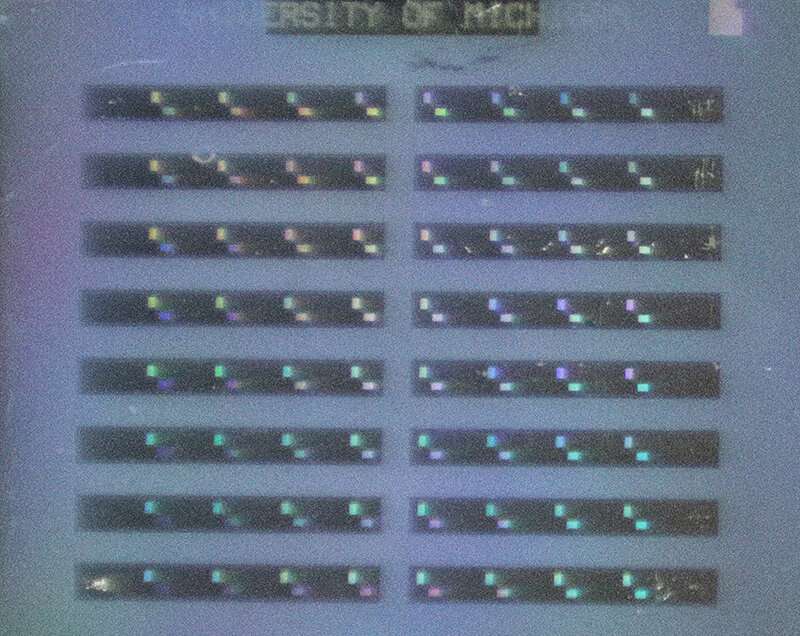
Single sensor consisting of 1.6M nanopillars, arranged into 64 nodes consisting of pairs of arrays placed at right angles to each other. Credit: University of Michigan

As a proof of concept, the team built a sensor, roughly the size of a fingertip, that contains 1.6 million gallium nitride (GaN) nanopillars. GaN was used because of its ability to measure force through its innate piezoelectric property, meaning its ability to generate an electrical charge when stressed.

The elliptical shape and arrangement of the nanopillars are key to its success in being able to detect directionality.

The smallest unit is the nanopillar. Each nanopillar has an elliptical shape, and is 450nm tall, which is about 1,000x smaller than the width of human hair. And each nanopillar is equipped with its own LED.

The nanopillars are grouped into individual arrays in the shape of a rectangle, 100×150 nanopillars, or 12,500 nanopillars per array. Each array is then grouped in close proximity with a second array at right angles to it. This arrangement is key to its ability to detect direction. The two orthogonal arrays are called a node.
Mimicking a human fingertip’s sensitivity and sense of direction for robotic applications
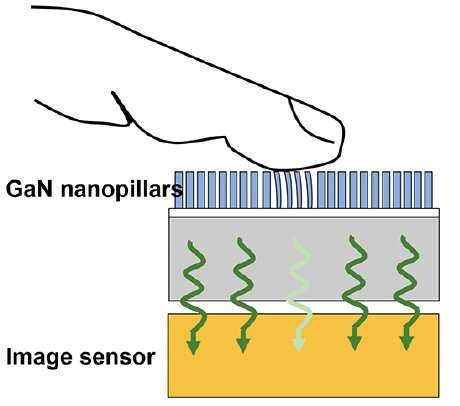
Conceptual drawing of the tactile sensor in action. Pressure applied to the nanopillars reduces the light emitted by the LEDs. Credit: University of Michigan

A complete sensor consists of 64 nodes in the shape of a square.

When a force is applied to the nanopillars, it changes the light intensity being emitted from the nanopillars, as shown in the video.

Because the sensor is able to determine the direction of the force, it can then alert a future prosthetic device about whether an object may be falling through its grasp, requiring a tighter grip.

The system does not require complex electrical interconnects, which require very high manufacturing uniformity. It also uses well-known methods of manufacturing that are easily repeatable.

“And we don’t need to have 100% yield on our devices, or even close,” said Dvořák. “On one of my current devices there are 1.6 million nanopillars on the sensor, and it is still effective even if 25% of the nanopillars in an array are damaged during manufacturing, because we’re detecting the change of light intensity rather than the absolute light intensity.”


This video demonstrates a fingertip being applied to the nanopillars. The system is sensitive enough to distinguish the individual ridges in a fingerprint. When a fingerprint ridge passes over the nanopillars, it bends the nanopillars causing a decrease in light intensity, resulting in an overall twinkling effect as the finger moves over the sensor. Credit: University of Michigan

The sensor was able to discern objects measuring a mere 4.3μm, making it nearly 10x more sensitive than that of a human fingertip. And it could detect the weight of an object similar to a paperclip, or about 0.1 gram.

The current proof of concept uses an off-the-shelf imager to detect the change in light that occurs when the surface is touched.

“We are now working to develop a complete system,” said Dvořák. After making the current system work with electricity, he will mount the sensor on top of a CMOS imager which will record the changes in light intensity, and connect it to a microprocessor for automated information processing.

The research is described in “Ultrathin Tactile Sensors with Directional Sensitivity and a High Spatial Resolution,” published in Nano Letters.


Insect wings hold antimicrobial clues for improved medical implants


More information:
Nathan Dvořák et al, Ultrathin Tactile Sensors with Directional Sensitivity and a High Spatial Resolution, Nano Letters (2021). DOI: 10.1021/acs.nanolett.1c02837

Provided by
University of Michigan

Citation:
Mimicking a human fingertip’s sensitivity and sense of direction for robotic applications (2021, December 3)
retrieved 3 December 2021
from https://phys.org/news/2021-12-mimicking-human-fingertip-sensitivity-robotic.html

This document is subject to copyright. Apart from any fair dealing for the purpose of private study or research, no
part may be reproduced without the written permission. The content is provided for information purposes only.


Credit: Source link

Previous Post

Sapphire Closes Growth-Focused Technology Funds, At Nearly $2 Billion

Next Post

Nucros Science & Taste raises Pre-Seed funding round led by Aavejak Advisers, ID8 Ventures, others

New York Tech Editorial Team

New York Tech Editorial Team

New York Tech Media is a leading news publication that aims to provide the latest tech news, fintech, AI & robotics, cybersecurity, startups & leaders, venture capital, and much more!

Next Post
Nucros Science & Taste raises Pre-Seed funding round led by Aavejak Advisers, ID8 Ventures, others

Nucros Science & Taste raises Pre-Seed funding round led by Aavejak Advisers, ID8 Ventures, others

  • Trending
  • Comments
  • Latest
Meet the Top 10 K-Pop Artists Taking Over 2024

Meet the Top 10 K-Pop Artists Taking Over 2024

March 17, 2024
Panther for AWS allows security teams to monitor their AWS infrastructure in real-time

Many businesses lack a formal ransomware plan

March 29, 2022
Zach Mulcahey, 25 | Cover Story | Style Weekly

Zach Mulcahey, 25 | Cover Story | Style Weekly

March 29, 2022
10 Raunchy Movies on Netflix You Won’t Regret Watching

10 Raunchy Movies on Netflix You Won’t Regret Watching

May 20, 2024
How To Pitch The Investor: Ronen Menipaz, Founder of M51

How To Pitch The Investor: Ronen Menipaz, Founder of M51

March 29, 2022
Japanese Space Industry Startup “Synspective” Raises US $100 Million in Funding

Japanese Space Industry Startup “Synspective” Raises US $100 Million in Funding

March 29, 2022
Startups On Demand: renovai is the Netflix of Online Shopping

Startups On Demand: renovai is the Netflix of Online Shopping

2
Robot Company Offers $200K for Right to Use One Applicant’s Face and Voice ‘Forever’

Robot Company Offers $200K for Right to Use One Applicant’s Face and Voice ‘Forever’

1
Menashe Shani Accessibility High Tech on the low

Revolutionizing Accessibility: The Story of Purple Lens

1

Netgear announces a $1,500 Wi-Fi 6E mesh router

0
These apps let you customize Windows 11 to bring the taskbar back to life

These apps let you customize Windows 11 to bring the taskbar back to life

0
This bipedal robot uses propeller arms to slackline and skateboard

This bipedal robot uses propeller arms to slackline and skateboard

0
laptop on glass table

Automat-it Cuts Deployment Friction as Monce Scales AI Order Processing on AWS

April 13, 2026
Lee's Famous Recipe Chicken

Why Lee’s Famous Recipe Chicken Is Betting on Hi Auto to Quietly Rewire the Drive-Thru

April 9, 2026
computer generated image of letters

San Francisco Tribune Lists 11 HumanX Startups Moving AI Closer to the Operating Core

April 8, 2026
Impala CEO and Highrise AI CEO

The Industrialization of AI Infrastructure: What Impala and Highrise AI Reveal About the Next Scaling Frontier

April 7, 2026
Employee Time Tracking

What is an Employee Time Tracking Solution? A Definite Guide for 2026

March 31, 2026
Voltify founders

Voltify Raises $30 Million Seed Round as It Challenges $1 Trillion Rail Electrification Model

March 31, 2026

Recommended

laptop on glass table

Automat-it Cuts Deployment Friction as Monce Scales AI Order Processing on AWS

April 13, 2026
Lee's Famous Recipe Chicken

Why Lee’s Famous Recipe Chicken Is Betting on Hi Auto to Quietly Rewire the Drive-Thru

April 9, 2026
computer generated image of letters

San Francisco Tribune Lists 11 HumanX Startups Moving AI Closer to the Operating Core

April 8, 2026
Impala CEO and Highrise AI CEO

The Industrialization of AI Infrastructure: What Impala and Highrise AI Reveal About the Next Scaling Frontier

April 7, 2026

Categories

  • AI & Robotics
  • Benzinga
  • Cybersecurity
  • FinTech
  • New York Tech
  • News
  • Startups & Leaders
  • Venture Capital

Tags

AI AI QSRs Allseated Automat-it AWS B2B marketing Business CISO CISO Whisperer Collaborations Companies To Watch cryptocurrency Cybersecurity Entrepreneur Fetcherr Finance FINQ Fintech Funding Announcement hi-tech Hi Auto Impala Investing Investors investorsummit Israel israelitech Leaders LinkedIn Leaders Metaverse Mindset Minnesota omri hurwitz PointFive PR QSR Real Estate start- up startupnation Startups Startups On Demand Tech Tech leaders Unlimited Robotics VC
  • Contact Us
  • Privacy Policy
  • Terms and conditions

© 2024 All Rights Reserved - New York Tech Media

No Result
View All Result
  • News
  • FinTech
  • AI & Robotics
  • Cybersecurity
  • Startups & Leaders
  • Venture Capital

© 2024 All Rights Reserved - New York Tech Media