

New York Tech Media
  • News
  • FinTech
  • AI & Robotics
  • Cybersecurity
  • Startups & Leaders
  • Venture Capital
No Result
View All Result
  • News
  • FinTech
  • AI & Robotics
  • Cybersecurity
  • Startups & Leaders
  • Venture Capital
No Result
View All Result
New York Tech Media
No Result
View All Result
Home AI & Robotics

Notre Dame professor develops plant-inspired robots // The Observer

New York Tech Editorial Team by New York Tech Editorial Team
February 23, 2022
in AI & Robotics
0
Notre Dame professor develops plant-inspired robots // The Observer
Share on FacebookShare on Twitter

Margaret Coad was working toward her doctorate degree at Stanford in 2017 when inspiration struck a postdoctoral researcher in her lab — a brand new way for researchers to create deployable structures, navigate confined spaces and apply forces, such as lifting people up which could save someone’s life one day. 

The inspiration: plants. The device: vine robots.

“He was thinking about the many ways to make robots lengthen and shorten and was looking at some plant and thought, ‘What if we could make a robot grow from its own tip?’” Coad said.

Coad, now assistant professor of mechanical and aerospace engineering at Notre Dame, designed the robots based on a plant’s ability to grow and shape itself based on its environment. As a result, the robots can explore spaces that are too small or dangerous for humans to enter.

The robots work by eversion, which is the process of turning the soft body of the robot inside out while it is lengthening. The soft body can be made of any airtight, unstretchable yet flexible material. This includes low density polyethylene, the material from which plastic bags are made. It is also the material of the “demo vine robot” Coad keeps in her purse for quick vine robot demonstrations. 

The soft body of the demo vine robot is a cylindrical plastic bag sealed at the tip. Coad inflates the plastic by blowing into a plastic tube at the bag’s base. In the actual robots, this end is connected to a hard plastic body. 

The tip of the tube is inside out toward the base. The eversion of the tube allows the tip of the tube to lead the rest of the body while it is lengthening. This is crucial, especially if there is a camera on the tip of the robot. 

Coad and her team members were not the first people to play with robots that lengthen by eversion. Other research labs have written papers about this method in the past, Coad noted. Her team was, however, the first to come up with a mechanism that controls the robot’s movement. 

In order to steer the robots, Coad and her team attached three tubes around the circumference of the robot body. These tubes shorten when inflated, so the shortening of these tubes causes the robot body to turn.

“It’s similar to how your finger works,” Coad said. “You’ve got your bone in the middle and your tendon going down the side. When you shorten your tendon, it curves your finger.”

Coad was able to put this steering mechanism to the test in both competition and at an archaeological site. 

During the competition, she was able to maneuver the device through uneven terrain, a small aperture and past unstable obstacles. 

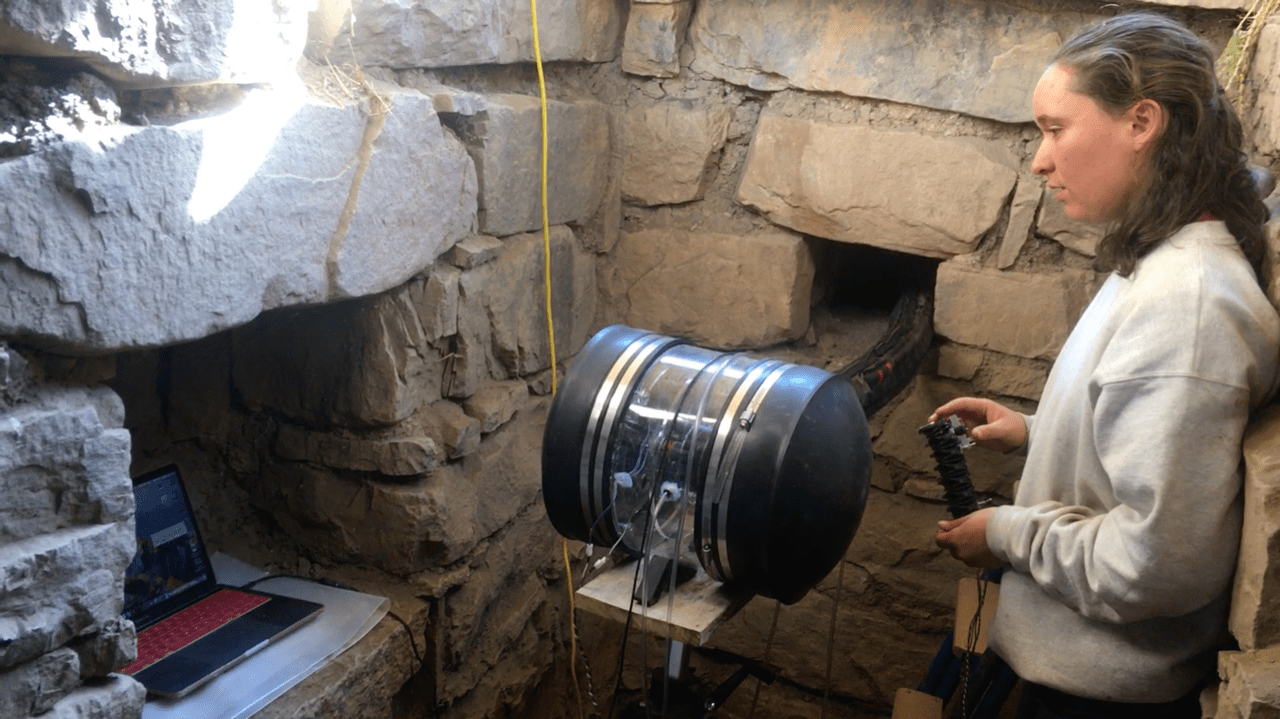
In 2019, Coad visited an archaeological site in Chavin, Peru, where her robot successfully navigated its way through a partially blocked tunnel, past a right angle and up a vertical shaft.

Notre Dame assistant professor of mechanical and aerospace engineering Margaret Coad operates her vine robots at the archaeological site in Chavin, Peru.

She documented her successes in a paper titled “Vine Robots: Design, Teleoperation, and Deployment for Navigation and Exploration.” Coad was the primary author of the paper that received the Institute of Electrical and Electronics Engineers (IEEE) Robotics and Automation Magazine Best Paper Award in May 2021. 

Coad works in the Innovative Robotics and Interactive Systems (IRIS) Lab at Notre Dame. The goal of the lab, Coad said, is to design robots in new ways that can be more helpful in the real world. This includes robots that interact with people through wearable devices, such as soft exosuits that can help people move. 

The researchers have also taken inspiration from nature beyond vines. Coad and her fellow researchers are also looking at spider monkey tails and their ability to grab objects as inspiration for robot design.

Nature has been an inspiration for Coad’s work, she said, but her biggest priority is helping people with her research.

“Our goal is to help people, and we’re going to try a bunch of different ways to do that,” Coad said. “One of the ways is looking to nature for inspiration and for new mechanisms of movement.”

The vine robot design and videos of both the robot in action at both the competition and archaeological site can be found on YouTube.

Tags: engineering, innovative robotics and interactive systems lab, IRIS Lab, research, robots, vine robots

Credit: Source link

Previous Post

Tom Waterhouse VC Fund Posts Huge Returns on Sports Betting Trend – Sportico.com

Next Post

Edutech StartUp, GoKampus partners with Netcore Cloud to increase user engagement & achieve higher conversions

New York Tech Editorial Team

New York Tech Editorial Team

New York Tech Media is a leading news publication that aims to provide the latest tech news, fintech, AI & robotics, cybersecurity, startups & leaders, venture capital, and much more!

Next Post
Edutech StartUp, GoKampus partners with Netcore Cloud to increase user engagement & achieve higher conversions

Edutech StartUp, GoKampus partners with Netcore Cloud to increase user engagement & achieve higher conversions

  • Trending
  • Comments
  • Latest
Meet the Top 10 K-Pop Artists Taking Over 2024

Meet the Top 10 K-Pop Artists Taking Over 2024

March 17, 2024
Panther for AWS allows security teams to monitor their AWS infrastructure in real-time

Many businesses lack a formal ransomware plan

March 29, 2022
Zach Mulcahey, 25 | Cover Story | Style Weekly

Zach Mulcahey, 25 | Cover Story | Style Weekly

March 29, 2022
10 Raunchy Movies on Netflix You Won’t Regret Watching

10 Raunchy Movies on Netflix You Won’t Regret Watching

May 20, 2024
How To Pitch The Investor: Ronen Menipaz, Founder of M51

How To Pitch The Investor: Ronen Menipaz, Founder of M51

March 29, 2022
Japanese Space Industry Startup “Synspective” Raises US $100 Million in Funding

Japanese Space Industry Startup “Synspective” Raises US $100 Million in Funding

March 29, 2022
Startups On Demand: renovai is the Netflix of Online Shopping

Startups On Demand: renovai is the Netflix of Online Shopping

2
Robot Company Offers $200K for Right to Use One Applicant’s Face and Voice ‘Forever’

Robot Company Offers $200K for Right to Use One Applicant’s Face and Voice ‘Forever’

1
Menashe Shani Accessibility High Tech on the low

Revolutionizing Accessibility: The Story of Purple Lens

1

Netgear announces a $1,500 Wi-Fi 6E mesh router

0
These apps let you customize Windows 11 to bring the taskbar back to life

These apps let you customize Windows 11 to bring the taskbar back to life

0
This bipedal robot uses propeller arms to slackline and skateboard

This bipedal robot uses propeller arms to slackline and skateboard

0
laptop on glass table

Automat-it Cuts Deployment Friction as Monce Scales AI Order Processing on AWS

April 13, 2026
Lee's Famous Recipe Chicken

Why Lee’s Famous Recipe Chicken Is Betting on Hi Auto to Quietly Rewire the Drive-Thru

April 9, 2026
computer generated image of letters

San Francisco Tribune Lists 11 HumanX Startups Moving AI Closer to the Operating Core

April 8, 2026
Impala CEO and Highrise AI CEO

The Industrialization of AI Infrastructure: What Impala and Highrise AI Reveal About the Next Scaling Frontier

April 7, 2026
Employee Time Tracking

What is an Employee Time Tracking Solution? A Definite Guide for 2026

March 31, 2026
Voltify founders

Voltify Raises $30 Million Seed Round as It Challenges $1 Trillion Rail Electrification Model

March 31, 2026

Recommended

laptop on glass table

Automat-it Cuts Deployment Friction as Monce Scales AI Order Processing on AWS

April 13, 2026
Lee's Famous Recipe Chicken

Why Lee’s Famous Recipe Chicken Is Betting on Hi Auto to Quietly Rewire the Drive-Thru

April 9, 2026
computer generated image of letters

San Francisco Tribune Lists 11 HumanX Startups Moving AI Closer to the Operating Core

April 8, 2026
Impala CEO and Highrise AI CEO

The Industrialization of AI Infrastructure: What Impala and Highrise AI Reveal About the Next Scaling Frontier

April 7, 2026

Categories

  • AI & Robotics
  • Benzinga
  • Cybersecurity
  • FinTech
  • New York Tech
  • News
  • Startups & Leaders
  • Venture Capital

Tags

AI AI QSRs Allseated Automat-it AWS B2B marketing Business CISO CISO Whisperer Collaborations Companies To Watch cryptocurrency Cybersecurity Entrepreneur Fetcherr Finance FINQ Fintech Funding Announcement hi-tech Hi Auto Impala Investing Investors investorsummit Israel israelitech Leaders LinkedIn Leaders Metaverse Mindset Minnesota omri hurwitz PointFive PR QSR Real Estate start- up startupnation Startups Startups On Demand Tech Tech leaders Unlimited Robotics VC
  • Contact Us
  • Privacy Policy
  • Terms and conditions

© 2024 All Rights Reserved - New York Tech Media

No Result
View All Result
  • News
  • FinTech
  • AI & Robotics
  • Cybersecurity
  • Startups & Leaders
  • Venture Capital

© 2024 All Rights Reserved - New York Tech Media