


From cockroaches to peregrine falcons, researchers are getting a closer look at the lives of animals by sending robot creatures undercover. Take a look at some of these biobots that are pushing the limits of engineering.
Bat robot, USA

Bat flight is fiendishly complex, requiring a system of muscles, bones and joints that incorporate folding of the wings in every wingbeat. The force that bat wings generate comes from a strong but flexible covering of skin, as opposed to the rigid feathers used by birds. Basically, of all the flying beasts in the world, if you’re going to pick one to try to emulate, don’t pick a bat.
Except that’s exactly what US researchers did when they created this robotic bat, dubbed ‘B2’, to help them understand bat flight. In an article published in the journal Science Robotics, they explain how they stretched a 56-micrometre-thick (one micrometre = one-thousandth of a millimetre), silicone-based skin over B2’s wings, enabling it “to morph its articulated structure in mid-air without losing an effective and smooth aerodynamic surface”.
B2 can execute sharp diving manoeuvres and banking turns and, as well as providing a way to mimic and study the flight mechanisms of real bats, it may feed into the design of more agile flying robots of the future, helping us reach inaccessible places without sustaining damage or causing injury.
Peregrine falcon robot, USA

The idea for this perching robot came from Stanford University engineer William Roderick, who was looking for a way to make a positive impact on the environment using his background in robotics. “It struck me as I was watching birds perching and flying through a forest [that] if there were a robot that could act like a bird, that would unlock completely new ways to study the environment,” Roderick says.
Roderick and his colleague Prof Mark Cutkosky teamed up with Prof David Lentink at the University of Groningen to design aerial robots with bird-like claws that enable them to land on and grasp irregularly shaped branches. Similar robots could eventually be used in environmental monitoring, for instance, to raise the alert when there is a forest fire or to study wild animals.

For now, just understanding and mimicking what birds do is proving quite a challenge. Perching requires strong legs and a good grasp, but also the branch needs to be approached at the right angle and speed to nail the landing. In a Science Robotics article published in 2021, the researchers described how they modelled their robot’s legs on those of a peregrine falcon, incorporating motors to rotate the hips in the direction of the perch and artificial tendons that flex the toes and lock to grip.
Read more about the future of robots:
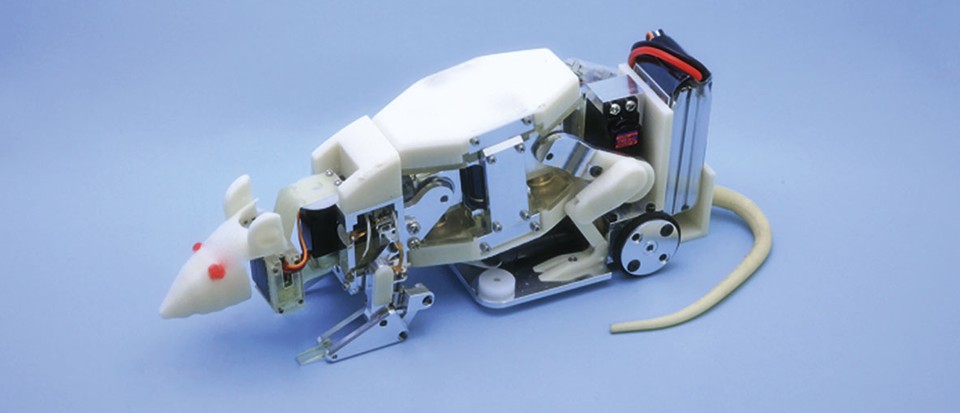
Rat robot, China & Japan

When scientists want to learn more about human mental disorders, they often look to animals with similar brains, such as rats and mice. These animals can act as important ‘models’ for human disease. However, the social impacts of mental disorders can be difficult to get a handle on in animals because of individual differences in the way they interact with others and in personality.
So in an effort to help standardise these interactions, at least from one side, Chinese and Japanese researchers collaborated to produce the WR-5, a robotic rat that interacts with real rats to study social integration. While they say it needs to be able to perform more complex behaviours like grooming, WR-5 did have a noticeable impact on behaviour towards a ‘target’ rat, encouraging other rats to try to mate with the target. The researchers even suggest that with development it could have a potential role in helping to pacify stressed lab rats.
Falcon robot, UK

A robotic falcon is helping researchers answer one of the most intriguing questions in animal behaviour: are animals naturally selfish, or do they try to protect the group as a whole?
If the ‘selfish herd’ theory is to be believed then, when under attack from birds of prey, each pigeon in a flock should gravitate towards the centre of the group, using the protection of the crowd to save itself from being eaten. But that’s not what happened when researchers from the UK and the Netherlands sent their robotic bird of prey into a flock of pigeons.
Instead of crowding together, the birds aligned themselves with each other in a way that the researchers suggest could help the entire flock to escape from a real-life predator. “We find no support for a selfish herd hypothesis in pigeon flocks,” they concluded in a Current Biology article published in 2021. Instead, they favour cooperative behaviour, which could have evolved because there is a decent chance of the whole group surviving, meaning, of course, that each individual survives too.
Guppy robot, Germany

Fish are often perceived as having a raw deal in the intelligence stakes, but there is still much we have to learn about the complexities of their behaviour, particularly when it comes to their social interactions.
That’s why German researchers have been employing a robotic fish to help them understand collective behaviour in guppy pairings. Writing in the journal Biology Letters in 2020, the team explained that they moved a 3D-printed fish replica around using magnets attracted to a wheeled robot beneath the test tank. The robot was programmed to copy the speed and direction of the individual fish it was partnered with and to stay the same distance away.
Watching how 20 different live guppies – some fast, some slower – behaved when followed by the robotic fish made the team realise how important swimming speed is in determining group dynamics. When the real fish swam faster, the pairs were better aligned and coordinated. According to the researchers, the study “highlights how both individual speeds and high levels of social responsiveness are important for the collective performance of groups.”
Cockroach robot, USA

It might have four legs instead of six, but this 4.5cm-long cockroach-like robot gets the most out of them, scuttling around and scaling walls like its insect counterparts.
Developed by Harvard University engineers, the 1.5g bot is based on an earlier design for miniature walking robots, and can climb vertical and curved surfaces, including parts from the inside of a jet engine.
In fact, aircraft engine maker Rolls-Royce, which funded the work, specifically asked the team if they could design an army of tiny jet engine inspectors to reach the parts of the engine that humans can’t. To meet their request, the engineers considered how insects like cockroaches climb walls using sticky pads on their feet.
They designed foot pads for their microrobot based on electroadhesion, which works by inducing opposite charges on the surface and whatever is sticking to it. Although it remains on a tether that supplies its sticky function, not many robots with such small legs are capable of the feats of climbing that this little guy has achieved.
Bee and fish robots, Europe

Would bees and fish be friends? We’ll probably never know, but they can make joint decisions – if they have robots to help them out.
As weird as it may seem, in 2019, a team of engineers from four European universities managed to get Austrian honeybees to talk to Swiss zebrafish by sending in robot bees and robot fish – that they called ‘agents’ – to infiltrate their social groups. These robot go-betweens tailored their messaging to their assigned species, with the robo-fish using colours and tail movements, while a stationary bee robot (the white device in this image) vibrated and changed temperature to transmit information.
The agents digitally conferred to coordinate the movements of the two species, which were actually 680km apart. Within half an hour they’d managed to synchronise their movements and even got them to adopt some of the characteristics of the other species, with the bees moving less as a swarm and the fish sticking together more than usual.
Read more about robots:
Credit: Source link