


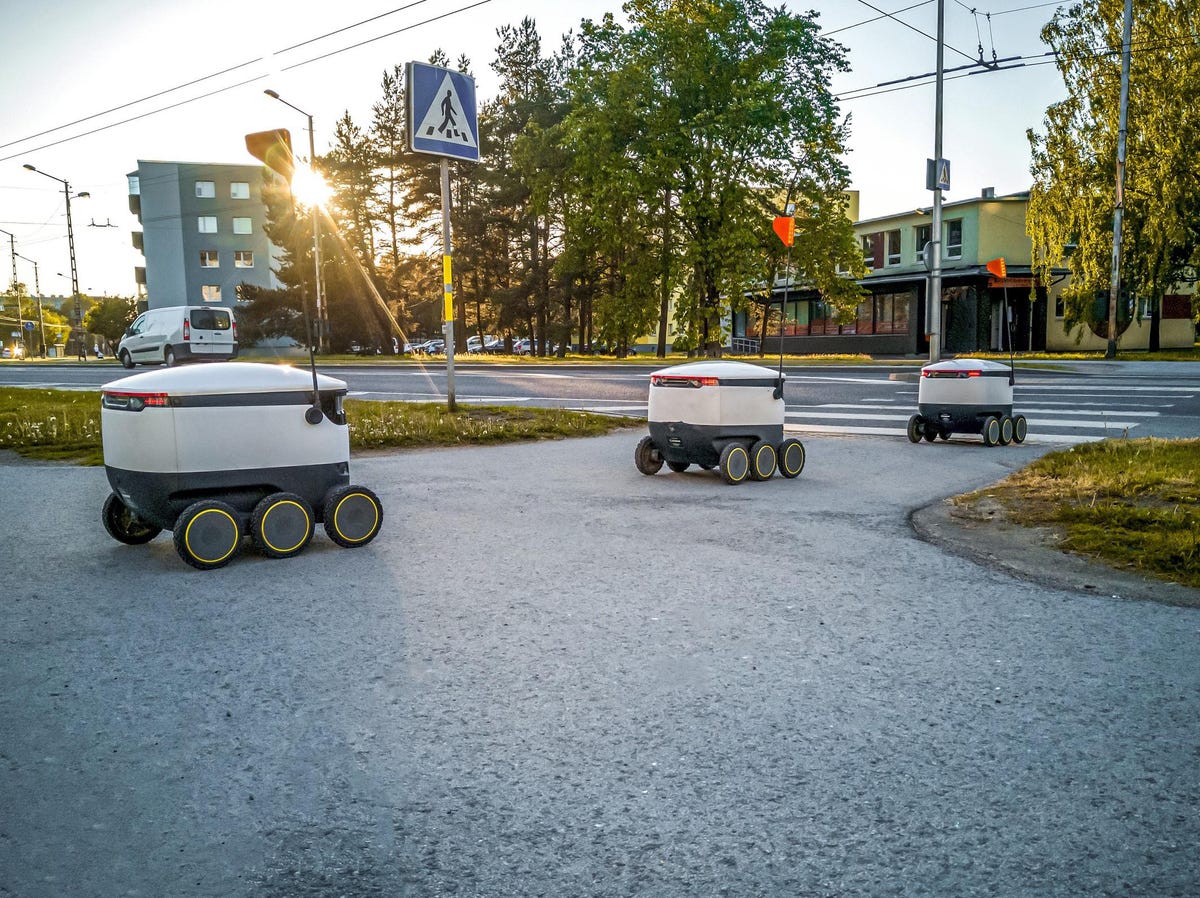
Delivery robots – just a few years ago, the stuff of pure science fiction – are now very much a reality and quickly becoming a part of everyday life for many of us. In fact, I will usually come across five or six when I go for an evening jog in my hometown of Milton Keynes, England!
These particular ones belong to Starship, a company that deployed its first autonomous delivery bots just three years ago and now operates a fleet of over a thousand, in several locations in the UK, USA, and very soon in mainland Europe too.
The Future Of Delivery Robots
Adobe Stock
I spoke to their CEO, Alastair Westgarth, who told me that his robots had traveled a total of 3.6 million kilometers to make 2 million deliveries. Powered by machine learning algorithms, they are constantly getting smarter, meaning they become more efficient as well as safer.
Of these journeys, the vast majority are completed fully autonomously; however, human operators are always ready to step in when needed. Westgarth told me, “Safety is always our number one priority, so if a robot encounters something unusual, it will stop and send an alert to our remote operators.
“Most of the time, they will say it’s okay, proceed – and release the robot. That’s 90% of the interactions … say there’s a new crossing that’s highly complex. But 99% of the time, they are driving completely autonomously.”
This increasingly confident performance is something I can vouch for myself, having witnessed their evolution with my own eyes. When they first appeared on the streets near my home, they would come to a halt any time a person moved close to them. Now, it is evident that they’ve learned to navigate by themselves, and I will see them just make small corrections to their course in order to avoid moving into my path.
The robots are packed with sensors, including cameras with machine vision, radar, and ultrasonic sensors that detect solid objects like curbs and walls. They cross 80,000 roads every day, and initially, these were all carried out by human operators. However, as the robots learned more about their environments, today almost every one is carried out autonomously.
“We’ve driven 3.6 million kilometres so that’s a significant amount of ground we’ve covered, and we do it 24/7, in the dark, in the snow, in heavy rain … when we first encountered snow it was something the robots weren’t familiar with, it produced different images from the cameras, and the sensors reacted differently, so we had to train our systems to deal with that environment. They are constantly learning … our autonomy today is orders of magnitude bigger.”
When we talk about robots, one topic we can’t afford to ignore is the potential impact on human jobs. Delivery robots clearly pose a threat to human employment, and while a common reaction to this is to suggest that humans could be doing better things with their brains and bodies than the relatively menial task of making deliveries, nevertheless these are jobs that allow people to earn a living and support families.
Westgarth says that he is confident that enterprises like Starship will make more job openings available to human beings than it will take away.
“We believe in our heart of hearts that as we bring in more technology that makes the experience more efficient and more valuable … that we add to the employment base. We’re migrating employment, and … at the end of the day, we hope that the number of jobs we create offsets the number of jobs that may be lost by autonomous delivery. If we look at history, as efficiency and autonomy come in, the economy grows, and more jobs are created – an obvious example is that there are no stagecoach drivers now, but there are car drivers.
“At the end of the day, there will be more people taking care of our robots, more people providing services to the merchants we deliver for, people programming our software, developing our apps on phones and tablets. So employment will change, but we believe it will go up,” Westgarth says.
Starship’s robots operate at what is known as the “last mile” of the delivery process – in reality, the last one to three miles. This involves delivering goods from supermarkets, grocery stores, takeaway food venues, and restaurants. Other elements of the delivery and logistics industry are concerned with longer distance domestic and international delivery, and here the impact of automation will be felt soon too – with autonomous shipping, delivery vans, and airborne drones all on the horizon. Of course, I took the opportunity to ask Westgarth where he sees Starship fitting into this and how society will adapt to the broader challenges of autonomous delivery, going forward.
“We have no intention of delivering Sprinter van levels … over ten or twenty kilometers”, he tells me. “There’s a need for that and ways to provide it, and today all of that is still manual. But probably, it will become more autonomous in the future. [Delivery is] multi-modal … its very difficult to scale these things economically with purely human-driven options … so there’re challenges there. [But] it’s much easier to scale the last-mile delivery, with an autonomous approach.
“We’re trying to deliver goods in as efficient and effective a manner – where we’re adding to the value chain instead of taking away. I think it’s a very bright future, we’ll see autonomous vehicles delivering on the road, we’ll see more on the sidewalk, and we’ll see other options like drones as well. We want to be part of that future.”
You can watch my interview with Alastair Westgarth, CEO of Starship, in full here, where we also cover issues including skills and qualities that workers will need to thrive in an autonomous future.
Credit: Source link