New York Tech Media
  • News
  • FinTech
  • AI & Robotics
  • Cybersecurity
  • Startups & Leaders
  • Venture Capital
No Result
View All Result
  • News
  • FinTech
  • AI & Robotics
  • Cybersecurity
  • Startups & Leaders
  • Venture Capital
No Result
View All Result
New York Tech Media
No Result
View All Result
Home AI & Robotics

Training Computer Vision Models on Random Noise Instead of Real Images

New York Tech Editorial Team by New York Tech Editorial Team
December 9, 2021
in AI & Robotics
0
Training Computer Vision Models on Random Noise Instead of Real Images
Share on FacebookShare on Twitter

Researchers from MIT Computer Science & Artificial Intelligence Laboratory (CSAIL) have experimented with using random noise images in computer vision datasets to train computer vision models , and have found that instead of producing garbage, the method is surprisingly effective:

Generative models from the experiment, sorted by performance. Source: https://openreview.net/pdf?id=RQUl8gZnN7O

Generative models from the experiment, sorted by performance. Source: https://openreview.net/pdf?id=RQUl8gZnN7O

Feeding apparent ‘visual trash’ into popular computer vision architectures should not result in this kind of performance. On the far right of the image above, the black columns represent accuracy scores (on Imagenet-100) for four ‘real’ datasets. While the ‘random noise’ datasets preceding it (pictured in various colors, see index top-left) can’t match that, they are nearly all within respectable upper and lower bounds (red dashed lines) for accuracy.

In this sense ‘accuracy’ does not mean that a result necessarily looks like a face, a church, a pizza, or any other particular domain for which you might be interested in creating an image synthesis system, such as a Generative Adversarial Network, or an encoder/decoder framework.

Rather, it means that the CSAIL models have derived broadly applicable central ‘truths’ from image data so apparently unstructured that it should not be capable of supplying it.

Diversity Vs. Naturalism

Neither can these results be attributed to over-fitting: a lively discussion between the authors and reviewers at Open Review reveals that mixing different content from visually diverse datasets (such as ‘dead leaves’, ‘fractals’ and ‘procedural noise’ – see image below) into a training dataset actually improves accuracy in these experiments.

This suggests (and it’s a bit of a revolutionary notion) a new type of ‘under-fitting’, where ‘diversity’ trumps ‘naturalism’.
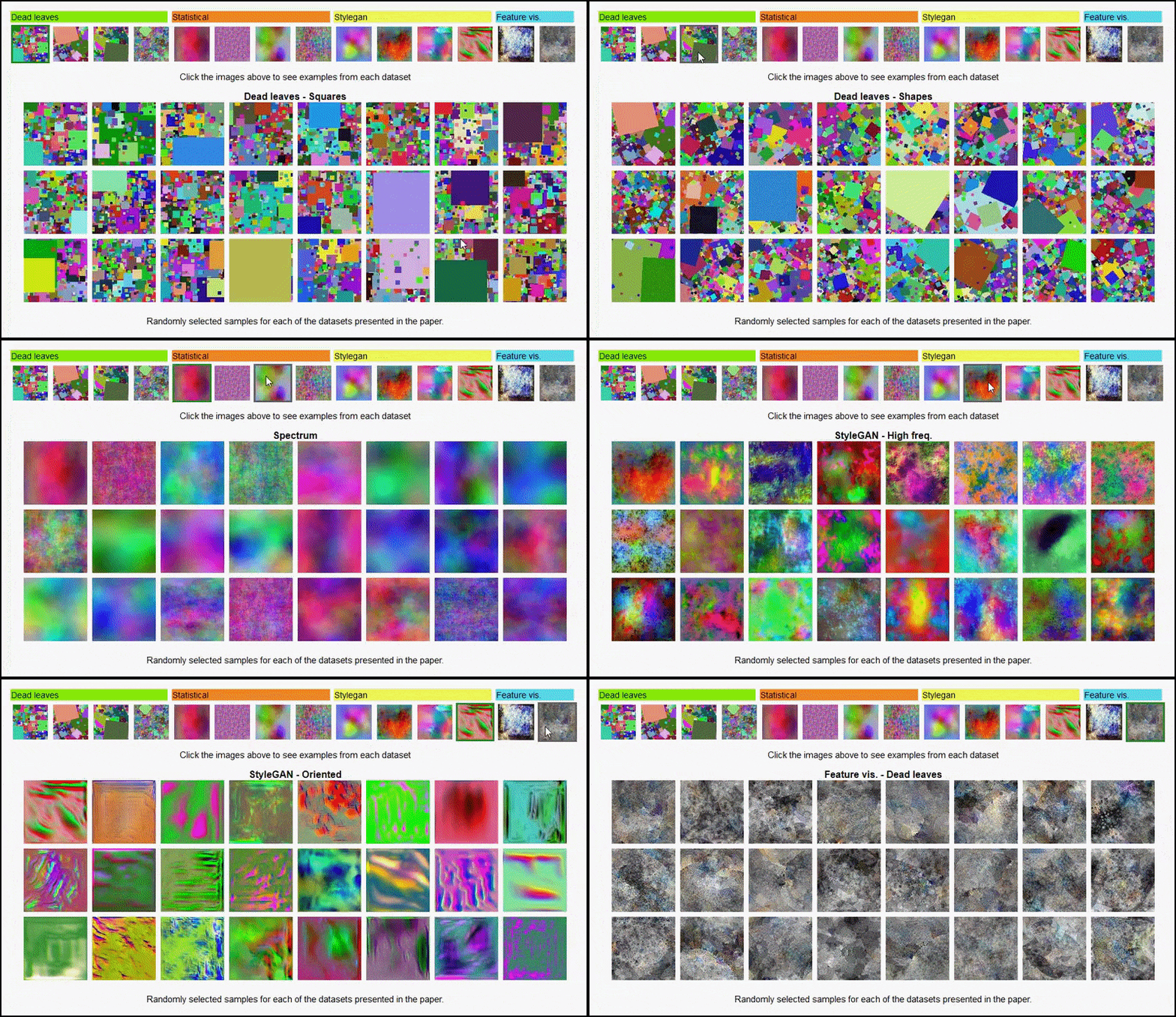
The project page for the initiative lets you interactively view the different types of random image datasets used in the experiment. Source: https://mbaradad.github.io/learning_with_noise/

The project page for the initiative lets you interactively view the different types of random image datasets used in the experiment. Source: https://mbaradad.github.io/learning_with_noise/

The results obtained by the researchers call into question the fundamental relationship between image-based neural networks and the ‘real world’ images that are thrown at them in alarmingly greater volumes each year, and imply that the need to obtain, curate and otherwise wrangle hyperscale image datasets may eventually become redundant. The authors state:

‘Current vision systems are trained on huge datasets, and these datasets come with costs: curation is expensive, they inherit human biases, and there are concerns over privacy and usage rights.  To counter these costs, interest has surged in learning from cheaper data sources, such as unlabeled images.

‘In this paper, we go a step further and ask if we can do away with real image datasets entirely, by learning from procedural noise processes.’

The researchers suggest that the current crop of machine learning architectures may be inferring something far more fundamental (or, at least, unexpected) from images than was previously thought, and that ‘nonsense’ images can potentially impart a great deal of this knowledge far more cheaply, even with the possible use of ad hoc synthetic data, via dataset-generation architectures that generate random images at training time:

‘We identify two key properties that make for good synthetic data for training vision systems:  1)naturalism, 2) diversity. Interestingly, the most naturalistic data is not always the best, since naturalism can come at the cost of diversity.

‘The fact that naturalistic data help may not be surprising, and it suggests that indeed, large-scale real data has value. However, we find that what is crucial is not that the data be real but that it be naturalistic, i.e. it must capture certain structural properties of real data.

‘Many of these properties can be captured in simple noise models.’

Feature visualizations resulting from an AlexNet-derived encoder on some of the various 'random image' datasets used by the authors, covering the 3rd and 5th (final) convolutional layer. The methodology used here follows that set out in Google AI research from 2017.

Feature visualizations resulting from an AlexNet-derived encoder on some of the various ‘random image’ datasets used by the authors, covering the 3rd and 5th (final) convolutional layer. The methodology used here follows that set out in Google AI research from 2017.

The paper, presented at the 35th Conference on Neural Information Processing Systems (NeurIPS 2021) in Sydney, is titled Learning to See by Looking at Noise, and comes from six researchers at CSAIL, with equal contribution.

The work was recommended by consensus for a spotlight selection at NeurIPS 2021, with peer commenters characterizing the paper as ‘a scientific breakthrough’ that opens up a ‘great area of study’, even if it raises as many questions as it answers.

In the paper, the authors conclude:

‘We have shown that, when designed using results from past research on natural image statistics, these datasets can successfully train visual representations. We hope that this paper will motivate the study of new generative models capable of producing structured noise achieving even higher performance when used in a diverse set of visual tasks.

‘Would it be possible to match the performance obtained with ImageNet pretraining? Maybe in the absence of a large training set specific to a particular task, the best pre-training might not be using a standard real dataset such as ImageNet.’


Credit: Source link

Previous Post

Is This Recent Fintech IPO Worth Your Money?

Next Post

RPSG Capital Ventures announces first D2C accelerator, selects 7 startups

New York Tech Editorial Team

New York Tech Editorial Team

New York Tech Media is a leading news publication that aims to provide the latest tech news, fintech, AI & robotics, cybersecurity, startups & leaders, venture capital, and much more!

Next Post
RPSG Capital Ventures announces first D2C accelerator, selects 7 startups

RPSG Capital Ventures announces first D2C accelerator, selects 7 startups

  • Trending
  • Comments
  • Latest
Meet the Top 10 K-Pop Artists Taking Over 2024

Meet the Top 10 K-Pop Artists Taking Over 2024

March 17, 2024
Panther for AWS allows security teams to monitor their AWS infrastructure in real-time

Many businesses lack a formal ransomware plan

March 29, 2022
Zach Mulcahey, 25 | Cover Story | Style Weekly

Zach Mulcahey, 25 | Cover Story | Style Weekly

March 29, 2022
10 Raunchy Movies on Netflix You Won’t Regret Watching

10 Raunchy Movies on Netflix You Won’t Regret Watching

May 20, 2024
How To Pitch The Investor: Ronen Menipaz, Founder of M51

How To Pitch The Investor: Ronen Menipaz, Founder of M51

March 29, 2022
Japanese Space Industry Startup “Synspective” Raises US $100 Million in Funding

Japanese Space Industry Startup “Synspective” Raises US $100 Million in Funding

March 29, 2022
Startups On Demand: renovai is the Netflix of Online Shopping

Startups On Demand: renovai is the Netflix of Online Shopping

2
Robot Company Offers $200K for Right to Use One Applicant’s Face and Voice ‘Forever’

Robot Company Offers $200K for Right to Use One Applicant’s Face and Voice ‘Forever’

1
Menashe Shani Accessibility High Tech on the low

Revolutionizing Accessibility: The Story of Purple Lens

1

Netgear announces a $1,500 Wi-Fi 6E mesh router

0
These apps let you customize Windows 11 to bring the taskbar back to life

These apps let you customize Windows 11 to bring the taskbar back to life

0
This bipedal robot uses propeller arms to slackline and skateboard

This bipedal robot uses propeller arms to slackline and skateboard

0
laptop on glass table

Automat-it Cuts Deployment Friction as Monce Scales AI Order Processing on AWS

April 13, 2026
Lee's Famous Recipe Chicken

Why Lee’s Famous Recipe Chicken Is Betting on Hi Auto to Quietly Rewire the Drive-Thru

April 9, 2026
computer generated image of letters

San Francisco Tribune Lists 11 HumanX Startups Moving AI Closer to the Operating Core

April 8, 2026
Impala CEO and Highrise AI CEO

The Industrialization of AI Infrastructure: What Impala and Highrise AI Reveal About the Next Scaling Frontier

April 7, 2026
Employee Time Tracking

What is an Employee Time Tracking Solution? A Definite Guide for 2026

March 31, 2026
Voltify founders

Voltify Raises $30 Million Seed Round as It Challenges $1 Trillion Rail Electrification Model

March 31, 2026

Recommended

laptop on glass table

Automat-it Cuts Deployment Friction as Monce Scales AI Order Processing on AWS

April 13, 2026
Lee's Famous Recipe Chicken

Why Lee’s Famous Recipe Chicken Is Betting on Hi Auto to Quietly Rewire the Drive-Thru

April 9, 2026
computer generated image of letters

San Francisco Tribune Lists 11 HumanX Startups Moving AI Closer to the Operating Core

April 8, 2026
Impala CEO and Highrise AI CEO

The Industrialization of AI Infrastructure: What Impala and Highrise AI Reveal About the Next Scaling Frontier

April 7, 2026

Categories

  • AI & Robotics
  • Benzinga
  • Cybersecurity
  • FinTech
  • New York Tech
  • News
  • Startups & Leaders
  • Venture Capital

Tags

AI AI QSRs Allseated Automat-it AWS B2B marketing Business CISO CISO Whisperer Collaborations Companies To Watch cryptocurrency Cybersecurity Entrepreneur Fetcherr Finance FINQ Fintech Funding Announcement hi-tech Hi Auto Impala Investing Investors investorsummit Israel israelitech Leaders LinkedIn Leaders Metaverse Mindset Minnesota omri hurwitz PointFive PR QSR Real Estate start- up startupnation Startups Startups On Demand Tech Tech leaders Unlimited Robotics VC
  • Contact Us
  • Privacy Policy
  • Terms and conditions

© 2024 All Rights Reserved - New York Tech Media

No Result
View All Result
  • News
  • FinTech
  • AI & Robotics
  • Cybersecurity
  • Startups & Leaders
  • Venture Capital

© 2024 All Rights Reserved - New York Tech Media