


Lee et al.
Most muscles in our bodies only act in response to incoming nerve signals, which have to trigger each individual muscle cell to contract or relax. But heart muscle is different. The impulses that trigger contraction in heart muscle are passed from one muscle cell to its neighbors, leading to a rhythmic wave of contractions. This is so thoroughly built into the system that a sheet of heart muscle cells in a culture dish will start contracting spontaneously.
Now, researchers have taken advantage of some of the unique properties of cardiac cells to build a swimming robot fish powered by nothing but sugar. And while they tried to craft the heart’s equivalent of a pacemaker, it turned out not to be needed: the right arrangement of muscle cells got the fish swimming spontaneously.
Building a heart-like muscle
In some ways, the paper describing the new robot fish is a tribute to our growing ability to control stem cell development. The researchers behind the paper, based at Harvard, decided to use cardiac muscle cells to power their robot. A couple of years ago, this would have meant dissecting out a heart from an experimental animal before isolating and growing its cardiac cells in culture.
For the robot fish, stem cells were better. That’s because stem cells are easier to genetically manipulate, and they are easier to grow into a uniform population. So, the team started with a population of human stem cells and went through the process needed to direct their development so they would form cardiac muscle cells.
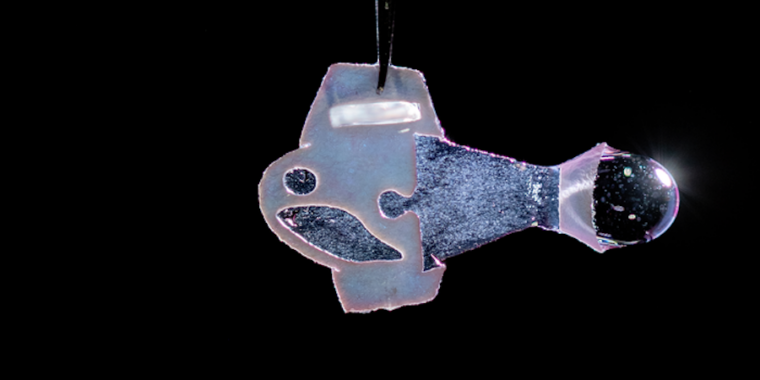
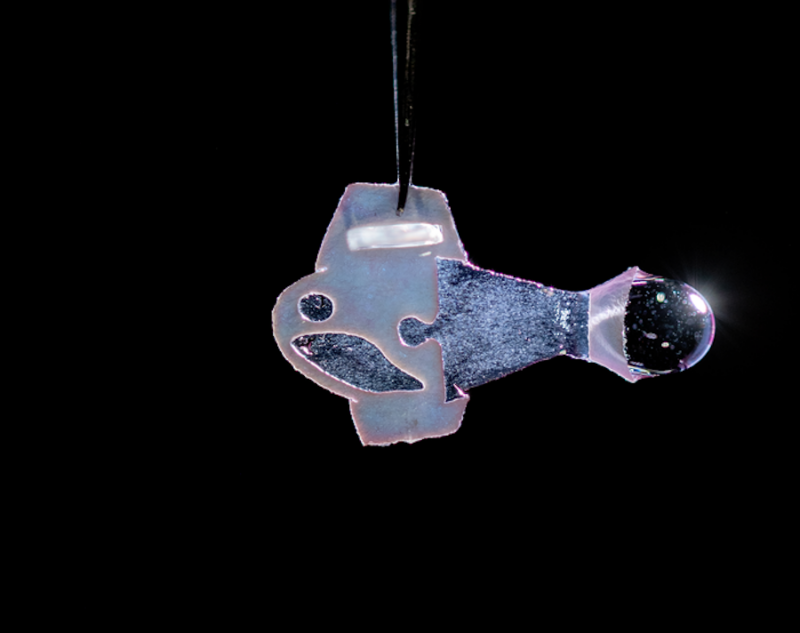
A thin layer of these cells was placed inside a thin slice of gelatin, which held the cells in place on the flanks of the “fish” (one slice on either side). The center of the fish was flexible, so a contraction of the muscle on the right flank would pull the tail to the right, and the same would work for the opposite side. By alternating left and right contractions, the fish would pull its tail from side to side, propelling it forward. Beyond that, the fish had a large dorsal “fin” that contained a buoyancy device to keep the beast oriented upright and prevent it from sinking. The whole thing was powered by putting it in a solution with sugar, which the cardiac muscle cells would absorb.
Perhaps because of this simplicity, the robot was so durable that it was able to swim for well over three months after its construction. Performance was decent at first but improved over the first month as the cardiac cells better integrated into a coherent muscle. Ultimately, the fish was able to travel more than a body length per second. At that pace, the robot was remarkably efficient—per unit of muscle mass, its swimming speed was better than that of actual fish.
In and out of control
One of the things that helped enable the robot fish’s efficiency is notable by its absence in the photo above: any sort of control circuitry. The researchers actually tested a number of ways of controlling the muscles but ultimately found that the simplest option was the best.
The first attempt to control the muscles relied on a bit of genetic engineering. Muscles are triggered to contract by the influx of ions, normally triggered by nerve impulses. But researchers have identified some proteins that act as light-activated ion channels, which will create an influx of ions in response to specific wavelengths of light. So, the researchers engineered the cells on one flank to be sensitive to red light and those on the other sensitive to blue. This worked well, allowing alternating flashes of red and blue light to swim the fish forward.
The second method the researchers tried was inspired by the structure of the heart, which contains a cluster of cells that acts as a pacemaker by triggering a contraction that spreads from there. The researchers formed a ball of cardiac cells to act as a pacemaker and made a bridge of cells that connected the cardiac cells to the flank muscles. The influx of ions that started in the pacemaker cells could spread to the muscles, driving a contraction.
This worked to a degree but turned out to be of secondary importance. The two muscles, the researchers discovered, paced each other’s contractions.
Cardiac muscle cells also have stretch receptors. Pull on the cell too much, and the receptor will be activated and trigger a contraction. This turned out to provide a built-in coordination for the flank muscles. As one right side contracted, it caused the cells on the opposite side to stretch. Once they hit a critical point, the stretch receptors on the left side would trigger that muscle to contract, stretching the right. That stretch then restarted the cycle.
This wouldn’t work indefinitely, and the two muscles would eventually go out of synch. That’s when the pacemaker could help get them back into a regular cycle.
Overall, this is far more impressive than useful (unless you’re the sort who’s only impressed by useful things). There aren’t a lot of situations that call for a robot to swim through a solution of sugar, after all. But the fact that researchers were able to figure out how to use the basic biological properties of these cells to craft an effective machine certainly fits my definition of impressive.
Science, 2022. DOI: 10.1126/science.abh0474 (About DOIs).
Credit: Source link