

New York Tech Media
  • News
  • FinTech
  • AI & Robotics
  • Cybersecurity
  • Startups & Leaders
  • Venture Capital
No Result
View All Result
  • News
  • FinTech
  • AI & Robotics
  • Cybersecurity
  • Startups & Leaders
  • Venture Capital
No Result
View All Result
New York Tech Media
No Result
View All Result
Home AI & Robotics

AI Generated Faces Are More Trustworthy Than Real Faces Say Researchers Who Warn of “Deep Fakes”

New York Tech Editorial Team by New York Tech Editorial Team
February 14, 2022
in AI & Robotics
0
AI Generated Faces Are More Trustworthy Than Real Faces Say Researchers Who Warn of “Deep Fakes”
Share on FacebookShare on Twitter

Summary: People have trouble distinguishing between real people’s faces and AI StyleGAN2 synthesized faces. People also consider AI-generated faces to be more trustworthy.

Source: Lancaster University

People cannot distinguish between a face generated by Artificial Intelligence – using StyleGAN2- and a real face say researchers, who are calling for safeguards to prevent “deep fakes”.

AI-synthesized text, audio, image, and video have already been used for so-called “revenge porn”, fraud and propaganda.

Dr Sophie Nightingale from Lancaster University and Professor Hany Farid from the University of California, Berkeley, conducted experiments in which participants were asked to distinguish state of the art StyleGAN2 synthesized faces from real faces and what level of trust the faces evoked.

The results revealed that synthetically generated faces are not only highly photo realistic, but nearly indistinguishable from real faces and are even judged to be more trustworthy.

“Our evaluation of the photo realism of AI-synthesized faces indicates that synthesis engines have passed through the uncanny valley and are capable of creating faces that are indistinguishable – and more trustworthy – than real faces.”

The researchers warn of the implications of people’s inability to identify AI-generated images.

“Perhaps most pernicious is the consequence that in a digital world in which any image or video can be faked, the authenticity of any inconvenient or unwelcome recording can be called into question.”

  • In the first experiment, 315 participants classified 128 faces taken from a set of 800 as either real or synthesized. Their accuracy rate was 48%, close to a chance performance of 50%.
  • In a second experiment, 219 new participants were trained and given feedback on how to classify faces. They classified 128 faces taken from the same set of 800 faces as in the first experiment – but despite their training, the accuracy rate only improved to 59%.

The researchers decided to find out if perceptions of trustworthiness could help people identify artificial images.

“Faces provide a rich source of information, with exposure of just milliseconds sufficient to make implicit inferences about individual traits such as trustworthiness. We wondered if synthetic faces activate the same judgements of trustworthiness. If not, then a perception of trustworthiness could help distinguish real from synthetic faces.”

A third study asked 223 participants to rate the trustworthiness of 128 faces taken the same set of 800 faces on a scale of 1 (very untrustworthy) to 7 (very trustworthy).

The average rating for synthetic faces was 7.7% MORE trustworthy than the average rating for real faces which is statistically significant.
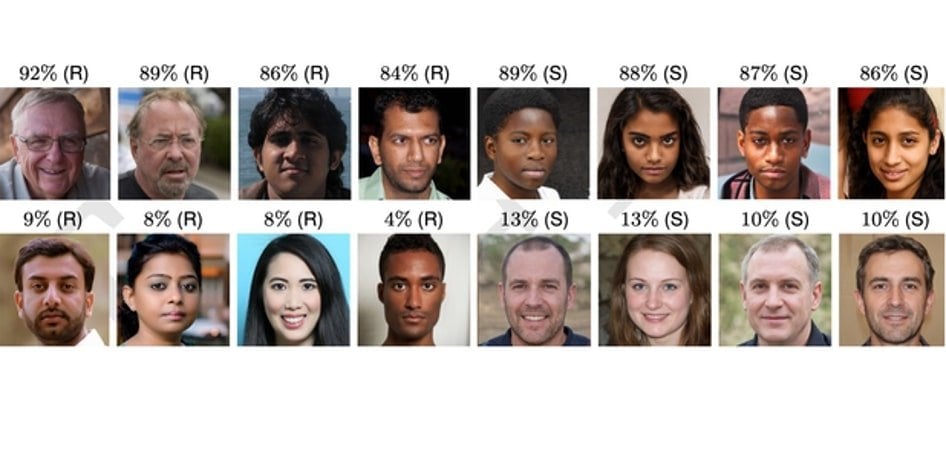
This shows a mix of real people's faces and AI generated faces
The most (top row) and least (bottom row) accurately classified real (R) and synthetic (S) faces. Credit: NVIDIA Corporation

“Perhaps most interestingly, we find that synthetically-generated faces are more trustworthy than real faces.”

  • Black faces were rated as more trustworthy than South Asian faces but otherwise there was no effect across race.
  • Women were rated as significantly more trustworthy than men.

“A smiling face is more likely to be rated as trustworthy, but 65.5% of the real faces and 58.8% of synthetic faces are smiling, so facial expression alone cannot explain why synthetic faces are rated as more trustworthy.”

See also

This shows a woman smelling flowers in a garden

The researchers suggest that synthesized faces may be considered more trustworthy because they resemble average faces – which themselves are deemed more trustworthy.

To protect the public from “deep fakes”, they also proposed guidelines for the creation and distribution of synthesized images.

“Safeguards could include, for example, incorporating robust watermarks into the image- and video-synthesis networks that would provide a downstream mechanism for reliable identification. Because it is the democratization of access to this powerful technology that poses the most significant threat, we also encourage reconsideration of the often-laissez-faire approach to the public and unrestricted releasing of code for anyone to incorporate into any application.

“At this pivotal moment, and as other scientific and engineering fields have done, we encourage the graphics and vision community to develop guidelines for the creation and distribution of synthetic-media technologies that incorporate ethical guidelines for researchers, publishers, and media distributors.”

About this AI research news

Author: Gillian Whitworth
Source: Lancaster University
Contact: Gillian Whitworth – Lancaster University
Image: The image is credited to NVIDIA Corporation

Original Research: The findings will appear in PNAS

Credit: Source link

Previous Post

The beating heart of a swimming robot

Next Post

Andrew Peterson joins Nucleus Security Advisory Board

New York Tech Editorial Team

New York Tech Editorial Team

New York Tech Media is a leading news publication that aims to provide the latest tech news, fintech, AI & robotics, cybersecurity, startups & leaders, venture capital, and much more!

Next Post
WekaIO expands its management team with two key executives

Andrew Peterson joins Nucleus Security Advisory Board

  • Trending
  • Comments
  • Latest
Meet the Top 10 K-Pop Artists Taking Over 2024

Meet the Top 10 K-Pop Artists Taking Over 2024

March 17, 2024
Clubhouse will soon let you pin links to the top of rooms

Clubhouse will soon let you pin links to the top of rooms

October 23, 2021
10 Raunchy Movies on Netflix You Won’t Regret Watching

10 Raunchy Movies on Netflix You Won’t Regret Watching

May 20, 2024
Panther for AWS allows security teams to monitor their AWS infrastructure in real-time

Many businesses lack a formal ransomware plan

March 29, 2022
Zach Mulcahey, 25 | Cover Story | Style Weekly

Zach Mulcahey, 25 | Cover Story | Style Weekly

March 29, 2022
How To Pitch The Investor: Ronen Menipaz, Founder of M51

How To Pitch The Investor: Ronen Menipaz, Founder of M51

March 29, 2022
Startups On Demand: renovai is the Netflix of Online Shopping

Startups On Demand: renovai is the Netflix of Online Shopping

2
Robot Company Offers $200K for Right to Use One Applicant’s Face and Voice ‘Forever’

Robot Company Offers $200K for Right to Use One Applicant’s Face and Voice ‘Forever’

1
Menashe Shani Accessibility High Tech on the low

Revolutionizing Accessibility: The Story of Purple Lens

1

Netgear announces a $1,500 Wi-Fi 6E mesh router

0
These apps let you customize Windows 11 to bring the taskbar back to life

These apps let you customize Windows 11 to bring the taskbar back to life

0
This bipedal robot uses propeller arms to slackline and skateboard

This bipedal robot uses propeller arms to slackline and skateboard

0
Bloom Security and Cyera Turn Data Classification into Real-Time Enforcement at the Endpoint

Bloom Security and Cyera Turn Data Classification into Real-Time Enforcement at the Endpoint

October 22, 2026
Pluto Security Emerges From Stealth With $42M in Funding After Building an AI Security Community

Pluto Security Emerges From Stealth With $42M in Funding After Building an AI Security Community

October 13, 2026
man ordering at a drive thru

Accents, Engine Noise and “No Pickles”: Inside the Hardest Job in Voice AI

October 4, 2026
Essential Car Care Tips for Better Performance and Longer Life

Essential Car Care Tips for Better Performance and Longer Life

October 1, 2026
EB1A graphic design

EB1A Experts Surpasses 330+ Approvals Milestone Amid Rising 2026 EB-1A Approval Rates

September 30, 2026
Upwind team

Upwind Brings Aegis Into Its Cloud and AI Security Platform With New AI Labs

September 23, 2026

Recommended

Bloom Security and Cyera Turn Data Classification into Real-Time Enforcement at the Endpoint

Bloom Security and Cyera Turn Data Classification into Real-Time Enforcement at the Endpoint

October 22, 2026
Pluto Security Emerges From Stealth With $42M in Funding After Building an AI Security Community

Pluto Security Emerges From Stealth With $42M in Funding After Building an AI Security Community

October 13, 2026
man ordering at a drive thru

Accents, Engine Noise and “No Pickles”: Inside the Hardest Job in Voice AI

October 4, 2026
Essential Car Care Tips for Better Performance and Longer Life

Essential Car Care Tips for Better Performance and Longer Life

October 1, 2026

Categories

  • AI & Robotics
  • Benzinga
  • Cybersecurity
  • FinTech
  • New York Tech
  • News
  • Startups & Leaders
  • Venture Capital

Tags

AI AI QSRs AI security Automat-it AWS B2B marketing Bloom Security Business CISO CISO Whisperer Collaborations Companies To Watch Cybersecurity Drive-Thru Enterprise AI Entrepreneur Fetcherr Finance FINQ Fintech Funding Announcement Hi Auto HumanX Impala Investing Investors investorsummit israelitech Mate Security Mindset Minnesota omri hurwitz Perion PointFive PR QSR Real Estate start- up startupnation Startups Startups On Demand Tech Tech leaders VC venture capital
  • Contact Us
  • Privacy Policy
  • Terms and conditions

© 2024 All Rights Reserved - New York Tech Media

No Result
View All Result
  • News
  • FinTech
  • AI & Robotics
  • Cybersecurity
  • Startups & Leaders
  • Venture Capital

© 2024 All Rights Reserved - New York Tech Media