

New York Tech Media
  • News
  • FinTech
  • AI & Robotics
  • Cybersecurity
  • Startups & Leaders
  • Venture Capital
No Result
View All Result
  • News
  • FinTech
  • AI & Robotics
  • Cybersecurity
  • Startups & Leaders
  • Venture Capital
No Result
View All Result
New York Tech Media
No Result
View All Result
Home Cybersecurity

Poor data sanitization practices put public sector data at risk

New York Tech Editorial Team by New York Tech Editorial Team
March 14, 2022
in Cybersecurity
0
Poor data sanitization practices put public sector data at risk
Share on FacebookShare on Twitter

A research launched by Blancco Technology Group reveals current practices and policies for device sanitization within the public sector.
public sector device sanitization

Researchers spoke to 596 government IT leaders across nine countries. The survey revealed that the governments and public sector organizations represented spend as much as $17M annually on the physical destruction of solid-state drives (SSDs), a data storage device widely used both independently and within laptops, desktops, and servers.

Additionally, replacement costs added another $40M, bringing expenses up to $57M for destroying public sector technology that is often still usable. For 70 organizations surveyed in each country, the costs for SSD destruction and replacement reached between $6.9M and $7.3M for the U.S. and between $6.4M and $6.9M for the U.K.

Environmental costs

With global electronic (e-waste) called the “world’s fastest growing domestic waste stream,” the study also explores the environmental costs of physical destruction and the public sector’s current engagement with sustainable alternatives. Unnecessary destruction increases IT operations and materials costs for fiscally constrained public sector organizations. It also fosters increased e-waste creation during a global call for more prudent environmental stewardship.

Despite 54% of respondents agreeing that reuse of SSDs is better for the environment than physical destruction and 93% of respondents saying their organization had defined plans to reduce the environmental impact caused by destroying IT equipment, 21% are actively implementing those plans.

Security concerns

For security reasons, physical destruction is still mandated if decommissioned drives were used to store classified or secret data. For unclassified data-bearing assets, other data sanitization solutions are available.

On the whole, respondents were well informed of their country’s or region’s respective data protection laws. However, some respondents’ processes for carrying out compliant SSD sanitization are concerning. For example, 78% of respondents globally said they reformat drives to sanitize them. Unfortunately, formatting alone can still leave drives vulnerable during transport or storage, and much of the data can be recovered with forensics tools easily available online.

“Governments and public sector organizations are responsible for handling some of the most sensitive information in the world. But several factors, including accelerated digital transformation, rising numbers of public sector data breaches and global sustainability initiatives, are changing the data management landscape,” said Alan Bentley, President of Global Strategy, Blancco.

“With growing environmental and funding pressures, there is a need for these public sector operations to be more sustainable and efficient while maintaining robust security. Public sector organizations must explore SSD sanitization alternatives to demonstrate prudent use of agency funds and a greater contribution to national and international sustainability efforts.”

“We’ve seen several public sector departments benefit from moving away from destroying data bearing assets to reusing them or building up the circular economy. Our study highlights that there are significant opportunities for policy reform surrounding SSD data protection as national policymakers seek to steward financial, environmental, and data resources entrusted to their care,” added Bentley.

As the report concludes, governments and public sector organizations are committing to sustainability improvements, but very few have pushed forward with their implementation. This is resulting in a high cost of SSD destruction and replacement.

With governments and public sector organizations under the spotlight when it comes to spending, it is increasingly urgent that they consider sustainable alternatives that extend device life, maintain lock-tight data security on end-of-life SSDs and, ultimately, save public services millions of dollars.

Device sanitization trends in the public sector

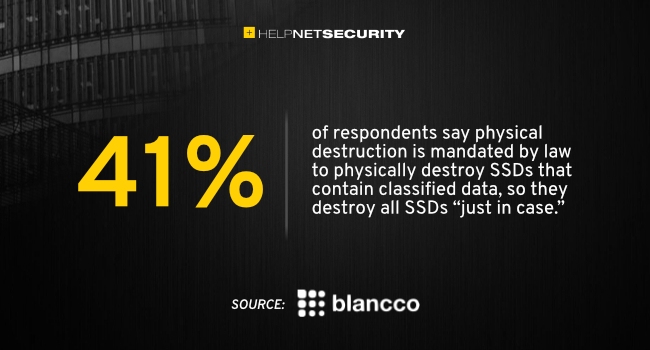
  • 41% of respondents say physical destruction is mandated by law to physically destroy SSDs that contain classified data, so they destroy all SSDs “just in case.”
  • 22% are unaware of alternative methods of sanitization.
  • Between 23% to 52% of organizations within a country believed that physical destruction was cheaper than other sanitization solutions, including those that would facilitate reuse and longer device life.
  • 35% believe there is no certified or approved vendor or solution that provides another option for them.
  • Between 37% and 45% of our respondents’ devices, or the drives alone, are sent offsite for physical destruction.
  • 37% of respondents are “aware of only” the NIST SP 800-88 r1 and do not know guideline details.

Credit: Source link

Previous Post

Model contract language for medical technology cybersecurity published

Next Post

Is this solar power startups’ moment to shine?

New York Tech Editorial Team

New York Tech Editorial Team

New York Tech Media is a leading news publication that aims to provide the latest tech news, fintech, AI & robotics, cybersecurity, startups & leaders, venture capital, and much more!

Next Post
Is this solar power startups’ moment to shine?

Is this solar power startups' moment to shine?

  • Trending
  • Comments
  • Latest
Meet the Top 10 K-Pop Artists Taking Over 2024

Meet the Top 10 K-Pop Artists Taking Over 2024

March 17, 2024
Panther for AWS allows security teams to monitor their AWS infrastructure in real-time

Many businesses lack a formal ransomware plan

March 29, 2022
Zach Mulcahey, 25 | Cover Story | Style Weekly

Zach Mulcahey, 25 | Cover Story | Style Weekly

March 29, 2022
10 Raunchy Movies on Netflix You Won’t Regret Watching

10 Raunchy Movies on Netflix You Won’t Regret Watching

May 20, 2024
How To Pitch The Investor: Ronen Menipaz, Founder of M51

How To Pitch The Investor: Ronen Menipaz, Founder of M51

March 29, 2022
Japanese Space Industry Startup “Synspective” Raises US $100 Million in Funding

Japanese Space Industry Startup “Synspective” Raises US $100 Million in Funding

March 29, 2022
Startups On Demand: renovai is the Netflix of Online Shopping

Startups On Demand: renovai is the Netflix of Online Shopping

2
Robot Company Offers $200K for Right to Use One Applicant’s Face and Voice ‘Forever’

Robot Company Offers $200K for Right to Use One Applicant’s Face and Voice ‘Forever’

1
Menashe Shani Accessibility High Tech on the low

Revolutionizing Accessibility: The Story of Purple Lens

1

Netgear announces a $1,500 Wi-Fi 6E mesh router

0
These apps let you customize Windows 11 to bring the taskbar back to life

These apps let you customize Windows 11 to bring the taskbar back to life

0
This bipedal robot uses propeller arms to slackline and skateboard

This bipedal robot uses propeller arms to slackline and skateboard

0
laptop on glass table

Automat-it Cuts Deployment Friction as Monce Scales AI Order Processing on AWS

April 13, 2026
Lee's Famous Recipe Chicken

Why Lee’s Famous Recipe Chicken Is Betting on Hi Auto to Quietly Rewire the Drive-Thru

April 9, 2026
computer generated image of letters

San Francisco Tribune Lists 11 HumanX Startups Moving AI Closer to the Operating Core

April 8, 2026
Impala CEO and Highrise AI CEO

The Industrialization of AI Infrastructure: What Impala and Highrise AI Reveal About the Next Scaling Frontier

April 7, 2026
Employee Time Tracking

What is an Employee Time Tracking Solution? A Definite Guide for 2026

March 31, 2026
Voltify founders

Voltify Raises $30 Million Seed Round as It Challenges $1 Trillion Rail Electrification Model

March 31, 2026

Recommended

laptop on glass table

Automat-it Cuts Deployment Friction as Monce Scales AI Order Processing on AWS

April 13, 2026
Lee's Famous Recipe Chicken

Why Lee’s Famous Recipe Chicken Is Betting on Hi Auto to Quietly Rewire the Drive-Thru

April 9, 2026
computer generated image of letters

San Francisco Tribune Lists 11 HumanX Startups Moving AI Closer to the Operating Core

April 8, 2026
Impala CEO and Highrise AI CEO

The Industrialization of AI Infrastructure: What Impala and Highrise AI Reveal About the Next Scaling Frontier

April 7, 2026

Categories

  • AI & Robotics
  • Benzinga
  • Cybersecurity
  • FinTech
  • New York Tech
  • News
  • Startups & Leaders
  • Venture Capital

Tags

AI AI QSRs Allseated Automat-it AWS B2B marketing Business CISO CISO Whisperer Collaborations Companies To Watch cryptocurrency Cybersecurity Entrepreneur Fetcherr Finance FINQ Fintech Funding Announcement hi-tech Hi Auto Impala Investing Investors investorsummit Israel israelitech Leaders LinkedIn Leaders Metaverse Mindset Minnesota omri hurwitz PointFive PR QSR Real Estate start- up startupnation Startups Startups On Demand Tech Tech leaders Unlimited Robotics VC
  • Contact Us
  • Privacy Policy
  • Terms and conditions

© 2024 All Rights Reserved - New York Tech Media

No Result
View All Result
  • News
  • FinTech
  • AI & Robotics
  • Cybersecurity
  • Startups & Leaders
  • Venture Capital

© 2024 All Rights Reserved - New York Tech Media