As Russia ramps up preparations for a possible assault on Ukraine, President Biden has ruled out sending U.S. troops, but an invasion would still face serious resistance and Ukraine’s defense minister promising a ‘bloody massacre’ if Russia invades. While Ukraine is heavily outmatched by Russian forces, the threat of heavy casualties is one which Russian cannot ignore. This is why uncrewed systems – remote-controlled robot warriors – could play an important part where the fighting is heaviest.
Soviet Russia shrugged off mass casualties, with Stalin remarking, “One death is a tragedy; a million deaths is a statistic.” During World War II – the Great Patriotic War to Russians – the Soviet Union lost more than 8 million members of its armed forces, 20 times as many as the United States. Names like Stalingrad became legendary for bloody battles and tough resistance regardless of casualties.
Modern Russia is very different. Unlike Stalin, President Putin cannot ignore public opinion, and his media machine will hide or deny Russian casualties in foreign operations. Mercenaries are increasingly used to keep conflict at arm’s length, as the loss of contractors does not play so badly in the motherland.
“Today Russia is more averse to casualties for military and political reasons,” Samuel Bendett, an expert on the Russian defense scene, and adviser to both the CNA and CNAS told me. “Both Chechnya wars are still fresh in many Russians’ memories and the casualties that Russian forces took in those wars has a very powerful and negative effect on the population’s overall support for such campaigns. “
A piece published by thinktank RAND in April suggested that Russia’s aversion to risk would keep it out of Ukraine. The author suggested that the Russian leadership is still haunted by the disastrous campaign in Afghanistan in the 1980s which cost thousands of Russian lives and turned many people against the country’s leadership. Putin could not afford that sort of reaction.
This is why Russia has severely limited its involvement on the ground in Syria and has only lost about fifty troops there – excluding numerous private military contractors. They have, however, used plenty of heavy firepower to remove potential threats to their forces, causing correspondingly high civilian casualties.
An invasion of Ukraine poses a major challenge if Russian casualties are to be avoided. While Russia may easily gain air supremacy, air forces alone cannot take and hold ground, and taking more ground is what the conflict will be all about.
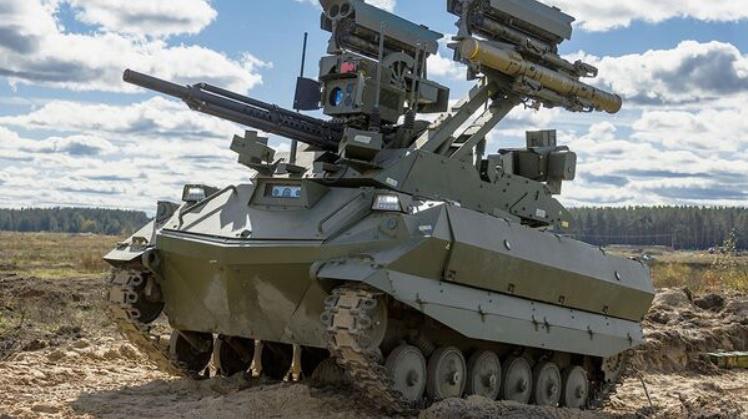
For several years Russia has been pursuing a technological solution to the problem of battlefield casualties. While other nations have pursued armed drones, Russia has carved out a niche in developing and fielding a variety of armed ground robots, most notably the Uran-9, which was used extensively in Syria. To be clear, these are all remote-controlled, with some limited capability to operate on their own when communication is lost, nothing like the traditional sci-fi fully autonomous robot.
Uran-9 “Mobile Robotic Complex” armed with cannon, guided missiles and rockets
Russian Ministry of Defence
The Uran-9 is an uncrewed tracked vehicle the size of a large SUV weighing ten tons. Usual armament is a 30mm automatic cannon, four anti-tank guided missiles and rocket launchers firing unguided thermobaric rockets (the Russians describe this as a rocket-flamethrower), plus a machine gun. It can be remotely controlled from two miles away. A specific aim of fielding the Uran-9 is to “minimize battlefield casualties”: throwing expendable robots into the assault means less fire will be directed at humans.
“The Russian military is presenting the ongoing modernization as turning the military into a precise and high-tech force. Developing different types of unmanned systems speaks to that principle as making missions more effective and ultimately saving soldiers by removing troops from certain dangerous front line combat,” says Bendett.
This approach is seen as heresy in some military quarters. In the U.S. Army for example, unmanned ground vehicles are seen more as auxiliaries, providing logistics support as robot truck drivers and battlefield mules to lug footsoldiers equipment, not replacign them. The Russian approach is to stick a machinegun and a rocket launcher on the mule and send it ahead of the troops, not have it trailing behind.
Russian Defense Minister Sergei Shoigu has been bullish about pursuing robot fighters and has advanced programs rapidly for seven years. Russian newspaper TASS cites a 2018 incident when someone at a technology forum asked Shoigu “whether it was possible that the role of the soldier in the army would change in the near future and combat operations would be conducted by remote-controlled vehicles, while the role of humans would boil down to performing the functions of an operator and a coordinator.”
In other words, will soldiers give up their centuries of warrior tradition to become technicians and machine minders? It is an idea to strike horror into the heart of any military traditionalist. Shoigu’s response was blunt: “Why in the near future? This is being implemented today and is being implemented quite energetically.”
Shoigu went on to state that mass production of combat robots would commence that year.
While the Uran-9 did not perform well in Syria, it was a useful baptism of fire and the developers claim to identified and corrected all the flaws in its performance. Russia has numerous other armed robot projects, such as the Marker, made by the Kalashnikov concern, which recently passed new milestones for autonomous driving as well as working with a drone swarm which located targets for it to destroy. The poster child for Russian’s military machines is the humanoid Fedor robot, shown blasting targets with a pair of Glocks in a video this year. Looking further ahead, an uncrewed versions of it the latest T-14 Armata tank is already going through tests.
While less useful for mobile warfare over varied terrain, such robots may be used for initial reconnaissance, and in set-piece assaults on specific targets. These are the actions where Russia might otherwise take most casualties, and uncrewed systems could be employed where the fighting expected to be fiercest. However, at this stage it still seems unlikely that Russia can field a substantial enough robot fighting force for its needs.
The Marker combat robot can launch a drone to find and confirm targets before engaging them.
Russian MoD
While serial production of Uran-9s was supposed to start in 2018, we do not know how many have been delivered or fielded. Earlier this year it was announced that the first mass testing with Uran-9s was to begin in 2022. Possibly, as with the Syrian deployment, field testing will be brought forward and conducted in a live environment. But are there enough machines and trained operators for a robot force big enough to take the edge off Russian casualties? Bendett doubts it, saying the numbers delivered to date is likely “in the low dozens” and it would take considerable work to get them all to front-line status.
Could armed ground robots, combined with air superiority and massed artillery, deliver victory against a powerful but inferior opponent, while keeping casualties down to a level that the Kremlin finds acceptable? It seems unlikely this time around, but the capability is growing as fast as Russian factories can churn out robots and robot war may not be far away. Just how far is a calculation that military planners, analysts and politicians will be weighing up in months and years to come.
Credit: Source link