


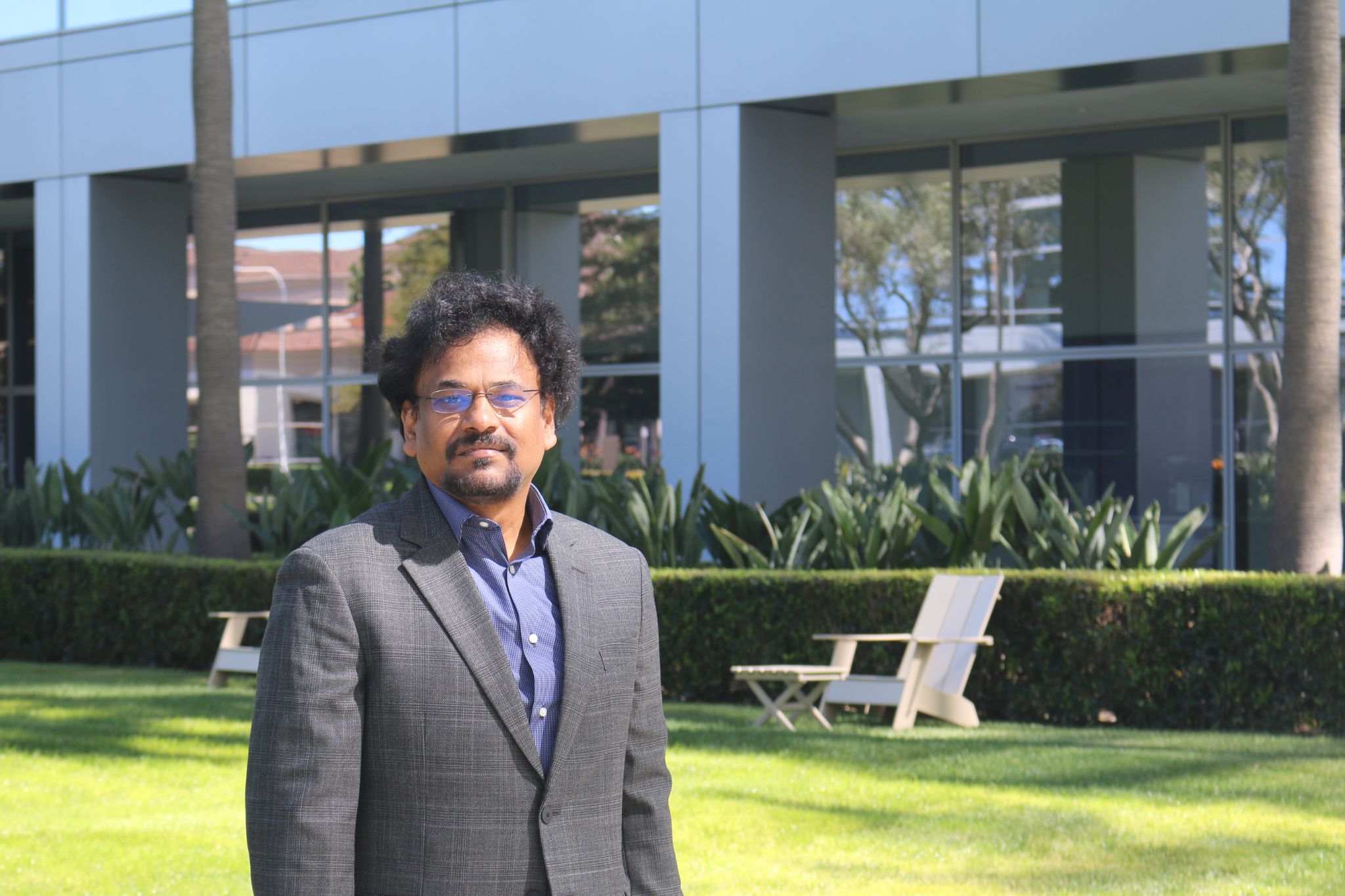
Selvamani Ramasamy holds three patents in the protocols AI fabrics depend on, co-authors the IETF standard extending them, and decides what enters the routing stack of the open-source network OS the hyperscalers run. There are not many like him – and that is the industry’s problem as much as its good fortune.
Every conversation about the artificial intelligence buildout eventually arrives at scarcity. Usually the scarce thing is chips, or power, or land near a substation. Less discussed, and arguably harder to procure, is the engineer who can make a hundred thousand GPUs behave as one machine.
The constraint is real and it is structural. AI fabrics inherited their reliability requirements from telecommunications, where a network interruption measured in seconds is a contractual failure. They inherited their scale and iteration speed from cloud computing. Almost nobody has worked seriously in both worlds. The engineers who have – who can design a routing protocol extension, defend it at a standards body, implement it in production software, and then watch it survive a Tier-1 carrier’s failure conditions – constitute a genuinely small population, and the AI infrastructure sector is currently bidding for all of them at once.
Selvamani Ramasamy is one of them.
Why the Existing Answers Do Not Hold
To understand the shortage it helps to understand the failure modes.
Ethernet VPN, or EVPN, is the technology that lets a data center attach a server to more than one switch so that losing a switch does not lose the server. Standard EVPN multi-homing behavior, however, can produce transient traffic black-holes when a failure and a configuration change overlap: the network keeps forwarding traffic into a path that no longer exists, silently, for a window long enough to matter. In a carrier network that is an SLA breach. In a GPU training cluster, where a synchronization step stalls until the slowest link recovers, it is thousands of accelerators idling on the operator’s money.
Segment Routing over IPv6, or SRv6, carries a parallel problem. It is the mechanism operators use to steer traffic deterministically across a fabric, but its service identifiers historically had to be configured by hand, device by device, and different vendors and hardware generations implement different identifier formats. The result was brittle configuration and route tables that ballooned because operators had to duplicate entries per format.
Neither problem yields to more hardware. Both are control-plane design problems, and both were solved by people who had watched them fail in production.
A Portfolio That Reads as a Repair Log
Ramasamy, now Senior Principal Engineer for routing and AI data center networking at Nexthop AI, spent more than a decade at Ciena as principal architect for EVPN and SRv6 in the NG-SAOS routing platforms that Tier-1 providers deploy worldwide. His three patent filings map directly onto the failures described above.
He redesigned the EVPN state machine and the ordering of protocol updates to hold sub-second convergence through overlapping failure sequences, closing the black-holing window. He defined a BGP-based mechanism by which routers advertise their own SRv6 service identifier handling capabilities, so that transposition happens automatically instead of by hand. And he built a framework allowing a single BGP route to carry services across multiple SRv6 identifier types, so heterogeneous fabrics stop paying a route-table tax for their heterogeneity.
These were shipped, not theorized. The implementations were validated in multi-vendor interoperability testing, including EANTC evaluations and Mobile World Congress demonstrations, before entering live networks carrying mobile backhaul, business VPN and cloud connectivity traffic across North America, Europe and Asia.
Where Authority Is Actually Conferred
In networking, standing is not awarded. It is granted by two bodies that are notoriously difficult to impress: the IETF and the maintainers of the open-source code the industry runs.
Ramasamy co-authors an active Internet-Draft in the IETF’s Inter-Domain Routing working group defining BGP extensions for SR Policy composite candidate paths – filling a gap that had left an advanced traffic-engineering construct usable in architecture documents but not in real networks. His independent submission was merged with an overlapping effort into the current joint draft, the working group’s way of signaling that a contribution is substantive enough to consolidate around. The draft is publicly tracked in the IETF Datatracker, verifiable without reference to anything he says about himself.
The second grant of authority is more unusual. SONiC, the open network operating system adopted across hyperscale and AI infrastructure as an alternative to proprietary vendor stacks, runs its routing subsystem through a working group of more than 300 members drawn from Microsoft, Alibaba, Cisco, Broadcom and Nvidia. For the 202505 release, that community made Ramasamy a co-maintainer for routing.
The role is gatekeeping in the literal sense. Contributions to BGP, EVPN and SRv6 pass through his review, and engineers at companies that compete with his employer rewrite their code in response to his comments in order to be accepted. Membership in that community is broad; authority to gate what enters it belongs to a handful of people.
The Peer Verdict
Senior technical leaders across three companies with no shared commercial interest reach the same conclusion. Cisco Distinguished Engineers Siva Sivabalan and Patrice Brissette – the latter a co-chair of the SONiC Routing Working Group – Alibaba’s Eddie Ruan, who chairs that working group and serves as Vice Chair of the SONiC Technical Steering Committee, and Ciena leaders including Dalen Bosteder and Eli Eisenpress converge on the same description: a very limited group of engineers operates at this depth across routing, EVPN and SRv6 in real production environments, and Ramasamy is in it.
The recurring specific in their assessments is judgment under uncertainty – the ability to say where a protocol will break before it breaks, and to be right often enough that release decisions get routed through him. Ciena leadership relied on that judgment for release-critical calls across multiple NG-SAOS programs. Nexthop AI recruited him specifically for it.
Why It Matters Beyond the Fabric
There is a national dimension to this that is easy to miss because it lives four layers below anything a user sees.
The United States is committing extraordinary capital to AI infrastructure, and the return on that capital is bounded by network reliability. A cluster that cannot converge cleanly through a link failure is a depreciating asset running at partial duty. Work that raises convergence performance and removes classes of silent failure is not an incremental efficiency; it is a precondition for the investment thesis.
The second dimension is control. Open, vendor-neutral routing software is the principal alternative to proprietary network operating systems, and American leadership in SONiC and in the IETF standards defining its behavior determines whether the country’s most strategic infrastructure runs on a foundation it helps govern or one it merely licenses. Every patent, standards contribution and maintainer decision on the open side of that line is a small addition to national technical sovereignty in a sector where sovereignty is now openly discussed as policy.
The third is people. Ramasamy mentors engineers at Nexthop AI, at Ciena, and across the SONiC community, where his reviews function as instruction as much as approval. In a specialty with a documented shortage of qualified engineers, teaching the next tier is not a side activity — it is how the constraint eventually loosens.
The Work Ahead
His current agenda is the unglamorous, decisive kind: BGP convergence behavior tuned for very large GPU clusters, SRv6-based multi-tenant isolation so shared AI infrastructure can be partitioned safely, and moving composite SR policies from standards text into deployed networks.
“The next big test for networking isn’t just carrier services anymore — it’s AI fabrics running at a scale and speed we haven’t fully designed for yet,” Ramasamy said. “I want to keep building the routing foundations that make that possible.”
It is a modest description of a field-defining position. The AI era will be judged on what its models can do. Whether they get the chance depends on a control plane most people will never think about, maintained by a group of engineers small enough to fit in a conference room.