


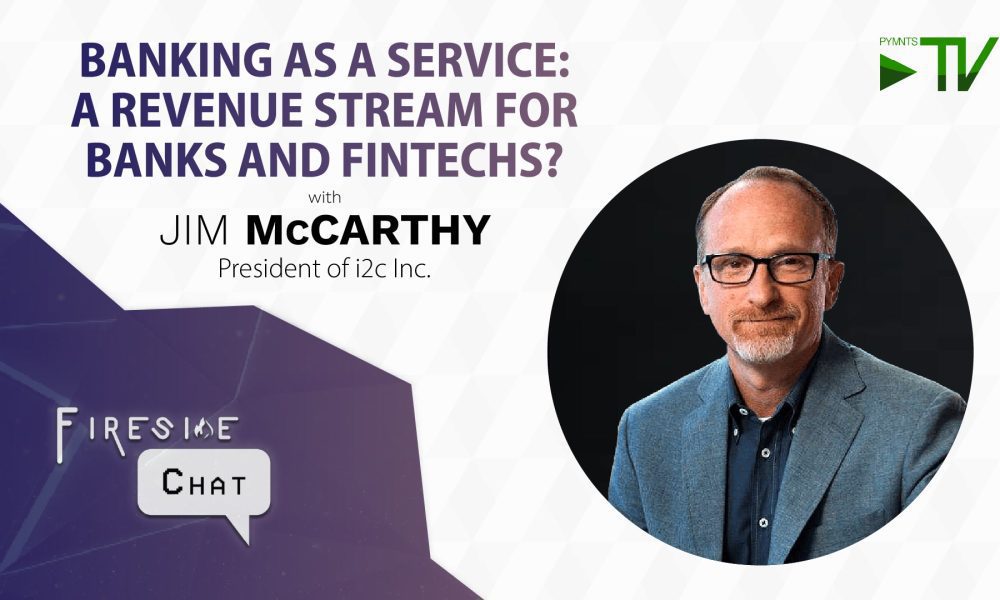
We’re headed toward a not-too-distant future when every retailer can act like a FinTech.
As i2c President Jim McCarthy told PYMNTS’ Karen Webster, every firm should consider doing so — adopting Banking-as-a-Service (BaaS) platforms to offer financial products to their end customers, in context, across digital channels and on demand.
We’ve been here before, in a way. All manner of traditional merchants has been doing this for years, if not decades. Walmart, to give but one example, had Woodforest National Bank housed in its stores; Kroger has had retail terminals and ATMs in its own brick-and-mortar locations.
But as McCarthy noted: “Nothing was ever fully integrated or easy.”
Those somewhat segmented experiences, housed within brick-and-mortar settings, can take a cue from the evolution of retail itself through the past decade and a half. Commerce emerged from its roots of checkout-laned, hard-wired green screens and terminals to a more fluid experience — one that that includes self-service kiosks and in-store devices that let consumers check out in the aisles once they’ve found what they’ve been looking for.
“Because of modern merchant acquiring, because of platforms and gateways, we’ve seen a tremendous amount of innovation in the merchant space to provide a range of new services,” said McCarthy. The key, then, has been the ability to bypass legacy infrastructure in favor of partnerships that leverage each stakeholders’ strengths.
Clocks Tick, Cash Burns
Within financial services’ own digital and physical channels, the lines are blurring across where and when we get access to checking, savings and investing activities. Digital-only platforms — think Monzo, Chime and others — have leveraged the mobile device into a point of access for those services.
But as McCarthy described it, as those digital upstarts began building out their various offerings, they’ve had to find traditional banking partners that would be willing to act as underwriters and ensure compliance — offering up the form and structure to provide checking accounts and cards. Then, they had to go find payment processors to underpin it all.
In the earlier days of financial innovation, he said, FinTechs would have to go out and find banking identification number (BIN) sponsors, banks and processors — and build out new back-office functions and consumer-facing services after doing that.
“All the while, the clock is ticking, and your cash is burning,” he said.
Thankfully, we’re moving past the days of such “stitching together” of services and infrastructure.
Instead of having to go out in the market and search the proverbial forest to find the right partners, there are entities (i2c and its platform among them) that can pull all stakeholders together — at a single point of access.
For the banks, there’s the advantage of leveraging the platforms to market compliance and issuance as services and to set up an incubator inside to test out their own digital initiatives, he said. For the FinTechs, there lies the advantage of sidestepping the hassles of hunting down partners.
The positive ripple effect across the ecosystem is that new products can be tested (and tweaked) quickly before coming to market with application programming interfaces (APIs) and sandboxes — so much so that enterprises can be up and running, issuing virtual cards in a matter of days rather than months.
Putting a better wrapper around banking “allows third parties to provide financial services — as part of bringing commerce in new and unique ways to consumers,” McCarthy said.
Data shows that BaaS can dramatically reduce the cost of acquiring a customer. Usually, these costs range from $100 to $200, but a BaaS solution can drop this to $5 to $35. There’s value, then, in outsourcing infrastructure to a platform, while focusing on the user experience.
“You can test the fundamentals of these new ideas without wasting a lot of time just getting to the starting line,” said McCarthy.
Dollar General stands as a prime example of the flexibility tied to BaaS, where earlier this week, the firm said it would debut new financial services and payment alternatives for its customers, announcing the launch of spendwell, its own banking platform. The firm will pilot a buy now, pay later (BNPL) program with Sezzle and a new FIS Worldpay card reward points system.
Read more: Dollar General Rolls out Banking Option, Tests BNPL
Looking ahead, no matter the merchant or enterprise that seeks to branch out into financial services, digital issuance of cards and wallets remains a significant piece of the BaaS value proposition, said McCarthy.
“The next logical step” of instant digital issuance of the virtual card is to push that card to a digital wallet so that it can be used (for example) anywhere Mastercard is accepted.
Right now, the BaaS service space is a fragmented one, where people will maintain several banking and brokerage relationships. Consolidation will occur naturally, he predicted, leading to the emergence of super apps.
There’s some prologue to tying it all together, said McCarthy, as tens of millions of consumers have their key commerce activities housed within Amazon, which has led to a naturally receptive audience for co-branded cards. He predicted that there will be an embrace of interoperability.
PYMNTS’ own research has found that 67% of consumers in the U.S. — which translates to 173 million people — want an app that manages their digital activities, while another 11% want an app that manages their entire digital lives.
See more: Are You Among the 173M Americans Who Want a Super App?
As banks, FinTechs, platforms and merchants leverage direct feedback and cost effectively, and then ramp new products, McCarthy told Webster, “Everyone is a FinTech — in fact, there’s a FinTech buried inside of every firm. They just may not know it yet.”
——————————
NEW PYMNTS DATA: ACCOUNT OPENING AND LOAN SERVICING IN THE DIGITAL ENVIRONMENT

About: Forty-two percent of U.S. consumers are more likely to open accounts with FIs that make it easy to auto-share their banking details during sign-up. The PYMNTS study Account Opening And Loan Servicing In The Digital Environment, surveyed 2,300 consumers to examine how FIs can leverage open banking to engage customers and create a better account opening experience.
Credit: Source link