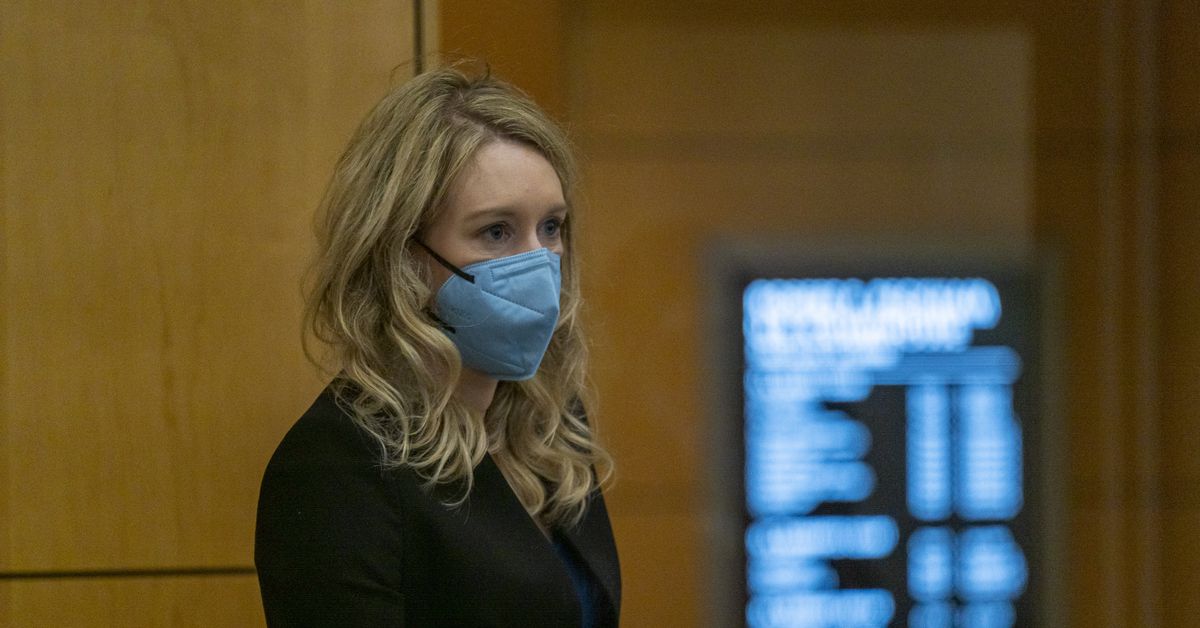
No one was more invested in Theranos than CEO and founder Elizabeth Holmes, she testified today. She owned the most stock. She could even fire the entire board of directors — and basically anyone else at the company.
“Is that fair?” Prosecutor Robert Leach asked Holmes in his cross-examination. “The buck stops with you?”
“I felt that,” Holmes replied.
Holmes’ defense has mostly tried to lay blame elsewhere — lab directors, her co-defendant Sunny Balwani (who is being tried separately), marketing firm Chiat Day, and more. Holmes, who is standing trial for 11 counts of wire fraud, portrayed herself as a true believer in Theranos’ technology who was largely unaware of Theranos’ problems.
In order to knock down that testimony, prosecutors got her to admit to:
- Knowing Theranos was in a precarious financial situation in late 2013
- Altering the text of reports Theranos had written for drug companies, in addition to adding logos to them, before sending them to Walgreens, investors, and journalist Roger Parloff
- Trying to control Wall Street Journal reporter John Carreyrou’s experience at a Theranos wellness center and attempting to kill his story by emailing the WSJ’s owner, Rupert Murdoch, who happened to be a Theranos investor
- Sending the law firm Boies Schiller Flexner after Carreyrou’s sources
- Having lawyers review the language on Theranos’ website, then ignoring their suggestions in slide decks presented to investors afterwards
- Asking Balwani to leave the company
Cash rules everything around me
Today, jurors stared deeply at an Excel sheet.
In August 2013, Theranos was running out of money. The company had to repay money to Blue Cross Blue Shield because Theranos hadn’t satisfied the conditions of a contract. On the week of September 23, 2013, Theranos had about $14.5 million left in free cash. The company had an intense burn rate and was nearly out of money, prosecutor Leach suggested. “I never thought of it like that,” Holmes replied.
A week later, Theranos raised $21.9 million from investors, but the cash crunch hadn’t ended. In December 2013, Balwani texted Holmes to warn her that they were down to $15 million in free cash. “I saw that,” she replied.
Motive established: Theranos needed money, fast.
A little editing
In her direct testimony, Holmes admitted that she’d added logos to the reports Theranos prepared for drug companies before sending them to Walgreens, investors, and others. Earlier in the trial, we heard testimony that these recipients thought the logos meant that the reports hadn’t been prepared by Theranos. During her direct exam, Holmes said adding those logos was an honest mistake, and she only wanted to convey the partnership. She said she regretted that people had been fooled.
Today, we were shown excerpts of Theranos’ contracts with drug companies that expressly forbid use of their logos without prior written permission.
But the logos weren’t all that changed. Snippets of text that might have made it easier to figure out the report was made for Pfizer instead of by Pfizer was removed by Holmes. On a memo Holmes added a Schering-Plough logo to, some of the language in its conclusion section was changed to be even more flattering to Theranos. Asked if she regretted it, she was defiant: “I think this was accurately reflecting the data in the document,” Holmes said.
One document she sent out did come from a drug company — it was an analysis from GlaxoSmithKline. It, too, had been altered. The original, sent from GSK to Theranos, was a word document with no logo. Holmes added the logo. Someone also deleted one of the report’s conclusions, a bullet point that said “finger prick/blood draw procedure was difficult (needed larger lancet and better syringe system).”
Did Holmes make this deletion? She said she didn’t know. She didn’t know who at Theranos might have made those changes to the documents, she said. I found this difficult to believe, particularly since she’d owned some other changes on those documents.
Bad Blood
When Theranos got wind of Wall Street Journal reporter John Carreyrou’s investigation into the company, Holmes and Balwani exchanged texts about him. They’d hired a firm, Fusion GPS, to do “oppo.” “Our oppo guy knows him well,” she texted Balwani.
“We’’ll get [a] killer package for when [we] meet with Carreyrou to turn this into our story,” she texted Balwani later. On the stand, Holmes said she didn’t know if that was a reference to work with Fusion GPS, but I honestly don’t know what else it could be.
“Need to get ahead of all of it,” Holmes texted Balwani. Holmes was shown this text and asked if she remembered she was trying to get ahead of the story. She said it didn’t refresh her memory.
The attempts to control Carreyrou’s reporting didn’t stop there. Holmes and Balwani texted about Carreyrou’s plans to visit a Theranos wellness center and debated whether they should intervene to make sure he didn’t get a fingerstick test.
Then, just for fun, we read some texts where Balwani and Holmes mocked Carreyrou for being French.
When Holmes’ attempts to kill Carreyrou’s stories didn’t work, she appealed to a major Theranos investor: Rupert Murdoch. (Murdoch owns the WSJ and, incidentally, is the inspiration for the menacing patriarch Logan Roy on the excellent television show Succession). She emailed him, with a document attached, trying to get him to broker a meeting between a senior WSJ staffer and Theranos’ lawyers. “I’ve also attached the material Theranos has shared with WSJ (responsive to questions from John Carreryrou) since the materials I gave you in July…. I thought that were I in your shoes I would want to know/be in the loop,” she wrote.
Holmes did not succeed in killing Carreyrou’s story. Shortly after it ran, she went on Jim Cramer’s show, Mad Money, to deny its central claims — so we watched the clip in court. “Every test we run on our laboratory can run on our proprietary devices,” Holmes told Cramer. This was not true — only 12 tests, even fewer than the 15 Carreyrou initially reported, ran on Theranos devices.
Holmes was motionless as she watched the video, except for occasionally pressing her lips together.
Retaliation
In Holmes’ and Balwani’s efforts to get ahead of the story, Balwani tried to figure out who Carreyrou’s sources were. “Down to 5 people. We’ll nail this motherfucker,” Balwani texted Holmes.
“Who do u think,” she replied. “Now we have legal grounds.”
Asked about this in court, Holmes claimed — not especially convincingly — that she and Balwani were talking about who’d left Theranos some bad reviews on Glassdoor.
Balwani texted Holmes, correctly, that Carreyrou’s sources were “Tyler [Shultz], Erika [Cheung] and Adam [Rosendorff].” Holmes didn’t ask who Cheung was, though they’d barely interacted. In fact, the issues Cheung raised were the same ones regulators later found in the Theranos lab, Holmes admitted. “I sure as hell wish we treated her differently,” Holmes said of Cheung.
The letter Cheung received instructed her to “cease and desist from these activities…. Theranos will consider all appropriate remedies, including filing suit against you.” Holmes denied that this was threatening and said she was only trying to protect trade secrets.
Cheung was tailed and served with a threatening letter from Theranos’ lawyers, Boies Schiller. Shultz was surprised at his grandfather’s house by Boies Schiller lawyers, though Holmes denied she’d meant to “ambush” him. Shultz’s grandfather, George, was also a Holmes mentor and sat on her board of directors. He called her, angrily, about the ambush.
“Better”
In 2013, Holmes hired a lawyer to review Theranos’ marketing materials just before the Walgreens launch. “I haven’t quite worked my way through the whole website, but I’m worried,” the lawyer emailed Holmes. “For example, every time you say ‘better’ without specifying what it is better than, you are making a comparative claim, at least to all market leaders. you must be able to substantiate these claims.”
We saw a proposed list of language changes: replacing “highest quality” with “high quality,” “highest levels of accuracy” with “high levels of accuracy,” and “more precise” to “precise.” Lawyers also suggested making sure Holmes substantiated several claims on the site.
But when she wanted more money from investors, it seems she ignored the lawyers.
About three months later, Holmes sent PFM Management’s Bryan Grossman a Powerpoint presentation. “Theranos provides the highest level of oversight, automation and standardization,” one slide said. Another said Theranos tests had the “highest levels of accuracy.”
Around the same time, Lisa Peterson — who worked for the DeVos family office and ultimately led an investment in Theranos— received a Powerpoint said that Theranos’ high-complexity lab “requires the highest level of training.” It also contained information about Theranos’ proficiency testing, but didn’t mention that testing all took place on conventional machines. Holmes said she didn’t remember discussing the slide, but that she didn’t mention modified conventional machines with any investors.
Balwani texts
We saw a lot of texts between Holmes and Balwani. The least successful use of those texts was to try to cast doubt on Holmes’ claims that Balwani abused her.
The prosecution delved into Holmes and Balwani’s relationship, bringing Holmes to tears on the stand twice. Though he hadn’t told her to lie to investors or anyone else, she said that his treatment affected “everything about who I was.”
That seemed particularly evident when she testified that, despite being Balwani’s boss at Theranos, she had to get his approval to live her life. In one text, she asked him if it would be okay for her to see friends in the morning, as long as she was home by 11AM. “I think I was asking permission to see my friends,” Holmes said. “I often tried to ask him if it would be okay if I could see a friend before going to the office or going to a work meeting.”
“Do you know how many times the word ‘love’ appears in these texts?” Leach asked today. She did not, but said she wasn’t surprised to hear it was 594 times. He then instructed her to read some tender exchanges to the court, which made her cry. Mixed in with the affection was business, as when Balwani texted her that he was “worried about your ‘all fingersticks on our technology comment.”
It was hard to tell what the jury made of all this, though I saw a few jurors shifting in their seats during this segment of testimony. It turned my stomach — and gave the defense a serious opening to challenge the prosecution’s overreach.
Some of Holmes’ testimony did actually bolster the prosecution’s case. She said she sometimes gave Balwani direction, that he was an at-will employee, and that she could have fired him at any time. As for his exit at Theranos, “I asked him to leave,” Holmes said. She said that her disillusionment with him after a lab audit turned up lots of problems was part of what prompted her to end their relationship.
Who is Elizabeth Holmes?
The portrait painted on the cross-examination showed a CEO who was in control of her company, and who was actively working to make sure that its presentation to the world was what she wanted it to be.
On direct examination, we were told that Holmes was young and naive. She’d made some mistakes, sure, but she’d also delegated to a lot of experts. Besides, those mistakes weren’t really criminal.
Today we saw someone else — someone who was in firm control of Theranos and wanted to make its story larger than life. We saw memos Holmes doctored to make Theranos more appealing. We read her texts and emails, where she tried to kill an unflattering news story. She also tried to punish the story’s sources when she couldn’t get to the reporter. Despite hiring lawyers to review her language, she ignored their advice when she made investor presentations.
The jury will soon decide whether Holmes is guilty of fraud. What’s no longer up for debate? She was pulling the strings at Theranos.
Credit: Source link