

New York Tech Media
  • News
  • FinTech
  • AI & Robotics
  • Cybersecurity
  • Startups & Leaders
  • Venture Capital
No Result
View All Result
  • News
  • FinTech
  • AI & Robotics
  • Cybersecurity
  • Startups & Leaders
  • Venture Capital
No Result
View All Result
New York Tech Media
No Result
View All Result
Home AI & Robotics

MIT’s Robotic Cheetah Taught Itself How to Run, Sets New Speed Record

New York Tech Editorial Team by New York Tech Editorial Team
March 17, 2022
in AI & Robotics
0
MIT’s Robotic Cheetah Taught Itself How to Run, Sets New Speed Record
Share on FacebookShare on Twitter

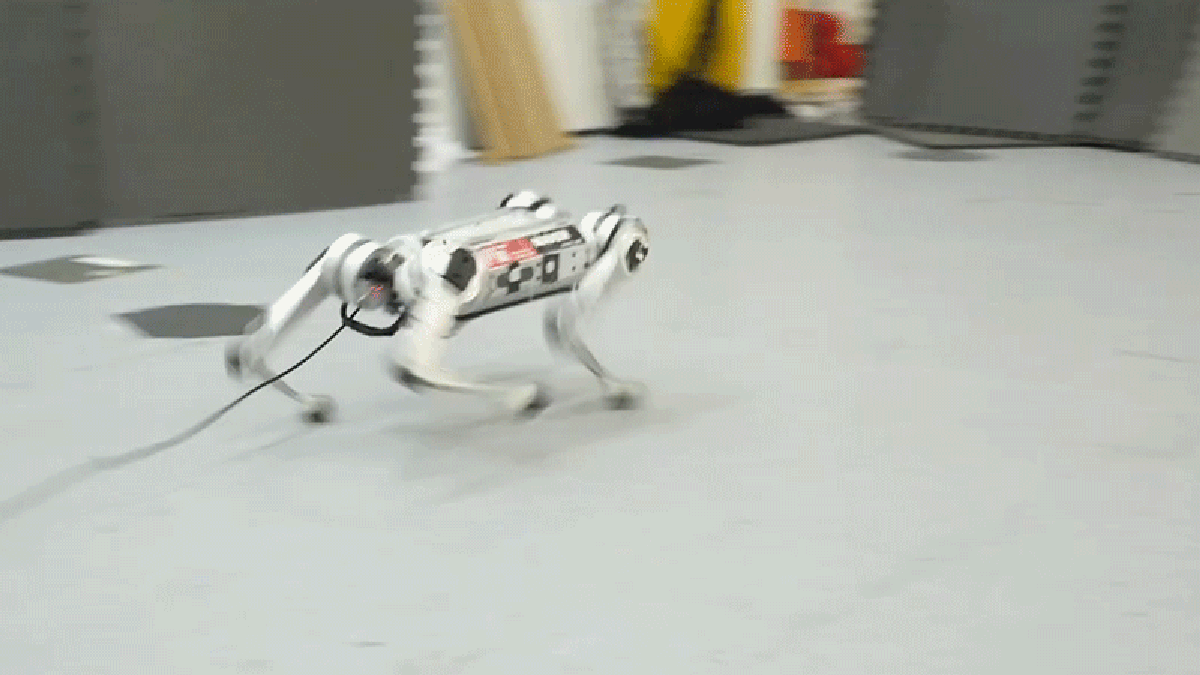
To make their Mini Cheetah better equipped to skillfully scramble across varying terrains, robotics researchers at MIT’s CSAIL used AI-powered simulations to quickly teach the bot to adapt its walking style as needed. That included learning how to run, which resulted in a new gait that allows the robot to move faster than it ever has before.

As much as robot designers strive to engineer and program a robot to handle any situation it might experience in the real world, it’s an impossible task. The world is endlessly chaotic. And when simply walking down a sidewalk, a robot could face a myriad of obstacles from smooth pavement to slippery patches of ice to areas covered in loose gravel to all of the above one after the other. It’s why bi-pedal robots and even quadrupeds usually have a very slow and careful gait. They’re designed and programmed to expect the worst-case scenario when it comes to the terrain they’re navigating and proceed very carefully, even when walking across smooth surfaces free of any debris or obstacles.

Adaptability is the key to making robots move faster and more confidently across varying terrains; changing their gait and speed when they’ve identified a transition from safer surfaces like pavement to materials like loose gravel that require a more careful and slower approach. A robot’s programming can be manually modified and upgraded every time it encounters a new terrain it can’t successfully navigate, but that’s a time-consuming process that inevitably sets the robot up for failure every time it encounters something new.

Image for article titled MIT's Robotic Cheetah Taught Itself How to Run and Set a New Speed Record in the Process

Photo: Thomas Buehler (MIT)

A better approach is to create a robot that can learn by trial and error, and automatically modify and alter its behavior and movements all by itself when it encounters a new terrain. The problem with that approach is that, as with a toddler, it’s not safe to let a robot simply run wild to have all these learning experiences on its own. One of the most promising use cases for robots is being able to send a machine with the same capabilities as a human into areas not safe for humans to go, and requiring a constant babysitter means a robot can’t fulfill that role.

To skip past the childhood full of random learning experiences that most humans go through and accelerate the Mini Cheetah’s development, the researchers at MIT CSAIL turned to artificial intelligence and simulations. In just three hours’ time, the robot experienced 100 days worth of virtual adventures over a diverse variety of terrains and learned countless new techniques for modifying its gait so that it can still effectively loco-mote from point A to point B no matter what might be underfoot.

The Mini Cheetah might not necessarily be able to recognize that it’s loose gravel that’s constantly causing it to lose its footing or ice that’s making its feet slip, but by constantly monitoring its movements it can tell when it’s not walking as effectively as it could, and based on what its legs are doing, it can now adapt their movements to ensure it keeps moving forward. Those adaptations can even compensate for how the robot’s components are performing or underperforming as a result of damage or being over-stressed.

There’s another reason robots don’t run, and it has nothing to do with researchers worried about damaging a custom machine that potentially costs hundreds of thousands of dollars to build. Running requires a robot to push its various components—like electric motors and servos—to the limits of its operating range, at which point they can start to behave and perform different behaviors that are as hard to predict as what might happen to a robot traversing slippery ice. But the same way that the Mini Cheetah can now adapt to different terrains, it can also adapt to how its own components are functioning, which allows it to run more effectively.

It might not be the most graceful thing to watch when moving at high speeds, but the Mini Cheetah hit a new top speed of 3.9 m/s, or a little over 8.7 MPH, which is faster than the average human can run. The new approach isn’t just about teaching robots to run, however. Robot hands could be quickly taught to safely handle thousands of different objects they’ve never physically touched before, and autonomous drones could be taught how to fly in inclement weather through safe simulations instead of sending them out into the real thing to learn by trial and error.

Credit: Source link

Previous Post

Northwestern Mutual’s Financial Planning Platform Wins FinTech Breakthrough Award for Innovation

Next Post

Want to make robots run faster? Try letting AI take control

New York Tech Editorial Team

New York Tech Editorial Team

New York Tech Media is a leading news publication that aims to provide the latest tech news, fintech, AI & robotics, cybersecurity, startups & leaders, venture capital, and much more!

Next Post
Want to make robots run faster? Try letting AI take control

Want to make robots run faster? Try letting AI take control

  • Trending
  • Comments
  • Latest
Meet the Top 10 K-Pop Artists Taking Over 2024

Meet the Top 10 K-Pop Artists Taking Over 2024

March 17, 2024
Panther for AWS allows security teams to monitor their AWS infrastructure in real-time

Many businesses lack a formal ransomware plan

March 29, 2022
Zach Mulcahey, 25 | Cover Story | Style Weekly

Zach Mulcahey, 25 | Cover Story | Style Weekly

March 29, 2022
How To Pitch The Investor: Ronen Menipaz, Founder of M51

How To Pitch The Investor: Ronen Menipaz, Founder of M51

March 29, 2022
10 Raunchy Movies on Netflix You Won’t Regret Watching

10 Raunchy Movies on Netflix You Won’t Regret Watching

May 20, 2024
Japanese Space Industry Startup “Synspective” Raises US $100 Million in Funding

Japanese Space Industry Startup “Synspective” Raises US $100 Million in Funding

March 29, 2022
Startups On Demand: renovai is the Netflix of Online Shopping

Startups On Demand: renovai is the Netflix of Online Shopping

2
Robot Company Offers $200K for Right to Use One Applicant’s Face and Voice ‘Forever’

Robot Company Offers $200K for Right to Use One Applicant’s Face and Voice ‘Forever’

1
Menashe Shani Accessibility High Tech on the low

Revolutionizing Accessibility: The Story of Purple Lens

1

Netgear announces a $1,500 Wi-Fi 6E mesh router

0
These apps let you customize Windows 11 to bring the taskbar back to life

These apps let you customize Windows 11 to bring the taskbar back to life

0
This bipedal robot uses propeller arms to slackline and skateboard

This bipedal robot uses propeller arms to slackline and skateboard

0
laptop on glass table

Automat-it Cuts Deployment Friction as Monce Scales AI Order Processing on AWS

April 13, 2026
Lee's Famous Recipe Chicken

Why Lee’s Famous Recipe Chicken Is Betting on Hi Auto to Quietly Rewire the Drive-Thru

April 9, 2026
computer generated image of letters

San Francisco Tribune Lists 11 HumanX Startups Moving AI Closer to the Operating Core

April 8, 2026
Impala CEO and Highrise AI CEO

The Industrialization of AI Infrastructure: What Impala and Highrise AI Reveal About the Next Scaling Frontier

April 7, 2026
Employee Time Tracking

What is an Employee Time Tracking Solution? A Definite Guide for 2026

March 31, 2026
Voltify founders

Voltify Raises $30 Million Seed Round as It Challenges $1 Trillion Rail Electrification Model

March 31, 2026

Recommended

laptop on glass table

Automat-it Cuts Deployment Friction as Monce Scales AI Order Processing on AWS

April 13, 2026
Lee's Famous Recipe Chicken

Why Lee’s Famous Recipe Chicken Is Betting on Hi Auto to Quietly Rewire the Drive-Thru

April 9, 2026
computer generated image of letters

San Francisco Tribune Lists 11 HumanX Startups Moving AI Closer to the Operating Core

April 8, 2026
Impala CEO and Highrise AI CEO

The Industrialization of AI Infrastructure: What Impala and Highrise AI Reveal About the Next Scaling Frontier

April 7, 2026

Categories

  • AI & Robotics
  • Benzinga
  • Cybersecurity
  • FinTech
  • New York Tech
  • News
  • Startups & Leaders
  • Venture Capital

Tags

AI AI QSRs Allseated Automat-it AWS B2B marketing Business CISO CISO Whisperer Collaborations Companies To Watch cryptocurrency Cybersecurity Entrepreneur Fetcherr Finance FINQ Fintech Funding Announcement hi-tech Hi Auto Impala Investing Investors investorsummit Israel israelitech Leaders LinkedIn Leaders Metaverse Mindset Minnesota omri hurwitz PointFive PR QSR Real Estate start- up startupnation Startups Startups On Demand Tech Tech leaders Unlimited Robotics VC
  • Contact Us
  • Privacy Policy
  • Terms and conditions

© 2024 All Rights Reserved - New York Tech Media

No Result
View All Result
  • News
  • FinTech
  • AI & Robotics
  • Cybersecurity
  • Startups & Leaders
  • Venture Capital

© 2024 All Rights Reserved - New York Tech Media