New York Tech Media
  • News
  • FinTech
  • AI & Robotics
  • Cybersecurity
  • Startups & Leaders
  • Venture Capital
No Result
View All Result
  • News
  • FinTech
  • AI & Robotics
  • Cybersecurity
  • Startups & Leaders
  • Venture Capital
No Result
View All Result
New York Tech Media
No Result
View All Result
Home AI & Robotics

Researchers create new learning model for prosthetic limbs

New York Tech Editorial Team by New York Tech Editorial Team
February 13, 2022
in AI & Robotics
0
Researchers create new learning model for prosthetic limbs
Share on FacebookShare on Twitter

Listen to this article

Voiced by Amazon Polly
prosthetic

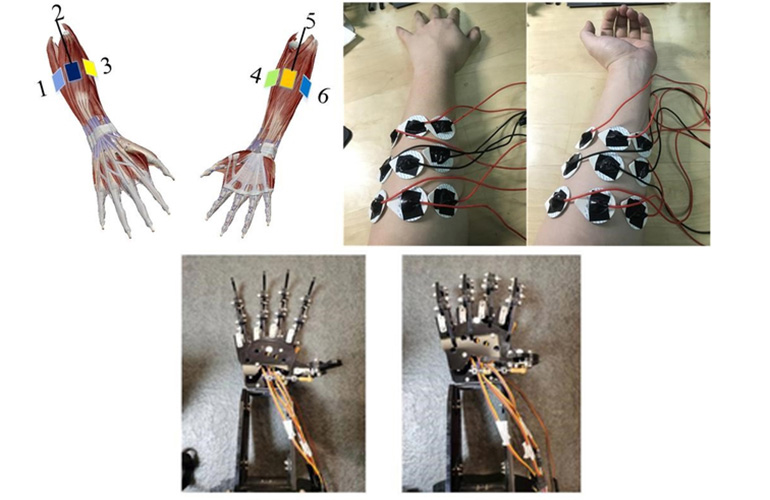
A schematic and physical diagram of the location of electrodes. Below, a prosthetic hand robot used by the team.

Researchers at Shenyang University of Technology and the University of Electro-Communications in Tokyo are trying to figure out how to make prosthetic hands respond to arm movements.

For the last decade, scientists have been trying to figure out how to use surface electromyography (EMG) signals to control prosthetic limbs. EMG signals are electrical signals that cause our muscles to contract. They can be recorded by inserting electrode needles into the muscle. Surface EMGs are recorded with electrodes placed on the skin above muscles.

Surface EMGs could be used to allows prosthetic limbs to respond faster, and move more naturally. However, interruptions, such as a shift in the electrodes, can make it hard for a device to recognize those signals. One way to overcome this is by doing surface EMG signal training. The training can be a long and at times difficult process for amputees.

So, many researchers have turned to machine learning. With machine learning, a prosthetic limb could learn the difference between muscle movements that indicate gestures, and movements of electrodes.

The authors of a study published in Cyborg and Bionic Systems developed a unique machine learning method that combined a convolutional neural network (CNN) and a long short-term memory (LSTM) artificial neural network. They landed on these two methods because of their complementing strengths.

A CNN does well at picking up on the spatial dimensions of surface EMG signals and understanding how they relate to hand gestures. It struggles with time. Gestures take place over time, but a CNN ignores time information in continuous muscle contractions. Typically, CNNs are used for image recognition.

LSTM is usually used for handwriting and speech recognition. This neural network is good at processing, classifying and making predictions based on sequences of data over time. They’re not very practical for prosthetics, however, because the size of the computational model would be too costly.

The research team created a hybrid model, combining the spacial awareness of CNN and temporal awareness of LSTM. In the end, they had reduced the size of the deep learning model, and still maintained high accuracy and a strong resistance to interference.

The system was tested on ten non-amputee subjects with a series of 16 different hand gestures. The system had a recognition accuracy of over 80%. It did well with most gestures, like holding a phone or pen, but struggled with pinching using it’s middle and index fingers. Overall, according to the team, the results outpaced traditional learning methods.

The end goal for the researchers is to develop a flexible and reliable prosthetic hand. Their next steps are to further improve accuracy of the system, and figure out why it struggled with the pinching gestures.

Credit: Source link

Previous Post

Further growth plans for north-east business

Next Post

2022 Startup 302 funding contest underway

New York Tech Editorial Team

New York Tech Editorial Team

New York Tech Media is a leading news publication that aims to provide the latest tech news, fintech, AI & robotics, cybersecurity, startups & leaders, venture capital, and much more!

Next Post
2022 Startup 302 funding contest underway

2022 Startup 302 funding contest underway

  • Trending
  • Comments
  • Latest
Meet the Top 10 K-Pop Artists Taking Over 2024

Meet the Top 10 K-Pop Artists Taking Over 2024

March 17, 2024
Clubhouse will soon let you pin links to the top of rooms

Clubhouse will soon let you pin links to the top of rooms

October 23, 2021
10 Raunchy Movies on Netflix You Won’t Regret Watching

10 Raunchy Movies on Netflix You Won’t Regret Watching

May 20, 2024
Panther for AWS allows security teams to monitor their AWS infrastructure in real-time

Many businesses lack a formal ransomware plan

March 29, 2022
Zach Mulcahey, 25 | Cover Story | Style Weekly

Zach Mulcahey, 25 | Cover Story | Style Weekly

March 29, 2022
How To Pitch The Investor: Ronen Menipaz, Founder of M51

How To Pitch The Investor: Ronen Menipaz, Founder of M51

March 29, 2022
Startups On Demand: renovai is the Netflix of Online Shopping

Startups On Demand: renovai is the Netflix of Online Shopping

2
Robot Company Offers $200K for Right to Use One Applicant’s Face and Voice ‘Forever’

Robot Company Offers $200K for Right to Use One Applicant’s Face and Voice ‘Forever’

1
Menashe Shani Accessibility High Tech on the low

Revolutionizing Accessibility: The Story of Purple Lens

1

Netgear announces a $1,500 Wi-Fi 6E mesh router

0
These apps let you customize Windows 11 to bring the taskbar back to life

These apps let you customize Windows 11 to bring the taskbar back to life

0
This bipedal robot uses propeller arms to slackline and skateboard

This bipedal robot uses propeller arms to slackline and skateboard

0
corporate practice of medicine

When Business Growth Starts to Influence Clinical Decisions

September 10, 2026
man using a computer

AI Is Easy to Try. Making It Work Is Harder.

September 9, 2026
Kesewi works to a two-word standard: think simple.

One Concept, One Yes: The Studio That Stopped Offering Options

September 8, 2026
FINQ’s Autonomous Ranking Engine Produces 23.51% and 23.83% Since Inception as the S&P 500 Returns 11.61%

FINQ’s Autonomous Ranking Engine Produces 23.51% and 23.83% Since Inception as the S&P 500 Returns 11.61%

September 7, 2026
Blackstone Backs Huskeys With $27M Series A as Security Teams Struggle to Control the Modern Network Edge

Blackstone Backs Huskeys With $27M Series A as Security Teams Struggle to Control the Modern Network Edge

September 2, 2026
Deal Room and Playlist Agent

Walnut Extends AI Agents Across the Full Buyer Journey With Enterprise-Grade Platform Launch

September 2, 2026

Recommended

corporate practice of medicine

When Business Growth Starts to Influence Clinical Decisions

September 10, 2026
man using a computer

AI Is Easy to Try. Making It Work Is Harder.

September 9, 2026
Kesewi works to a two-word standard: think simple.

One Concept, One Yes: The Studio That Stopped Offering Options

September 8, 2026
FINQ’s Autonomous Ranking Engine Produces 23.51% and 23.83% Since Inception as the S&P 500 Returns 11.61%

FINQ’s Autonomous Ranking Engine Produces 23.51% and 23.83% Since Inception as the S&P 500 Returns 11.61%

September 7, 2026

Categories

  • AI & Robotics
  • Benzinga
  • Cybersecurity
  • FinTech
  • New York Tech
  • News
  • Startups & Leaders
  • Venture Capital

Tags

AI AI QSRs AI security Allseated Automat-it AWS B2B marketing Business CISO CISO Whisperer Collaborations Companies To Watch Cybersecurity Enterprise AI Entrepreneur Fetcherr Finance FINQ Fintech Funding Announcement Hi Auto Impala Investing Investors investorsummit israelitech Leaders Mate Security Metaverse Mindset Minnesota omri hurwitz Perion PointFive PR QSR Real Estate start- up startupnation Startups Startups On Demand Tech Tech leaders Unlimited Robotics VC
  • Contact Us
  • Privacy Policy
  • Terms and conditions

© 2024 All Rights Reserved - New York Tech Media

No Result
View All Result
  • News
  • FinTech
  • AI & Robotics
  • Cybersecurity
  • Startups & Leaders
  • Venture Capital

© 2024 All Rights Reserved - New York Tech Media