
On 23 January, The Foundation for Economic Education (FEE) published “Is Star Trek’s Dream of a World Without Money Utopian or Dystopian?”, a piece does not serve the cause of Liberty well. Sure, the article is not written in bad faith. But it ends up justifying a parasitic form of capitalism that has less and less to do with entrepreneurship and increasingly colludes with and corrupts regulators and political authorities.
***
Money yes, money no — How to debate pointlessly, and wrongly
The issue of money’s disappearance has long been at the centre of heightened debates. Probably, some familiarised with the idea thanks to the cult sci-fi serial Star Trek. Yet, much earlier than that, classical Greek thinkers like Xenophon, Plato and Aristotle reflected on the function of money. And there are also more recent discussions on this issue: from political theorist Anitra Nelson to industrial designer Jacque Fresco. However, two millennia of debates have not yielded many results or anything resembling a consensus on the function/s money serves.
Against this background, unwarranted claims by eclectic billionaires become the unwitting target of misplaced defences of nowadays monopolistic, crony capitalism. Henceforth, this sort of capitalism – or accumulation regime, as some economists label it – is referred to as “neo-feudalistic” capitalism. Even paradoxically, perhaps, given that the authors of such articles really believe they are defending freedom and individual self-determination. Recently, the Foundation for Economic Education’s (FEE) published a piece titled “Is Star Trek’s Dream of a World Without Money Utopian or Dystopian?”, which is a clear example of such misplaced defence of neo-feudalistic capitalism in the name of an enterprising, freedom-generating capitalism that does not exist.
Namely, the piece samples many of the libertarian field’s weakest talking point and reflects a narrow-minded conception economic theory. First, the text creates a fake equivalence between capitalism as it is now, raising living standards and absolute-poverty reduction without observing the data critically and informing their readers correctly. Secondly, it oversimplifies most counter-arguments ignoring the many problems of neo-feudalistic capitalism and recent findings in behavioural economics.
Instead of merely criticising, deconstructing these arguments offers an occasion to imagine a wider front of liberty defenders. After all, Mises, Keynes, Marx, Sowell and Friedman disagree on the road towards, rather than notion of freedom. Hence, libertarian, conservative and progressive economics ought to reject the current form of predatory capitalism — not to defend it.
Argument 1: Capitalism has been incredibly successful at lifting most of humanity out of poverty
One of libertarians’, neoliberals’, and conservatives’ most-often repeat argument in defence of capitalism’s current form tackles the problem of poverty. In fact, the piece reads that capitalism has been “successful at lifting most of humanity out of poverty”. But, did it?
Indeed, this is true when considering UN data on absolute poverty; or the “severe deprivation of basic human needs”. And the UN lists these “basic needs” as: “food, safe drinking water, sanitation facilities, health, shelter, education and information.” In fact, the authors themselves use Our World in Data’s (OWD) chart showing the reduction in absolute poverty since 1820. In addition, Figure 1 (below) shows also OWD’s chart showing the share of the world population in absolute poverty. Still, it would be worth asking if is it possible for almost 90% of the world population to be extremely poor at any point in time.

Figure 1 Data on extreme poverty, (A) absolute numbers and (B) percentage. All data are before taxes and transfers. (Charts from: Our World in Data)
Looking at the methodological note on OWD’s website, the solution appears related to the definition of absolute poverty. In fact, the charts count the people who “lived in conditions that are similar to the living conditions of the very poorest in the world today”. Therefore, OWD is assessing poverty as if the 20th century’s “basic needs” were universal or trans-epochal. Clearly, logically and rationally this is an econometric and statistical absurd. Conversely, it should be unsurprising that in the 19th century sanitation, education and information were of lower quality.
As a matter of fact, “as countries get richer, the value of what they consider as ‘basic needs’ increases”. If anything, the reason lies in society’s constant evolution, which ingenerates new needs and spurs new technologies — also before modernity. Hence, the real success of an economic system lies in increasing the number of people who can live a decent lifeby their times’ standards. And economists gave a name to this measurement: “relative” or “social” poverty. According World Bank data in Figure 2, the current version of capitalism has achieved little or nothing in this respect. On the contrary: “the total headcount of societal poverty is essentially at the same level it was in 1990 due to the increasing global population.”
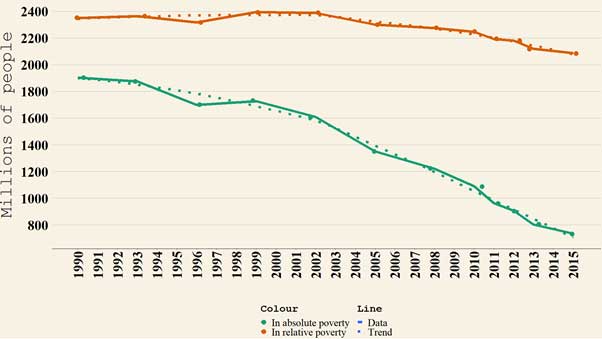
Figure 2 World Bank data on relative poverty between 1990 and 2015.
(Data source: Jolliffe and Prydz 2017; Chart: Author’s elaboration)

Table 1 Data on relative poverty from Jolliffe and Prydz (2017).
Argument 2: Fiat money circulating in Free markets creates free people
The second argument supporting the unquestionability of money derives from Ayn Rand’s Atlas Shrugged:
Money rests on the axiom that every man is the owner of his mind and his effort. […] Money permits no deals except those to mutual benefit by the unforced judgment of the traders.
For anyone with an up-to-date understanding of economic theory this is straightforward naivety. In other words, there should be is nothing in a monetary transaction besides the free will of the participants.
Yet, there are enormous conditionings that weight on the result of any transaction beyond one’s free will. For instance, there may be regulations prohibiting the provision of certain services to specific individuals (e.g., international sanctions). Again, rules can fix certain goods’ and services’ minimum or maximum price (e.g., the US Office of Price Administration). More, indirect taxes, surcharges and subsidies alter prices leading some people not to buy and other to buy more. Finally, laws can impose a transaction (e.g., US law mandated covid-19 tests, but either employers or employees had to pay).
Even assuming no State intervention, one cannot disregard the power relations in the economic sphere — mention one. In fact, neo-feudalistic capitalism is full of monopolies and oligopolies with stratospheric margins that dictate unreasonable prices and lobby regulators. Moreover, major corporations tend to develop “predatory” traits and annihilate any competition at first sight — or even in the cradle. Additionally, behavioural economics shows that advertising and other practices alter preferences and behaviours surreptitiously, with the potential to generate inefficiencies.
Clearly, contrary statements prove that Kurt W. Rothschild was right when he wrote “power is neglected in contemporary economic theory”. Furthermore, they lead to a completely false reading of economic history. In fact, the authors’ strenuous critique of Marx and Marxism goes as far as saying that “workers chose industrial jobs because they paid better than those in agriculture” in 19th century England. Really, this reconstruction may appear ‘rational’ to a libertarian but, as Karl Polanyi wrote, it is simply false. In fact, wealthy individuals began “enclosing” previously common plots of land, forced poor farmers out into the towns. And once there, disorientation, hunger, and other desperate peoples’ competition of dissipated any semblance of fair wage negotiations.
Argument 3: Instead of a conclusion: A call to action
Admittedly, the aim of this article is not to prove that the abolition of money would create a utopia. Nor to support the authors’ claim that it would almost certainly lead to a dystopia. In reality, money is not a guarantee of freedom — but neither is its abolition. Meanwhile, given that nowadays’ societies are already on the brink of a dystopic tomorrow, talented libertarians like the authors should refrain from pursuing counter-productive critiques of far-fetched speculations like a money-less society. Indeed, neo-feudalistic capitalism seems even unable to abolish cash — let alone money itself.
Instead, it is high time for libertarians, conservatives and progressive to join forces to protect civil and economic freedoms. Each of these groups can contribute with a different, and differentiated, analysis of today’s deep crisis. Yet, only forming a united front can they stop neo-feudalistic capitalism’s mania for social control, monopoly and state capture. Essentially, no one supports an embryonic social-credit system, the death of small and medium businesses and reckless monetary policy. Yet, this is the direction in which neo-feudalistic capitalism is leading humanity at an accelerating speed.
Once this formidable adversary is no more, there will be plenty of time for libertarians to criticise some risk-prone progressives. As well as to serve an uppercut to some conservative’s cultural traditionalism. But until then, everyone’s attention should be on stopping the current drift before it is too late.
Related
Credit: Source link