

Africa builds mRNA vaccine capacity
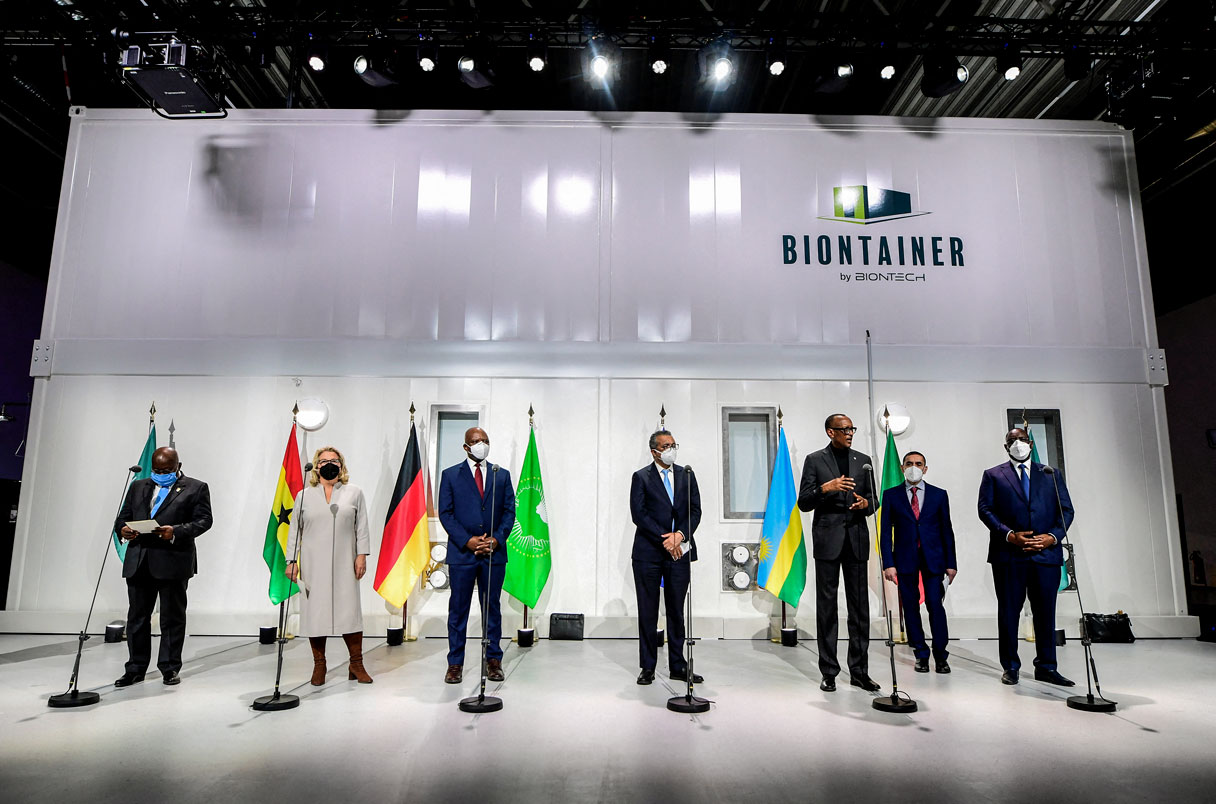
The drive to help African countries produce vaccines with messenger RNA (mRNA) technology got big boosts last week from the World Health Organization (WHO) and the company BioNTech. The success of mRNA COVID-19 vaccines made by the Pfizer-BioNTech collaboration and Moderna led to intense global demand, but African countries have had little access because of limited supply and high prices. Campaigns by several governments and nongovernmental organizations failed to convince the companies to freely share their technologies with economically strapped countries. So last year WHO launched a hub in South Africa to produce mRNA vaccines independently. The agency, which hopes the hub licenses a product by 2024, last week announced plans to train scientists from South Africa, Egypt, Kenya, Nigeria, Senegal, and Tunisia. BioNTech, which has been criticized for trying to undermine the WHO effort, separately announced that later this year it will train local scientists and send modular, shipping container–size vaccine factories to Ghana, Rwanda, and Senegal.
Wild poliovirus back in Africa
In a setback for the global polio eradication campaign, a wild poliovirus has leapt from Pakistan to the African continent, where it has paralyzed a 3-year-old girl in Malawi. The case, announced on 17 February by the Malawi government, is the first wild polio case in the country since 1992. Pakistan and Afghanistan are the last two countries that are endemic for the wild virus, which means circulation there has never stopped. Occasionally, however, the virus spills over from these entrenched reservoirs. Africa’s last known case of wild polio occurred in 2016 in Nigeria’s Borno state. The continent is still battling big outbreaks of vaccine-derived polio, however, which occur in areas of low immunization when the live but attenuated virus in the oral polio vaccine regains its ability to paralyze and spread. The Global Polio Eradication Initiative is hopeful that it can stop the spread of the virus in Malawi quickly through a vaccination campaign, as it has done for several other “imported” wild polio outbreaks.

[Hong Kong’s] hospitals are sandcastles in a tsunami.
- University of Hong Kong virologist Siddharth Sridhar
- in a tweet describing the impact of the recent COVID-19 surge on the city’s health care system.
Winter study probes Great Lakes
Researchers from the United States and Canada last week used sleds, snowmobiles, airboats, and icebreakers to fan out across the Great Lakes in a bid to better understand how the five water bodies function in the dead of winter and how climate change is reshuffling their ecosystems. Scientists from 19 research institutions and government agencies participated in the Winter Grab, a weeklong push to collect data at some 30 sampling sites. Fewer than 5% of Great Lakes studies have been done in winter, in part because lakes were long considered relatively dormant when covered by ice—not to mention dangerous to access. As a result, scientists know relatively little about how lake organisms behave during winter or how nutrient cycles vary by season. As warmer winters shrink ice cover, Winter Grab researchers hope their findings will help spur more efforts to study lakes around the world during the coldest months.
First secondary craters found on Earth point to giant asteroid impact

Scientists have identified a series of 31 craters in Wyoming with diameters from 10 to 70 meters, created 280 million years ago by boulders ejected from a previously unknown cosmic impact. Such “secondary” craters are common on airless moons and planets, but previously have never been identified on Earth. Many scientists suspected the planet’s thick atmosphere would prevent their formation altogether by cracking up boulders on descent. The finding, published this month in the Geological Society of America Bulletin, also suggests a 60-kilometer-wide impact crater is likely buried some 2 kilometers below Wyoming’s eastern border—potentially one of the largest known impacts in North American history.
Dinosaurs’ death came in spring
The beginning of the end for dinosaurs was likely one day in spring, according to a study of fish fossils excavated in North Dakota. To pinpoint the season of the Cretaceous-Paleogene mass extinction 66 million years ago, paleontologists analyzed the bones of filter-feeding fish from a site called Tanis. There, the asteroid impact that doomed dinosaurs kicked up a large river wave, burying countless late-Cretaceous era animals and plants. The fish had debris from the impact lodged in their gills, evidence that they had perished within minutes. The researchers used carbon isotopes in the bones to identify seasonal growth layers. (The fish grew faster in spring, when food was plentiful.) They report on 23 February in Nature that the fish—along with three-quarters of life on Earth—perished during spring in the Northern Hemisphere.
Psilocybin shows lasting effects
The antidepressant effects of psilocybin-assisted therapy may last at least 1 year for some people, a small follow-up study suggests. In a clinical trial of 24 people with major depressive disorder, researchers found that two doses of the substance found in magic mushrooms, given approximately 2 weeks apart alongside psychotherapy, led to clinically significant reductions in depression severity in 18 participants and remission in 14 of them after 1 year. The results, reported last week in the Journal of Psychopharmacology and discussed in a panel at the annual meeting of AAAS, which publishes Science, offer the longest follow-up yet for a randomized study of psilocybin’s antidepressant effect. They extend findings from the same trial, published in November 2020, that revealed improvements for 17 of the 24 participants after 1 month. Other factors may have contributed to the persistent benefit, the researchers note: One-third of participants began treatment with an antidepressant sometime over the course of follow-up study, and nearly half received some form of psychotherapy outside of the study.
Centipedes inspire robot

Centipedes’ ability to speed over rock, sand, and soil has led to a new robot that could prove handy to farmers. On land, centipedes move their legs in a wave that switches direction when they encounter obstacles, researchers reported this month at the virtual meeting of the Society of Integrative and Comparative Biology. In water, they wiggle their bodies to move forward. To better understand how the animals coordinate their legs and body in different environments, the researchers built a 70-centimeter robot model and determined the most efficient timing of leg and body movements. The robot was so adept at moving across a natural landscape that the team has formed a company to develop the device for finding and destroying weeds in agricultural fields.
Health equity fight loses pioneer
Paul Farmer, an infectious disease physician, anthropologist, and champion of global public health, died suddenly this week at age 62. At the time of his death, he was visiting the University of Global Health Equity in Butaro, Rwanda, that he helped found. Farmer, who was also a professor at Harvard Medical School, dedicated his career to bringing health care to poor and marginalized communities, in particular in Haiti and Rwanda. In 1987, he founded the nonprofit Partners in Health, focused on providing high-quality health care in resource-poor settings and advocating for human rights and social justice. Farmer’s work also helped inspire global efforts to expand access to lifesaving treatments for HIV and other diseases.
Antarctic pollution melting snow
Burning of fossil fuels in Antarctica is hastening snow melt there, researchers have found. When soot, a byproduct of combustion, settles out of the air, the dark particles absorb sunlight and heat the snow. To estimate the impact, researchers measured soot in snow taken from 28 places across the northern Antarctic Peninsula, including sites near research bases and stops for ships that carry an average of 53,000 tourists per year to the continent. Melting from the ship soot amounts to hundreds of tons of snow loss per person, the group reports this week in Nature Communications. Per person losses are estimated to be an order of magnitude higher near research stations, because of generators, helicopters, and vehicles. In the most polluted areas, the snowpack has declined by 2.3 centimeters each summer. The researchers recommend limits on research infrastructure and surging tourism, as well as improvements in energy efficiency and renewable power.
Yeasty dance video rises to top of Ph.D. contest

Lithuanian scientist Povilas Šimonis’s colorful and catchy interpretation of the electrical stimulation of yeast cells is the winner of this year’s “Dance Your Ph.D.” contest. The annual competition, which is hosted by Science and sponsored by the artificial intelligence company Primer, invites researchers to interpret their theses through movement and to commit the act to video for cash prizes and nerd fame. Šimonis’s doctoral work at Lithuania’s Center for Physical Sciences and Technology and Vilnius University explores how the single-celled fungus that powers bread baking behaves when pulsed with electricity. The performance, which included original music and several sets, casts people as yeast cells prancing amid mouthwatering baked goods. The result beat out 29 other submissions to win both the overall award and the biology category. A judging panel of dancers, scientists, and artists also selected winners in chemistry, physics, and social sciences. See videos from all the winners at https:/scim.ag/DancePhD.
European Commission pushes for gender equality
Effective this year, higher education and research organizations must have a gender equality plan to qualify for European Commission research grants. Among other commitments, grantees will be required to train staff about unconscious bias and collect data on staff and students for accountability. Anne Pépin, a physicist at the French national research agency, CNRS, and senior policy officer at the Commission, spoke with Science about the changes and structural barriers for female scientists. (A longer version of this interview is at https://scim.ag/GenderEqEurope.)
Q: What motivated you to get involved?
A: When I became a researcher, I was clearly a minority in physics. I didn’t suffer from explicit discrimination. But it was more a cumulative effect—like sometimes people taking you for the postdoc when you’re the permanent researcher. I’ve been involved in pioneering a gender equality plan at CNRS, and I think it can have long-lasting and multiplier effects. We were able to implement a range of actions—for example, sensitizing the recruitment and promotion committees to gender issues and allowing women to have 6 months off teaching duties to concentrate on their research after a maternity leave.
Q: Why make this a mandatory requirement?
A: To some extent, the voluntary implementation of gender equality plans over the last decade by European organizations was a success—we’ve accumulated a wealth of good practices and established practical tools. Still, changes are fragmented and very slow. We’re roughly at gender parity among doctoral graduates, but women only represent 26% of full professors. The institutions will be responsible for identifying the most pressing areas to address based on their data.
Q: Are you optimistic for change?
A: There is still a lot of work ahead, and it’s not all on the side of the European Commission. It also has to be a collective effort with everyone—women, men, gender-diverse individuals—getting onboard to further improve working conditions for all.
Credit: Source link