

Middle East
March 10, 2022
Fintech is opening new doors in MENA for inclusive finance
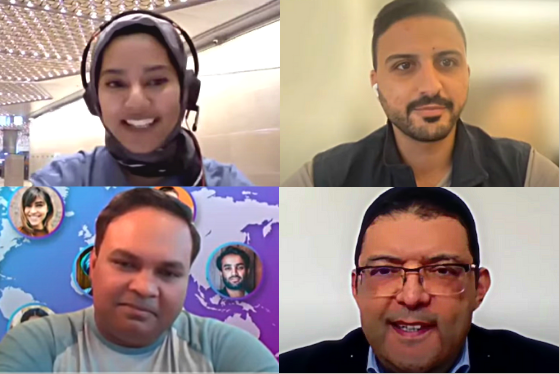
On March 1, the Atlantic Council’s empowerME Initiative, in partnership with ABANA, held a virtual event to discuss the opportunities for inclusive finance that the financial technology (Fintech) sector presents to the Middle East and North Africa’s (MENA) population. The event featured welcome remarks by Atlantic Council empowerME Director and Resident Senior Fellow Amjad Ahmad and a conversation with Aydi Founder Hassan Fayed, Wiki Startup Founder Mondher Khanfir, and Xare Co-Founder Milind Singh. It was moderated by Bloomberg News Fintech Reporter Aisha Gani.
This was the third webinar in a joint series to shed light on the changing Fintech landscape in the MENA region, identify challenges and opportunities, and explore policy recommendations.
The key points made at the event are summarized below.
Fintech innovations make finance more inclusive
- Hassan Fayed explained that “Fintech adds tremendous value to the underbanked and the unbanked in the Middle East and North Africa region” by “enabling trust and increasing efficiency.” In the case of agricultural workers, Aydi’s wallet app provides a service to its users who otherwise wouldn’t be able to track their wages, bonuses, and deductions daily or know when they can access these funds. This tool has also increased worker retention.
- Fayed stressed the importance of data collection by Fintech startups in order to build profiles for users and offer products accordingly. The income of Aydi users tends to be informal, cash-based, and seasonal rather than annual. By tracking workers’ income for the first time, documenting their reliability and productivity, and aggregating the demand for various crops, Aydi aims to offer its users access to meaningful, year-round work opportunities.
- “Every financial product in the world is designed for someone who has an income,” said Milind Singh, yet about two-thirds of the global population—4.5 billion people—don’t work and therefore cannot access insurance, credit, or loans. Rather than trying to engineer trust through income statements and credit checks as banks do, Xare “flips the equation” by enabling everyday individuals to “bank their tribe,” extending their financial access to and creating financial products for people they know and trust already. The startup also offers financial literacy tests so users can contextualize their financial situation and learn about saving, investment, and retirement strategies.
Remaining obstacles in providing financial services to the underserved populations
- While Fayed has observed a “drastic improvement” in the venture capital (VC) space over the past two years, highlighting more collaborative and balanced relationships between founders and investors, he identified the gender disparity in VC funding as a pressing issue. He recommends strengthening the female founder pipeline by offering greater flexibility in working hours and remote work to all workers. Moreover, he suggests that tech companies should focus on achieving gender balance in their workforce so that more female employees will become founders after leaving the company.
- Mondher Khanfir remarked that interest rates in Tunisia can be “prohibitive for vulnerable groups, in particular, women.” Ecosystem builders can support entrepreneurs and small- and medium-sized (SME) enterprise owners by helping them generate a higher profit margin that they can save or re-invest in their business.
- Khanfir explained that farmers’ ability to assess and predict their crop production is vital. However, a mismanaged and fragmented logistics sector and supply chain in Tunisia impedes investment in agriculture.
- Singh commented that access to loans is a pressing issue throughout the region because it requires both an appetite for risk as well as cash. In fact, 70 percent of all borrowing in MENA comes from a friend or family member, not a bank. Xare has created a “paradigm shift” by tapping into existing trusted networks and enabling individuals to transition from informal, cash-based, and inefficient systems towards “seamless, meaningful, and digital” transactions.
The future of Fintech in MENA
- Fayed argued that Know Your Customer or Know Your Client (KYC) compliance, data, and distribution are three areas ripe for innovation. Development finance is another field of interest that is “largely untapped” in MENA and other emerging markets: he explained that disruptions to the status quo are urgently needed, since only a small portion of hundreds of millions of dollars of allotted funding reaches its target beneficiaries after passing through layers of intermediaries.
- Fayed elaborated that MENA has “traditionally not embraced financial institutions” and that the winners in this Fintech space will be “embedded players,” who use technology “in a smooth and elegant way” and “offer tangible value on a daily basis.” He cited Fawry’s success, thanks to its distribution model and use of embedded finance, as an example of where Fintech is headed.
- Singh pointed to the pandemic as a catalyst behind the shift in public opinion that Fintech companies are a “force for good” in the region. He noted that “a healthy equilibrium is now emerging” in which banks and regulators understand that Fintechs won’t replace them but instead target specific segments of the population and provide different products and services, such as embedded finance.
- Singh asserted that “the pendulum is swinging the other way” towards a decentralized system in which more decisions and products are made and solutions are found at the local level, with less reliance on centralized institutions.
What role policymakers should play
- Fayed commended Egypt’s government for being “a major enabler of Fintech over the past few years” and its goal of bringing each segment of the population into the formal economy to encourage inclusive growth. In particular, he is encouraged by a new law on the use of financial technology in non-banking financial activities signed in mid-February. The Central Bank of Egypt has played a key role by issuing legislation and offering a regulatory sandbox for Fintech startups to test their solutions over a period of two years.
- Khanfir commented that Tunisia is a “very hostile environment” that “isn’t favorable to innovation.” While many incubators and accelerators have been established to support youth who are aspiring entrepreneurs, especially in the financial industry, policymakers must play their part in developing the country’s nascent Fintech scene into a genuine sector of the economy.
- Khanfir explained that cryptocurrencies and new financial services outside of common regulatory frameworks could lead to conflict when governments are reluctant to embrace these innovations. Still, policymakers should prioritize inclusive finance so that the Fintech sector can reach its full potential. The pandemic prompted Tunisia’s government to dematerialize some financial processes, including payment; Tunisia- and France-based Expensya is one example of a Fintech startup that offers that specific technology and has gone global with its business-to-business (B2B) model.
- In Singh’s view, it is nearly impossible for policymakers to ignore how Fintech startups are succeeding in meeting the masses’ financial needs. He advocates cooperation and collaboration as the best path forward for shared prosperity between the public and private sectors.
Allison Holle is assistant director of the Atlantic Council’s empowerME Initiative. Follow her @AllisonHolle.
Credit: Source link