New York Tech Media
  • News
  • FinTech
  • AI & Robotics
  • Cybersecurity
  • Startups & Leaders
  • Venture Capital
No Result
View All Result
  • News
  • FinTech
  • AI & Robotics
  • Cybersecurity
  • Startups & Leaders
  • Venture Capital
No Result
View All Result
New York Tech Media
No Result
View All Result
Home AI & Robotics

Neural Rendering: NeRF Takes a Walk in the Fresh Air

New York Tech Editorial Team by New York Tech Editorial Team
November 25, 2021
in AI & Robotics
0
Neural Rendering: NeRF Takes a Walk in the Fresh Air
Share on FacebookShare on Twitter

A collaboration between Google Research and Harvard University has developed a new method to create 360-degree neural video of complete scenes using Neural Radiance Fields (NeRF). The novel approach takes NeRF a step closer to casual abstract use in any environment, without being restricted to tabletop models or closed interior scenarios.
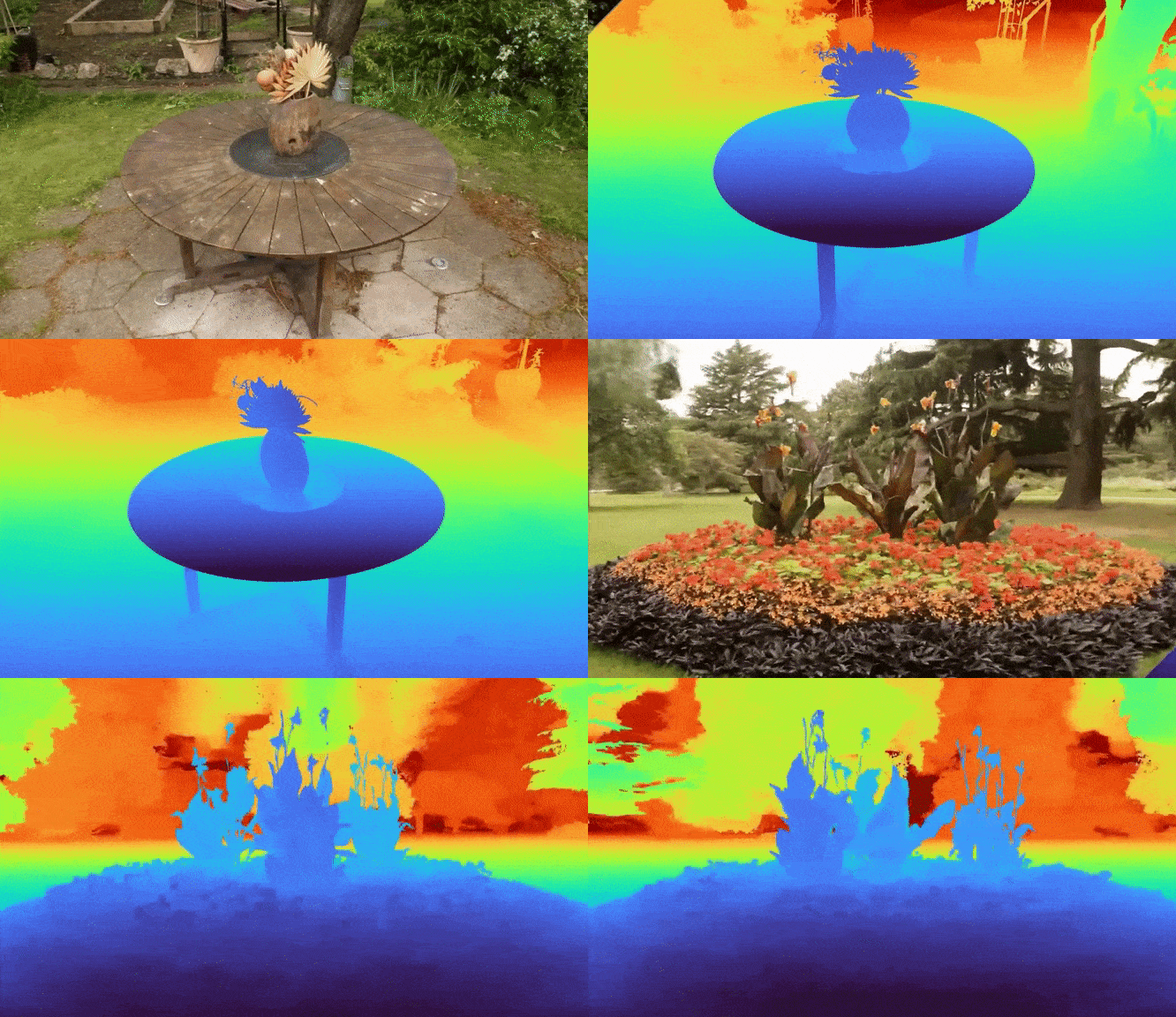
Source: https://www.youtube.com/watch?v=YStDS2-Ln1s

See end of article for full video. Source: https://www.youtube.com/watch?v=YStDS2-Ln1s

Mip-NeRF 360 can handle extended backgrounds and ‘infinite’ objects such as the sky, because, unlike most previous iterations, it sets limits on the way light rays are interpreted, and creates boundaries of attention that rationalize otherwise lengthy training times. See the new accompanying video embedded at the end of this article for more examples, and an extended insight into the process.

The new paper is titled Mip-NeRF 360: Unbounded Anti-Aliased Neural Radiance Fields, and is led by Senior Staff Research Scientist at Google Research Jon Barron.

To understand the breakthrough, it’s necessary to have a basic comprehension of how neural radiance field-based image synthesis functions.

What is NeRF?

It’s problematic to describe a NeRF network in terms of a ‘video’, as it’s nearer to a fully 3D-realized but AI-based virtual environment, where multiple viewpoints from single photos (including video frames) are used to stitch together a scene that technically exists only in the latent space of a machine learning algorithm – but from which an extraordinary number of viewpoints and videos can be extracted at will.
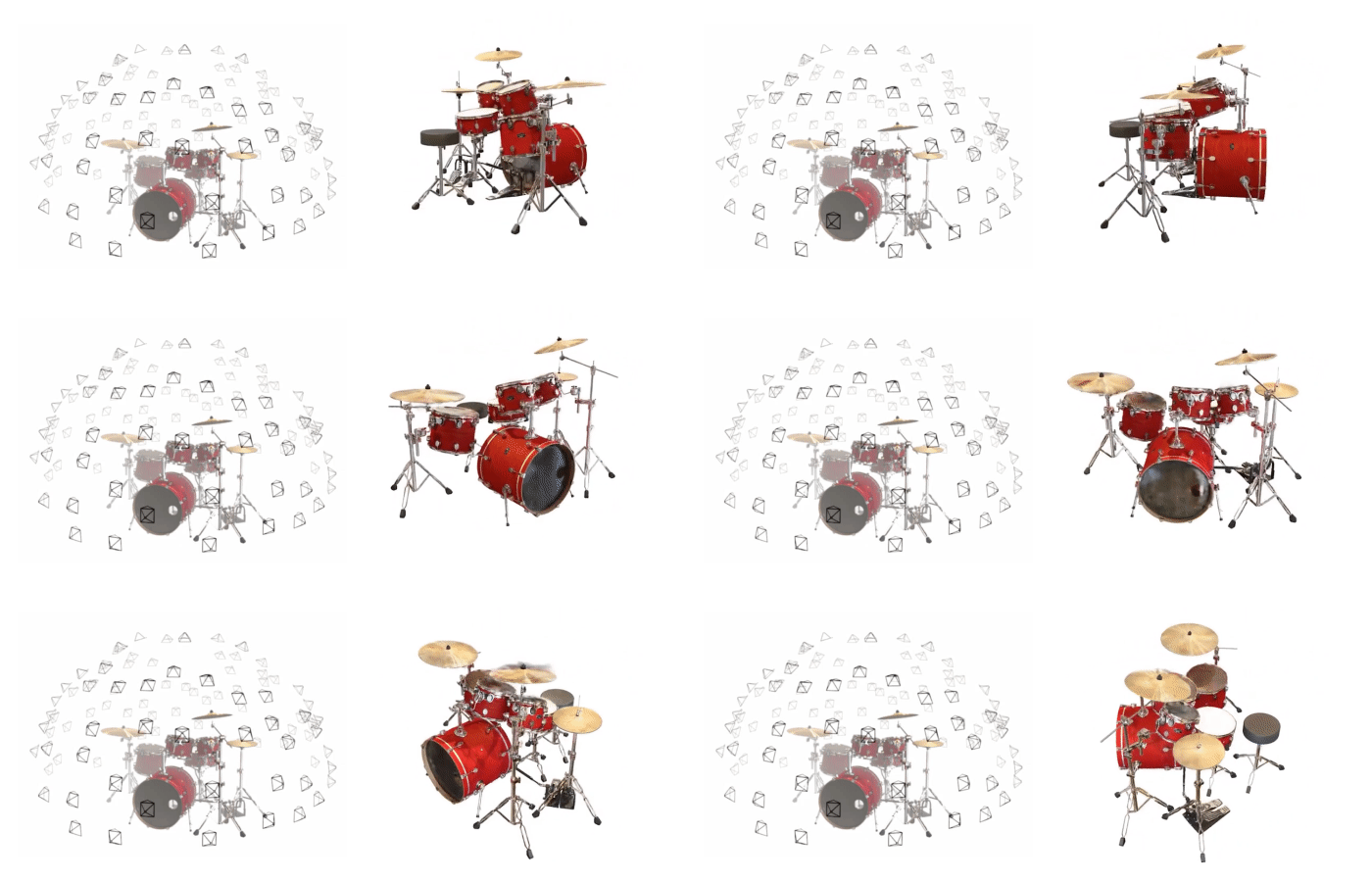
A depiction of the multiple camera capture points that provide the data which NeRF assembles into a neural scene (pictured right).

A depiction of the multiple camera capture points that provide the data which NeRF assembles into a neural scene (pictured right).

Information derived from the contributing photos is trained into a matrix that’s similar to a traditional voxel grid in CGI workflows, in that every point in 3D space ends up with a value, making the scene navigable.

A traditional voxel matrix places pixel information (which normally exists in a 2D context, such as the pixel grid of a JPEG file) into a three-dimensional space. Source: https://www.researchgate.net/publication/344488704_Processing_and_analysis_of_airborne_full-waveform_laser_scanning_data_for_the_characterization_of_forest_structure_and_fuel_properties

A traditional voxel matrix places pixel information (which normally exists in a 2D context, such as the pixel grid of a JPEG file) into a three-dimensional space. Source: ResearchGate

After calculating the interstitial space between photos (if necessary), the path of each possible pixel of each contributing photo is effectively ‘ray-traced’ and assigned a color value, including a transparency value (without which the neural matrix would be completely opaque, or completely empty).

Like voxel grids, and unlike CGI-based 3D coordinate space, the ‘interior’ of a ‘closed’ object has no existence in a NeRF matrix. You can split open a CGI drum kit and look inside, if you like; but as far as NeRF is concerned, the existence of the drum kit ends when the opacity value of its surface equals ‘1’.

A Wider View of a Pixel

Mip-NeRF 360 is an extension of research from March 2021, which effectively introduced efficient anti-aliasing to NeRF without exhaustive supersampling.

NeRF traditionally calculates just one pixel path, which is inclined to produce the kind of ‘jaggies’ that characterized early internet image formats, as well as earlier games systems. These jagged edges were solved by various methods, usually involving sampling adjacent pixels and finding an average representation.

Because traditional NeRF only samples that one pixel path, Mip-NeRF introduced a ‘conical’ catchment area, like a wide-beam torch, that provides enough information about adjacent pixels to produce economical antialiasing with improved detail.

The conical cone catchment that Mip-NeRF uses is sliced up into conical frustums (below), which is further 'blurred' to represent a vaguer Gaussian space that can be used to calculate the accuracy and aliasing of a pixel. Source: https://www.youtube.com/watch?v=EpH175PY1A0

The conical cone catchment that Mip-NeRF uses is sliced up into conical frustums (lower image), which are further ‘blurred’ to create vague Gaussian spaces that can be used to calculate the accuracy and aliasing of a pixel. Source: https://www.youtube.com/watch?v=EpH175PY1A0

The improvement over a standard NeRF implementation was notable:

Mip-NeRF (right), released in March 2021, provides improved detail through a more comprehensive but economical aliasing pipeline, rather than just 'blurring' pixels to avoid jagged edges. Source: https://jonbarron.info/mipnerf/

Mip-NeRF (right), released in March 2021, provides improved detail through a more comprehensive but economical aliasing pipeline, rather than just ‘blurring’ pixels to avoid jagged edges. Source: https://jonbarron.info/mipnerf/

NeRF Unbounded

The March paper left three problems unsolved with respect to using Mip-NeRF in unbounded environments that might include very distant objects, including skies. The new paper solves this by applying a Kalman-style warp to the Mip-NeRF Gaussians.

Secondly, larger scenes require greater processing power and extended training times, which Mip-NeRF 360 solves by ‘distilling’ scene geometry with a small ‘proposal’ multi-layer perceptron (MLP), which pre-bounds the geometry predicted by a large standard NeRF MLP. This speeds training up by a factor of three.

Finally, larger scenes tend to make discretization of the interpreted geometry ambiguous, resulting in the kind of artifacts gamers might be familiar with when game output ‘tears’. The new paper addresses this by creating a new regularizer for Mip-NeRF ray intervals.

On the right, we see unwanted artifacts in Mip-NeRF due to the difficulty in bounding such a large scene. On the left, we see that the new regularizer has optimized the scene well enough to remove these disturbances.

On the right, we see unwanted artifacts in Mip-NeRF due to the difficulty in bounding such a large scene. On the left, we see that the new regularizer has optimized the scene well enough to remove these disturbances.

To find out more about the new paper, check out the video below, and also the March 2021 video introduction to Mip-NeRF. You can also find out more about NeRF research by checking out our coverage so far.


Credit: Source link

Previous Post

Blackbird targets $1b VC fund; Square Peg, AirTree also ready to raise

Next Post

Global Robotics in Medical Devices Thematic Research Report 2021

New York Tech Editorial Team

New York Tech Editorial Team

New York Tech Media is a leading news publication that aims to provide the latest tech news, fintech, AI & robotics, cybersecurity, startups & leaders, venture capital, and much more!

Next Post
Global Robotics in Medical Devices Thematic Research Report 2021

Global Robotics in Medical Devices Thematic Research Report 2021

  • Trending
  • Comments
  • Latest
Meet the Top 10 K-Pop Artists Taking Over 2024

Meet the Top 10 K-Pop Artists Taking Over 2024

March 17, 2024
Panther for AWS allows security teams to monitor their AWS infrastructure in real-time

Many businesses lack a formal ransomware plan

March 29, 2022
Zach Mulcahey, 25 | Cover Story | Style Weekly

Zach Mulcahey, 25 | Cover Story | Style Weekly

March 29, 2022
10 Raunchy Movies on Netflix You Won’t Regret Watching

10 Raunchy Movies on Netflix You Won’t Regret Watching

May 20, 2024
How To Pitch The Investor: Ronen Menipaz, Founder of M51

How To Pitch The Investor: Ronen Menipaz, Founder of M51

March 29, 2022
Japanese Space Industry Startup “Synspective” Raises US $100 Million in Funding

Japanese Space Industry Startup “Synspective” Raises US $100 Million in Funding

March 29, 2022
Startups On Demand: renovai is the Netflix of Online Shopping

Startups On Demand: renovai is the Netflix of Online Shopping

2
Robot Company Offers $200K for Right to Use One Applicant’s Face and Voice ‘Forever’

Robot Company Offers $200K for Right to Use One Applicant’s Face and Voice ‘Forever’

1
Menashe Shani Accessibility High Tech on the low

Revolutionizing Accessibility: The Story of Purple Lens

1

Netgear announces a $1,500 Wi-Fi 6E mesh router

0
These apps let you customize Windows 11 to bring the taskbar back to life

These apps let you customize Windows 11 to bring the taskbar back to life

0
This bipedal robot uses propeller arms to slackline and skateboard

This bipedal robot uses propeller arms to slackline and skateboard

0
laptop on glass table

Automat-it Cuts Deployment Friction as Monce Scales AI Order Processing on AWS

April 13, 2026
Lee's Famous Recipe Chicken

Why Lee’s Famous Recipe Chicken Is Betting on Hi Auto to Quietly Rewire the Drive-Thru

April 9, 2026
computer generated image of letters

San Francisco Tribune Lists 11 HumanX Startups Moving AI Closer to the Operating Core

April 8, 2026
Impala CEO and Highrise AI CEO

The Industrialization of AI Infrastructure: What Impala and Highrise AI Reveal About the Next Scaling Frontier

April 7, 2026
Employee Time Tracking

What is an Employee Time Tracking Solution? A Definite Guide for 2026

March 31, 2026
Voltify founders

Voltify Raises $30 Million Seed Round as It Challenges $1 Trillion Rail Electrification Model

March 31, 2026

Recommended

laptop on glass table

Automat-it Cuts Deployment Friction as Monce Scales AI Order Processing on AWS

April 13, 2026
Lee's Famous Recipe Chicken

Why Lee’s Famous Recipe Chicken Is Betting on Hi Auto to Quietly Rewire the Drive-Thru

April 9, 2026
computer generated image of letters

San Francisco Tribune Lists 11 HumanX Startups Moving AI Closer to the Operating Core

April 8, 2026
Impala CEO and Highrise AI CEO

The Industrialization of AI Infrastructure: What Impala and Highrise AI Reveal About the Next Scaling Frontier

April 7, 2026

Categories

  • AI & Robotics
  • Benzinga
  • Cybersecurity
  • FinTech
  • New York Tech
  • News
  • Startups & Leaders
  • Venture Capital

Tags

AI AI QSRs Allseated Automat-it AWS B2B marketing Business CISO CISO Whisperer Collaborations Companies To Watch cryptocurrency Cybersecurity Entrepreneur Fetcherr Finance FINQ Fintech Funding Announcement hi-tech Hi Auto Impala Investing Investors investorsummit Israel israelitech Leaders LinkedIn Leaders Metaverse Mindset Minnesota omri hurwitz PointFive PR QSR Real Estate start- up startupnation Startups Startups On Demand Tech Tech leaders Unlimited Robotics VC
  • Contact Us
  • Privacy Policy
  • Terms and conditions

© 2024 All Rights Reserved - New York Tech Media

No Result
View All Result
  • News
  • FinTech
  • AI & Robotics
  • Cybersecurity
  • Startups & Leaders
  • Venture Capital

© 2024 All Rights Reserved - New York Tech Media