


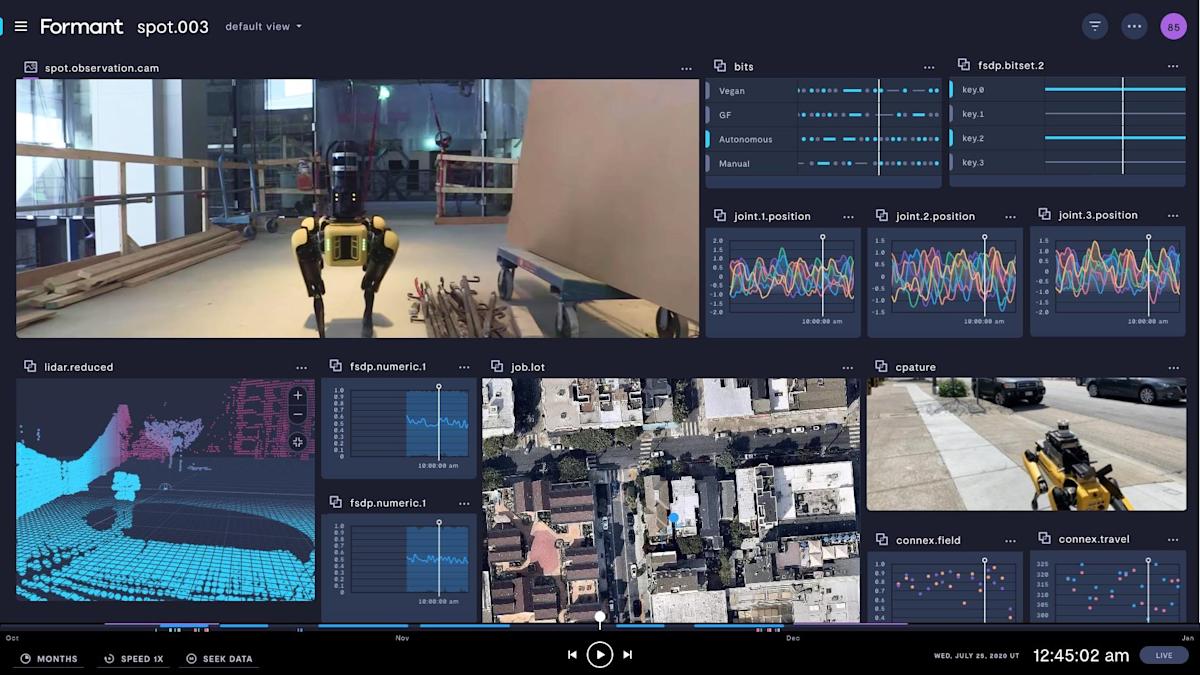
If you’re building a SaaS company or a web app, you’re not going to roll your own analytics solution — it’s specialized work with lots of edge cases, rabbit holes and, for most companies, it’s so far removed from the core platform, that it just doesn’t make sense. Formant is doing kinda-sorta the same thing for robotics, helping automation companies with a number of shortcuts that speed up their time to market. The company has three major strings to its bow: remote-controlling autonomous bots (“operation”), analytics and “why is my robot being so dumb,” — or “observe,” as Formant would no doubt prefer I referred to it.
The company just closed an $18 million Series A round led by SignalFire, with participation from a selection of VCs and strategic investors, including Hillsven, Pelion, Goodyear Ventures, Thursday Ventures, Ericsson, Picus Capital and Holman Strategic Ventures.
“We founded this in 2017, when I left Google and brought my team with me. I was working in the robotics group and I saw an opportunity. The insight was that the robotics hardware was incredible, with folks like Boston Dynamics, really pushing the envelope. Before that, we had 20-25 years of industrial robots that are incredibly accurate, powerful and build every car that you see on the road,” Jeff Linnell outlines the genesis of the company. “That said, the software was in the stone age. There’s no unified operating system. Everybody is building every part of the stack, for every application. If you were starting a company, you had to build your perception and your autonomy, of course. But on top of that, you’d also have to build your data management and everything else. We saw an opportunity to build a generalized solution that could amplify a lot of companies.”
Linnell left Google to found that exact company. It started off as an API that would enable a machine or a robot to request assistance from a human — imagine a cart getting stuck in a corner, for example. The robot would get confused and could phone a friend for some help. A human could control the robot to get it free using a D-pad or a joystick and then hit the “resume” button so the robot could continue on its merry way.
From there, the company built a more substantial platform to help manage the edge cases in robotics and, specifically, robotic fleets.
“We don’t really touch the autonomy part of the robot — getting the robot to do what you need it to do is still the responsibility of our customers,” explains Linnell, “But when it goes off track, or when you need to figure out what happened when something goes wrong, or if you need to determine whether the robot is performing well, that’s where our software comes in.”
If your robo-vac has ever gotten stuck behind the sofa, the “oh crap not again, I wish I could control it with a remote rather than having to go back there and haul its sorry, confused little carcass out from the television wiring” use case will make sense to you. Except with much bigger and potentially more dangerous robots that have all sorts of fail-safes so they stop without just bumping into stuff until they run out of batteries.
The other use cases may need a bit of additional context.
“Imagine you’re in a services department for a company that makes floor-scrubbing robots. You notice a trend that a certain set of robots are struggling with a particular area of the warehouse. You see this happen, or someone contacts customer support to complain, or a customer goes ‘Hey, we have bad performance over here.’ With Formant, you could go back in time and look at the logs, inspecting the moment that the customers say this happens,” explains Linnell. “You might notice that the Wi-Fi strength drops low in this corner of the warehouse.”
Of course, if the Wi-Fi drops altogether, most robots are smart enough to report that, but things like low connectivity or time-outs can be a nightmare to troubleshoot without either sending a (very expensive) customer service engineer to the warehouse or using something like Formant’s software. The solution might be as simple as plugging in a Wi-Fi extender.
“The third use might be that a business owner could wish to measure the ROI of this fleet of 200 robots that are working in a particular warehouse, with efficiency statistics,” Linnell explains. “How many times do they need assists? How much time are they spending doing their jobs autonomously, versus being manually controlled? Think of it as an analytics workflow, where you are looking at dashboards that will show you trends of data over days, months, weeks and years.”
Most of the customers come to Formant to solve one of those three specific problems, the company claims, and then stay for the full solution.
The final benefit is that Formant offers a platform to get a broader view of the performance of a number of different robotics manufacturers.
“Some of our larger customers are working with a diverse fleet of robots. They may have an autonomy department that is interested in robots from multiple vendors, and they might need to have a unified data platform that can speak to a Boston Dynamics robot, a Fanuc robot, a drone from DJI — and have all that data in the same place,” says Linnell. “By using Formant, they will know what’s going on within the operation of their heterogenous fleet of robots. And no individual robot manufacturers is able to offer that.”
The company suggests that its software has been used to run tens of thousands of robots, and is going to spend the next 12-18 months to double the size of the company, building out engineering and sales operations, and expanding into Europe. The company is hiring in a few locations, including Pittsburgh.
“We acquired a stealth teleoperations company several years ago, that was based in Pittsburgh,” Linnell says, describing the city as a hub of automation. “They’ve got Carnegie Mellon University, and probably more-self driving companies, even than in the Bay Area. There’s a huge robotics community in Pittsburgh, and we are going to want to continue to invest there. I believe it is one of the hubs, in addition to Cambridge, Massachusetts, and the Bay Area. The cost of doing business in Pittsburgh is just tremendously different — you’ve got top talent, but it’s very cost-effective.”

Credit: Source link